England · Restored
Brownsea Castle
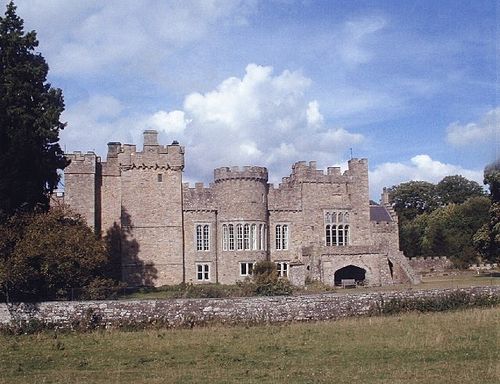
Brownsea Castle is a coastal castle on Brownsea Island in Poole Harbour, originally built as a mid-16th-century blockhouse and later converted and extended into a large country house with battlemented towers and wings. It combines a compact, crenellated central tower with later red-brick Jacobethan ranges, terraces and a seaward pier, and in the modern era has been restored and reused as a hotel and visitor property.
First raised
1545
Its prime
1905
Today
Restored
As it stood in 1905
What Brownsea Castle looked like in its prime.
A compact, battlemented four-storey central tower of pale masonry sits at the heart of an asymmetrical red-brick and ashlar country house, with mullioned and transomed windows in tall rectangular openings. To the seaward side are terraced gardens stepping down to a stone retaining wall and beach, with a small round gazebo and a family pier extending into the water. A crenellated gatehouse and clocktower mark the courtyard entrance; a flagpole rises from the central tower parapet.
Its story
The story of Brownsea Castle.
Henry VIII's Device Fort, 1539-1547
Brownsea Castle came out of an invasion scare. Henry VIII issued an instruction called a "device" in 1539 ordering fortifications along the most vulnerable parts of the coast, and a second in 1544 when France threatened an invasion across the Channel. Between 1545 and 1547 a blockhouse rose on the south-east corner of Brownsea Island to guard the entrance of the busy Poole Harbour, on ground confiscated from Cerne Abbey during the Dissolution.
The design was conservative: a single-storey square blockhouse, reported in 1552 to be 44 feet across, with guns on its roof and a hexagonal gun platform on the seaward side. The Crown and the town of Poole shared the cost, and Poole took on the garrison and the upkeep.
Poole's Petitions and the Bountiful Gift, 1552-1589
The fort needed regular investment: Poole spent £133 on its defences in 1552, and repairs following a petition to the Crown in 1571 cost £520 and took 4,000 tonnes of stone. Early in Elizabeth's reign the normal garrison was described as six men with eight artillery pieces.
In 1576 Elizabeth granted the castles of Brownsea and Corfe for life to Sir Christopher Hatton, making him Admiral of Purbeck. Hatton claimed the right to search ships entering the harbour, and lost a case over the local ferry rights in 1581. In 1589 the Bountiful Gift refused to pull in for inspection, arguing she already held a valid pass to leave; the castle fired on her and killed two of the crew. Its captain, Walter Partridge, was tried and convicted of manslaughter, then pardoned.
Held for Parliament, then Sold, 1640s-1726
In the civil war of the 1640s the castle was held for Parliament under the Governor of Poole and refortified; in 1644 Parliament ordered four pieces of artillery and four chests of muskets sent out, and by 1646 it had a garrison of twenty men. During the Interregnum the merchant Sir Robert Clayton bought the island but probably did not live in the castle, and by the end of the century Poole refused to garrison the decaying defences.
The amateur architect William Benson bought the island from Clayton's heirs in 1726 for £300 and began converting the castle into a private residence. Poole took the matter to the Attorney General, arguing that he had bought the island and not the castle, a national fortification built by Henry VIII; Benson replied that it had never been a castle but a lodging house. The matter was dropped, and Benson demolished the external fortifications.
The Sturts, Colonel Waugh and the Fire of 1896
The castle passed to Sir Gerard Sturt in 1762 and his cousin Sir Humphrey Sturt in 1765, who wrapped the 16th-century core in a four-storey battlemented Palladian tower with wings on three sides. The diplomat Sir Augustus Foster acquired the place on his retirement in 1840 and took his own life there in 1848, his inquest recording temporary insanity following a disease of the heart and lungs.
Colonel William Waugh, a retired Indian Army officer, bought the island in 1852 hoping to work it as a pottery. He restored the castle and raised a Jacobethan range along its south and east sides; the venture failed and in 1857 he fled his creditors to Spain. George Cavendish-Bentinck bought the property in 1873 and closed the pottery works; his debts at his death in 1891 forced his son to sell to Major Kenneth Robert Balfour. After the installation of new-fangled electric lighting the castle caught fire on 26 January 1896, gutting the interiors; Balfour rebuilt it with the architect Philip Brown.
Van Raalte, Bonham-Christie and the National Trust
Balfour sold in 1901 to the stockbroker Charles van Raalte, whose castle by then had 38 bedrooms and who assembled some 250 historical musical instruments there. On the death of his widow Florence in 1927 the castle went to Sir Arthur Wheeler, who auctioned the contents for £22,300 and meant to demolish the building.
It was not demolished. Mary Bonham-Christie bought it later that year for £125,000 and let the island return to nature; by her death in 1961 the roof had partly collapsed and a tree was growing through the building. Her grandson's proposal for 400 luxury houses was refused after an outcry, and the Treasury took the island in lieu of death duty and offered it to the National Trust for £100,000. The Trust could raise only £25,000; the Scout and Guide movements, the forerunner of the Dorset Wildlife Trust and the John Lewis Partnership found the rest. The Trust took ownership in 1962, considering the castle of "little antiquity or architectural interest"; John Lewis took a 99-year repairing lease and still uses it as a corporate hotel for employees and retired staff. It is a Grade II listed building.
Step inside
8 places to explore in 1905.
The record describes 8 distinct spots at Brownsea Castle, including 1 interior: great hall (interior). Create your own photoreal reconstruction and explore every one, more scenes means more rooms, more angles, and more of the place to stand in.
Build Your Own Castle
Recreate Brownsea Castle with AI to explore it.
The artist rebuilds it as it stood in 1905, a photoreal reconstruction that belongs to you alone. Pay with coins, no subscription needed.
Recreate this castle →Defend this castle →Nearby