England · Partial ruin
Farnham Castle
Farnham Castle is a 12th-century stone motte-and-bailey castle in Farnham, Surrey, England, long used as the residence of the Bishops of Winchester. The site comprises a shell keep atop a motte, an inner bailey with domestic ranges and a bishop's palace, and an outer curtain wall with gatehouse and ditch. The keep and palace have been conserved and are open to the public with exhibitions and guided tours.
Its prime
1450
Today
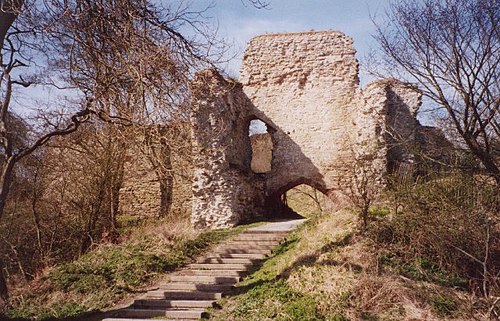
Partial ruin
As it stood in 1450
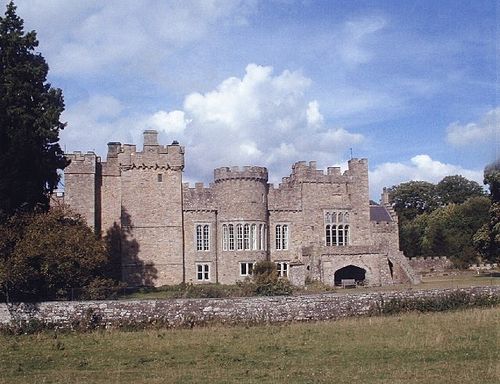
What Farnham Castle looked like in its prime.
A squat, largely circular shell keep set on a raised grassy motte with a pronounced sloping basal batter of darker masonry; the upper walls of the keep are irregular and broken in places but retain the outline of the enclosed rampart. A stone curtain wall extends away from the motte with square flanking towers and a visible gate passage; the overall stonework mixes lighter and darker ashlar and rubble. The site sits within tended lawns and park trees, the motte rim enclosing a planted garden.
Its story
The story of Farnham Castle.
Henri de Blois and the Bishops of Winchester
Farnham Castle was built in 1138 by Henri de Blois, Bishop of Winchester and a grandson of William the Conqueror, and it became the home of the bishops of Winchester for more than eight hundred years. The original building did not last two decades: Henry II had it slighted in 1155, after the Anarchy, and it was rebuilt in the late 12th and early 13th centuries.
The large motte was raised around the massive foundations of a Norman tower and then wholly enclosed by a shell keep with buttress turrets and a shallow gatehouse. A triangular inner bailey adjoins it, holding a range of domestic buildings and a fifteenth-century brick entrance tower, while the outer bailey curtain carries square flanking towers, a 13th-century gatehouse and a large ditch. The castle has been in almost continuous occupation since the 12th century.
Beaufort, the Slighting of 1648 and Bishop Morley
In the early 15th century the castle was the residence of Cardinal Henry Beaufort, who presided at the trial of Joan of Arc at Rouen in 1431; it is for that reason that St Joan of Arc's Church in Farnham carries her dedication. Mary I stayed at Farnham in the days before her wedding to Philip of Spain in July 1554, and the stables burnt down during a visit by King James, Anne of Denmark and Henry, Prince of Wales, in July 1609. A letter of 1594 mentions white clay being dug in Farnham Park to make drinking vessels for the lawyers of the Inner Temple in London.
The castle was slighted a second time after the Civil War, in 1648. More buildings went up in the grounds after that, the most impressive of them the work of Bishop George Morley in the 17th century.
The Camouflage Development and Training Centre
During the Second World War the castle housed the Camouflage Development and Training Centre of the Camouflage Branch of the Royal Engineers. The artists Roland Penrose and Julian Trevelyan and the magician Jasper Maskelyne were among those trained there in the arts of military camouflage.
From the Office of Works to English Heritage
The Office of Works was given custodianship of the castle in 1933; the site was listed Grade I in April 1950, excavated between April 1958 and 1959, and scheduled as a monument in June 1975. Since 1962 the buildings have been used as an intercultural training and conference centre.
With help from the Heritage Lottery Fund the keep and the Bishop's Palace were completely renovated, and the keep reopened in July 2010 displaying the research undertaken into the castle's history; a separate exhibition on the site covers its nine hundred years. English Heritage holds guardianship of the keep while Farnham Castle manages its visitors; entry is free, and local guides show the Bishop's Palace on certain days for a charge.
Step inside
10 places to explore in 1450.
The record describes 10 distinct spots at Farnham Castle, including 4 interiors: shell keep interior garden, inner bailey domestic ranges, bishop's palace great hall and more. Create your own photoreal reconstruction and explore every one, more scenes means more rooms, more angles, and more of the place to stand in.
Build Your Own Castle
Recreate Farnham Castle with AI to explore it.
The artist rebuilds it as it stood in 1450, a photoreal reconstruction that belongs to you alone. Pay with coins, no subscription needed.
Recreate this castle →Defend this castle →Nearby