England · Restored
Amberley Castle
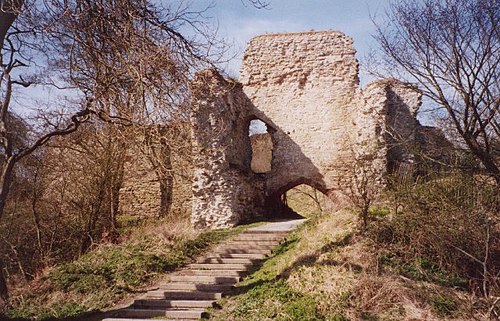
Amberley Castle is a fortified medieval manor in the village of Amberley, West Sussex, long held by the bishops of Chichester. Fortified in 1377, the site retains its high curtain walls, a prominent gatehouse and surviving towers and is now a Grade I listed building, adapted for use as a country-house hotel.
Its prime
1377
Today
Restored
As it stood in 1377
What Amberley Castle looked like in its prime.
A rhomboid-plan stone enclosure with high crenellated curtain walls and corner towers set around a central inner ward; a massive central gatehouse is flanked by two cylindrical towers forming the main approach. A straight causeway or bridged approach crosses a wide defensive ditch to the gateway. An attached two-storey east wing with a pitched roof and small roof-turret adjoins one curtain. Masonry is coursed stone, wall tops lined with battlements and arrow-slits; the site appears compact and tightly enclosed.
Its story
The story of Amberley Castle.
The Bishop of Chichester's Summer Palace, 683–1337
Cædwalla of Wessex endowed the site to the See of Selsey in AD 683, and when the bishopric moved to Chichester after the Norman conquest the land went with it and stayed in the bishops' hands. The first building on record is a timber-framed lodge put up by Bishop Ralph de Luffa in 1103. Bishop Seffrid I pulled that down in 1140 and replaced it with a more elaborate stone hall, to which Seffrid II added an east wing in 1200. Between 1305 and 1337 Bishop John Langton added a larger great hall, and by then the manor was known as the Bishop of Chichester's Summer Palace.
Licence to Fortify Against the French, 1377–1536
Bishop William Reade had Langton's great hall taken down and a better one built in its place. In 1377, at the beginning of the Hundred Years War, there was concern that the French would raid the south coast of England, so the bishop applied for and received permission to fortify the site and add a gatehouse and an oubliette. Walls up to 40 feet high were run round the whole site: a rhomboid stonework enclosure with internal towers at each corner, a hall and a gateway. The bishops of Chichester used it as a fortress.
Bishop Robert Sherborne, who died in 1536, was the last Bishop of Chichester to live at Amberley. After him the castle was let to a succession of tenants.
Waller's Attack and the Restoration of 1660
During the English Civil War the tenant's Royalist allegiance brought Oliver Cromwell to order General William Waller against the castle. The attack cost the walls 20 feet of their height and destroyed the great hall. The castle was sold to a Mr Butler and then restored to the Bishop of Chichester after the Restoration of the Monarchy in 1660, with the Butlers staying on as tenants and the Briscoes following them.
Hunting Lodge to Hotel, 1872 Onwards
In 1872 the castle was sold to Robert Curzon, 15th Lord Zouche, who used it as a hunting lodge, and in 1893 to Henry Fitzalan-Howard, 15th Duke of Norfolk. Known as the Builder Duke, the 15th Duke renovated Amberley as well as modernising Arundel Castle and building Arundel Cathedral. It passed to the Emmet family in 1926, to Hollis Baker in 1982, to an American family in 1987 and in 1988 to Joy and Martin Cummings, who turned it into an award-winning country house hotel; it has belonged to Relais & Châteaux since 2004.
Much modified over the centuries, the castle is now owned by Andrew and Christina Brownsword and run as a privately owned hotel within their group. The walls, the gateway and two of the towers survive; the castle is a scheduled monument and has been listed Grade I since March 1955.
Step inside
9 places to explore in 1377.
The record describes 9 distinct spots at Amberley Castle, including 4 interiors: gatehouse passage, great hall (interior), east wing chamber (interior) and more. Create your own photoreal reconstruction and explore every one, more scenes means more rooms, more angles, and more of the place to stand in.
Build Your Own Castle
Recreate Amberley Castle with AI to explore it.
The artist rebuilds it as it stood in 1377, a photoreal reconstruction that belongs to you alone. Pay with coins, no subscription needed.
Recreate this castle →Defend this castle →Whose castle
Clans who held Amberley Castle.
The families that held Amberley Castle for a decade or more across its history, follow a name to its clan.
Curzon
Bought by Robert Curzon, 15th Lord Zouche, in 1872 and used as a hunting lodge until he sold it in 1893.
Fitzalan-Howard
Held 1893–1926 by Henry Fitzalan-Howard, 15th Duke of Norfolk, the 'Builder Duke', who renovated the castle.
Emmet
The castle passed to the Emmet family in 1926 and stayed with them until 1982.
From the archive
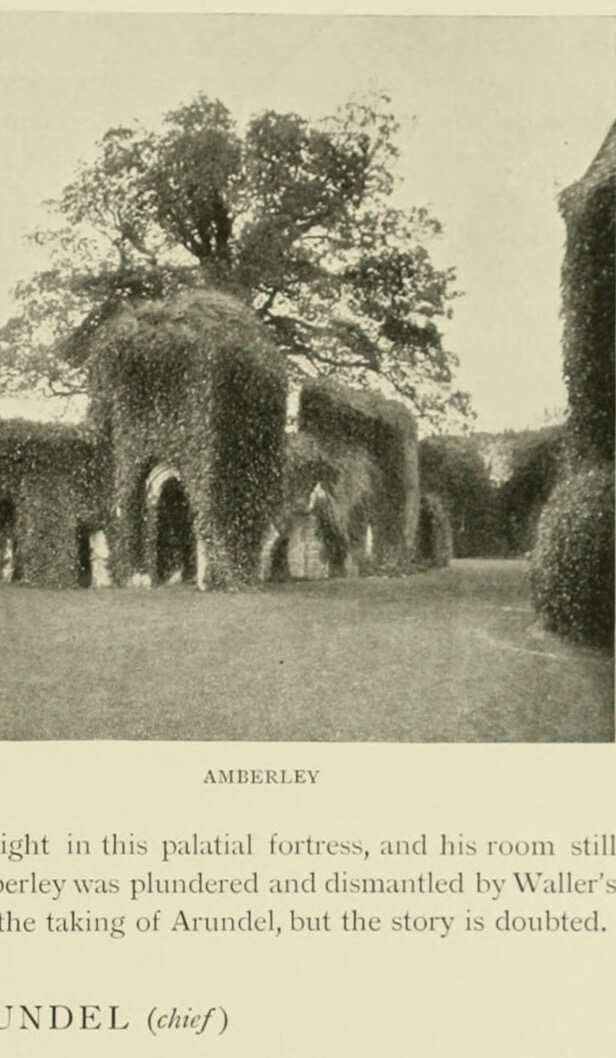
Amberley Castle on paper: the measured plan and period views.
The survey plan and photographs below are the ground truth this page's reconstructions are checked against, drawn and photographed while the castle was still a working garrison. Every image is public-domain or openly licensed, with its source named.
AMBERLEY
1897 · J. D. Mackenzie, The Castles of England, vol. 1 (1897)
Public domain
Nearby