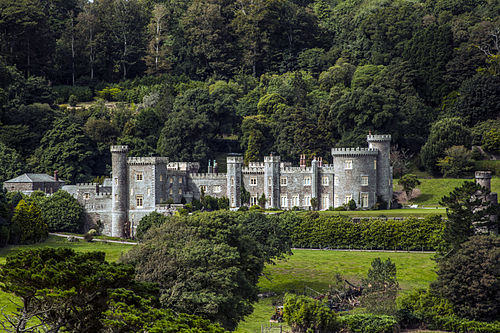
England · Restored
Whittington Castle
Whittington Castle is a medieval marcher castle in northern Shropshire, England, centred on a stone gatehouse flanked by two round towers and an inner curtain wall forming a courtyard. It developed from an earlier motte-and-bailey into a stone inner bailey with towers, moat and an outer gatehouse, and later had elaborate 14th-century gardens. The site has been conserved and restored and is open to visitors under a preservation trust.
Its prime
1320
Today
Restored
As it stood in 1320
What Whittington Castle looked like in its prime.
A broad arched central gate is flanked by two massive round drum towers of coursed grey sandstone with crenellated parapets and corbelled machicolation courses; narrow cross-shaped arrow-slits and small pointed-arched glazed windows puncture the towers. A low stone bridge crosses the surrounding moat to the gate. To the right the curtain wall steps down into a ruined stretch with a projecting chimney, and the moat margins are grassy with reeds.
Its story
The story of Whittington Castle.
Fortified for Empress Matilda, 1138-1204
Whittington lies on the English side of Offa's Dyke, which along this stretch of border was the Norman boundary between England and Wales. The site may have begun as a Norman manor house, though there is no evidence for it; it was fortified as a castle for William Peverel in 1138, in support of the Empress Matilda against King Stephen during the Anarchy. In 1149 the lordship of Whittington, like nearby Oswestry, was annexed by Madog ap Maredudd and became part of the Kingdom of Powys, remaining so until Madog's death in 1160.
Henry II conferred the castle on Roger de Powys in 1165 and gave him funds for its repair in about 1173; Roger was followed by his son Meurig, then by Meurig's son Werennoc. A rival claim from Fulk III FitzWarin, apparently pressed under the Peverels, went unrecognised until 1204, leading him to rebel against King John. FitzWarin was pardoned, and the castle and lordship of Whittington, though not Overton Castle, were granted to him.
Llywelyn's Capture and the Stone Rebuilding, 1223-1282
In 1223 the castle was captured and destroyed by Llywelyn ab Iorwerth of Gwynedd. It was returned under the peace treaty and rebuilt in stone: the motte-and-bailey tower keep gave way to an inner bailey of buildings along a curtain wall with five towers, raised on a platform within a moat, with an outer gatehouse or barbican beyond. For the next forty years it stayed in English hands, until it was ceded by treaty to Llywelyn ap Gruffudd. After Llywelyn's defeat in 1282 the castle became a lordly residence for the FitzWarin family, whose lords were all called Fulk.
The FitzWarin Water Gardens and the Glyndŵr Years
An archaeological investigation by Peter Brown and Peter King in 2003 established that in the fourteenth century the outer bailey had held two elaborate gardens ringed by water. The "lavish" garden was installed by one of the FitzWarins, and the viewing mound at its centre may be the oldest of its type yet discovered in England.
After Fulk VII died in 1349 the lords were almost always under age and usually absentees, though some repairs were carried out in about 1402. Owain Glyndŵr's rebellion laid the lordship waste in 1404, and by 1407 it was worth nothing; the castle itself was not captured. During Fulk XI's minority it was occupied by his mother and her new husband William, Lord Clinton, during whose time a dispute arose with the people of Oswestry, who had cut down oaks in his woods. The FitzWarin line died out with Fulk XI in 1420 and the lordship passed to his sister Elizabeth, wife of Richard Hankeford; in 1422 William Fitzwaryn, presumably a cousin claiming as heir male, and Richard Laken took the castle by escalade, though it was evidently soon restored to Lord Clinton.
Exchanged with Henry VIII, then Quarried, 1545-1776
Elizabeth's daughter Thomasia married William Bourghchier, carrying the FitzWarin peerage into the Bourchier family; their grandson John Bourchier was made Earl of Bath, and his son John, 2nd Earl of Bath, exchanged the lordship and castle with Henry VIII in 1545 for former monastic estates nearer the family's Devon home. The detailed survey made at the exchange describes some of the buildings as "in decay", and the castle was probably never inhabited again.
It passed through various hands to William Albany, a London merchant taylor, though he and his descendants, from 1750 the Lloyd family of Aston near Oswestry, lived at Great Fernhill. William's grandson Francis Albany fell into debt and sold his wood at Babbinswood to Arthur Kynaston of Shrewsbury, who built a forge at Fernhill using stone from the castle. In 1632 the gatehouse was let, the tenant allowed to take "freestone out of the castle". By the time of the Civil War the place was evidently no longer defensible, and there is no evidence that it played any part in that war. In 1673 the gatehouse was let as a romantic dwelling to Thomas Lloyd, a London merchant. About 1760 one of the towers fell into the moat, and that stone and other parts went into road-making, probably including the new turnpike to Ellesmere in 1776.
From Farmhouse Gatehouse to the Preservation Trust
The castle fronts onto the old line of the Holyhead Road and was thus noticed by travellers; about 1808 William Lloyd restored the gatehouse and let it as a farmhouse, and it went on being occupied as a house until the 1990s. The site was scheduled as a monument on 5 December 1928 and listed Grade I on 8 October 1959. The Whittington Castle Preservation Trust, a rural community trust formed in December 1998, has held the castle on a 99-year lease since 2002 and has completed a £1.5 million renovation, while the Lloyds of Aston remain its owners.
Step inside
7 places to explore in 1320.
The record describes 7 distinct spots at Whittington Castle, including 2 interiors: gatehouse passage through the central arch, gatehouse chamber (residential room). Create your own photoreal reconstruction and explore every one, more scenes means more rooms, more angles, and more of the place to stand in.
Build Your Own Castle
Recreate Whittington Castle with AI to explore it.
The artist rebuilds it as it stood in 1320, a photoreal reconstruction that belongs to you alone. Pay with coins, no subscription needed.
Recreate this castle →Defend this castle →Whose castle
Clans who held Whittington Castle.
The families that held Whittington Castle for a decade or more across its history, follow a name to its clan.
FitzWarin
Held by the FitzWarins, lords all named Fulk, until the line ended in 1420.
Bourchier
Carried into the Bourchier family by marriage; exchanged with Henry VIII in 1545 by the 2nd Earl of Bath.
Owned since 1750 by the Lloyds of Aston, near Oswestry, who still hold the castle.
Nearby