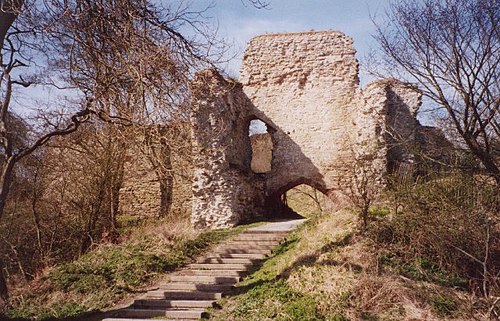
England · Ruin
Wigmore Castle
Wigmore Castle is a Norman-origin medieval fortification near the village of Wigmore in north-west Herefordshire, England. It became the chief seat of the Mortimer family, was extensively remodelled in the late 13th and early 14th centuries, and is now a managed ruin in the care of English Heritage.
Its prime
1328
Today
Ruin
As it stood in 1328
What Wigmore Castle looked like in its prime.
Perched on the south-eastern edge of a spur, the castle in its prime was a compact stone complex with a continuous curtain wall surrounding an inner bailey, a prominent gatehouse with a large central arched passage, and several towers including a fortified mound/keep on the north-west side. Walls are built of pale, roughly coursed rubble masonry and rise to crenellated parapets; defensive ditches cut across the spur act as moats. An internal lodging range and small chapel stood against the inner face of the walls.
Its story
The story of Wigmore Castle.
FitzOsbern's Castle at Merestun, c.1070–1075
Wigmore was founded after the Norman Conquest, probably around 1070, by William FitzOsbern, 1st Earl of Hereford and a close associate of William the Conqueror. It went up on waste ground at Merestun, on land held at the Conquest by Gunnfrothr. Wigmore lies almost halfway between the rivers Teme and Lugg, about four kilometres from each, commanding the ground between them.
The form of that first castle is unknown; no evidence of early stone defences has yet been found, leading to the conclusion that FitzOsbern built in timber, though vegetation and debris may still conceal an early stone keep.
FitzOsbern was killed in Flanders in 1071. His son Roger de Breteuil took part in the Revolt of the Earls in 1075, and after the earls' defeat William I seized the castle and gave it to another of his supporters, Ranulph de Mortimer. From that point Wigmore was the head of the Mortimer barony.
Henry II's Siege and the Stone Curtain, 1155–1227
In 1155 Henry II besieged Wigmore because Hugh de Mortimer refused to hand Bridgnorth Castle back to the crown. Two small earthworks east and west of the castle survive, and may be siege-works thrown up for that campaign.
Parts of the walls were built or rebuilt in stone in the late 12th or early 13th century, with further work in the 13th, perhaps when Hugh de Mortimer (1197–1227) received royal money for garrisoning the place. That work included the curtain wall around the bailey.
The Mortimer Rebuilding and Earl Roger's Fall, to 1330
Extensive works followed in the late 13th or early 14th century, under Roger Mortimer (1231–1282), Edmund Mortimer (1282–1304) and Roger Mortimer, 1st Earl of March. The walls were raised, the gatehouse remodelled, and other buildings put up, including a substantial block within the inner bailey that may have been a lodgings range.
Roger succeeded his father Edmund in 1304 and strengthened the family considerably, acquiring Ludlow Castle and many lands in Ireland through marriage to the heiress Joan de Geneville. In the 1320s he was a leader of the party opposed to Edward II and around 1325 became the lover of Edward's queen, Isabella of France. After Edward's deposition and death in 1327 Mortimer, as the queen's lover and the young Edward III's effective stepfather, became the most important man in the kingdom. In 1328 he held a tournament near Wigmore attended by the king and almost all the magnates of England. He was executed in 1330 by Edward III, his lands seized by the crown.
Heir Presumptive to Mortimer's Cross, 1332–1461
Edward III spent several weeks at Wigmore in the summer of 1332. Mortimer's grandson, another Roger, recovered Wigmore and the rest of his lands in 1342, and his son Edmund married Edward III's granddaughter Philippa. Their son Roger inherited in 1381 at the age of six and was declared heir presumptive should Richard II, Philippa's cousin, die childless; he was killed in battle in Ireland in 1398.
When the Mortimer male line died out in 1424 the castle passed to Richard Plantagenet, 3rd Duke of York, through his mother Anne Mortimer. Wigmore is said to have been derelict in 1425, though excavation suggests building work was carried out there in the mid-15th century. Richard's son Edward, Earl of March, was almost certainly based at Wigmore before his victory at the Battle of Mortimer's Cross in 1461; that same year he deposed Henry VI and was crowned Edward IV.
Council of the Marches to English Heritage, 1500s–2008
Through the 16th century the castle was managed by the Council of the Marches, partly as a prison, though it was already decaying again. John Dee saw the records of Wigmore Abbey in an old decayed chapel within the castle in 1574. It was granted to Sir Gelli Meyrick in 1595; after Meyrick was executed as a traitor, Elizabeth I sold Wigmore in 1601 to Thomas Harley of Brampton Bryan, whose son Sir Robert Harley, a Parliamentarian, later inherited it. During the Civil War Harley left the castle in the charge of his wife, Lady Brilliana Harley, who had its defences dismantled to prevent the Royalists using it against her.
After the war the castle was left a ruin and gradually swallowed by trees and undergrowth, its towers, curtain walls and gatehouse almost indiscernible by the 20th century. Because Wigmore stayed in private hands it escaped the large-scale clearances at most other major historic sites in the late 19th and early 20th centuries. It has been a scheduled monument since 1928 and Grade I listed since 1959. In 1995 it came into the guardianship of English Heritage, which carried out conservation and small-scale excavation and made the site a little more accessible to visitors; further site panels followed in 2008.
Step inside
9 places to explore in 1328.
The record describes 9 distinct spots at Wigmore Castle, including 3 interiors: gatehouse passage, lodging block, great hall or chambers, chapel within the castle. Create your own photoreal reconstruction and explore every one, more scenes means more rooms, more angles, and more of the place to stand in.
Build Your Own Castle
Recreate Wigmore Castle with AI to explore it.
The artist rebuilds it as it stood in 1328, a photoreal reconstruction that belongs to you alone. Pay with coins, no subscription needed.
Recreate this castle →Defend this castle →Whose castle
Clans who held Wigmore Castle.
The families that held Wigmore Castle for a decade or more across its history, follow a name to its clan.
Mortimer
Head of the Mortimer barony from 1075 until the male line died out in 1424; Earls of March from 1328.
Passed in 1424 to Richard Plantagenet, 3rd Duke of York, through his mother Anne Mortimer.
Nearby


