
England · Partial ruin
Cambridge Castle
Cambridge Castle (Castle Mound) is a medieval motte-and-bailey castle in Cambridge, England. Built after the Norman Conquest and substantially rebuilt in stone under Edward I, almost all above-ground stonework was later robbed and demolished; today only the 10 m motte and some earthworks remain and the site is open to the public.
Its prime
1298
Today
Partial ruin
As it stood in 1298
What Cambridge Castle looked like in its prime.
At its prime the castle was a compact stone fortress: a four-sided curtain wall linked by round corner towers, defended by a substantial gatehouse and outer barbican. A high circular stone keep crowned the earthen motte at the centre of the site. The curtain connected the keep and towers to enclose a bailey containing the hall and chamber. The whole ensemble stood on the highest point in the town, visible above surrounding timber-and-stone buildings and streets.
Its story
The story of Cambridge Castle.
Picot's Motte and Bailey, 1068
Cambridge Castle was one of three castles raised across the east of England in late 1068 by William the Conqueror, in the aftermath of his northern campaign to capture York. The town, Grantabridge as it was then known, stood on Ermine Street, the old Roman road from London to York, and was both strategically significant and at risk of rebellion. The initial building work was carried out by Picot, the high sheriff, who later founded a priory beside the castle. It was a motte and bailey set inside the existing town, and 18 or 27 houses had to be destroyed to make room for it.
Geoffrey de Mandeville and the Anarchy, 1139-1144
The castle was held by the Norman kings until the civil war of the Anarchy broke out in 1139. In 1143 Geoffrey de Mandeville, a supporter of the Empress Matilda, attacked Cambridge: the town was raided and the castle temporarily captured. Stephen counter-attacked, forced Geoffrey to retreat into the Fens and retook the castle. Cambridge Castle remained exposed, and Stephen decided to build a supporting fortification at Burwell. Geoffrey died attacking Burwell Castle the following year, leaving Cambridge Castle secure.
Castle-Guard, King John and the Barons' Wars
Under Henry II the castle was adequately maintained but little improved. A castle-guard system was established, granting lands around Cambridge to local lords on condition they provide guard forces, and the castle was used primarily to hold the sheriff's court and records. King John spent £200 on it in the years before the First Barons' War of 1215 to 1217, the work going on a new hall and chamber. During that war the rebel barons, supported by Prince Louis of France, captured much of eastern England, and Cambridge Castle fell in 1216.
It returned to royal control after the war, but Henry III did no more than basic maintenance. Cambridge was attacked again during the Second Barons' War in 1266; this time the town and castle held long enough to be relieved by Henry's forces, and the king reinforced the city defences with a large ditch, later known as King's Ditch.
Edward I's Stone Fortress and the Robbing of the Ruins, 1284-1604
Cambridge remained a basic fortification until 1284, when Edward I decided on major expansion. Over the next 14 years the king spent at least £2,630 rebuilding it in stone: a four-sided castle with circular towers at each corner, a gatehouse and a barbican, and a circular stone keep on the motte. The result was a "major fortress in the latest fashion", though never quite completed. Edward stayed there for two nights in 1294.
The 14th century saw it fall into disrepair (from Edward III onwards little money was spent on it), and by the 15th century it was in ruins, the hall and chamber roofless. In 1441 Henry VI ordered those buildings destroyed and their stone reused for King's College, with other parts going to Trinity College's chapel. Mary I gave more stonework away in the 16th century for a mansion at Sawston, and further grants went to Emmanuel and Magdalene. By 1604 only the gatehouse, used as a jail, and the keep remained intact; contemporaries described the surrounding walls as "rased and utterly ruinated".
Cromwell's Bastions, the County Jail and Shire Hall
Parliamentary forces occupied Cambridge Castle in the first year of the civil war that broke out in 1642. Oliver Cromwell ordered emergency work on the defences, which produced two new earthwork bastions and a brick barracks in the old bailey; in 1643 the governor of Cambridge wrote that "our town and castle are now very strongly fortified... with breastworks and bulwarks". The castle saw no further fighting during the war, and in 1647 Parliament ordered the remaining fortifications slighted.
It deteriorated rapidly after the slighting, and the last walls and bastions came down in 1785, leaving the gatehouse and the earth motte. The gatehouse served as the county jail into the 19th century, run as a private business: the county paid its keeper £200 a year in 1807. A new county prison, octagonal and influenced by the designs of the reformer John Howard, was built by G. Byfield in the former bailey between 1807 and 1811, and the gatehouse was destroyed to make way for a new county court. By the end of the century the jail was deemed surplus, Huntingdon's being sufficient for both. By 1920 it was a branch repository of the Public Record Office; Cambridgeshire County Council acquired it in 1928. The prison was demolished in 1932 and its bricks used to build Shire Hall on the same site.
What is left is the 10-metre motte, on the highest point in the city, and some earthwork fragments. The site is a scheduled monument, open to the public daily without charge.
Step inside
7 places to explore in 1298.
The record describes 7 distinct spots at Cambridge Castle, including 1 interior: great hall and chamber in the bailey. Create your own photoreal reconstruction and explore every one, more scenes means more rooms, more angles, and more of the place to stand in.
Build Your Own Castle
Recreate Cambridge Castle with AI to explore it.
The artist rebuilds it as it stood in 1298, a photoreal reconstruction that belongs to you alone. Pay with coins, no subscription needed.
Recreate this castle →Defend this castle →From the archive
Cambridge Castle on paper: the measured plan and period views.
The survey plan and photographs below are the ground truth this page's reconstructions are checked against, drawn and photographed while the castle was still a working garrison. Every image is public-domain or openly licensed, with its source named.
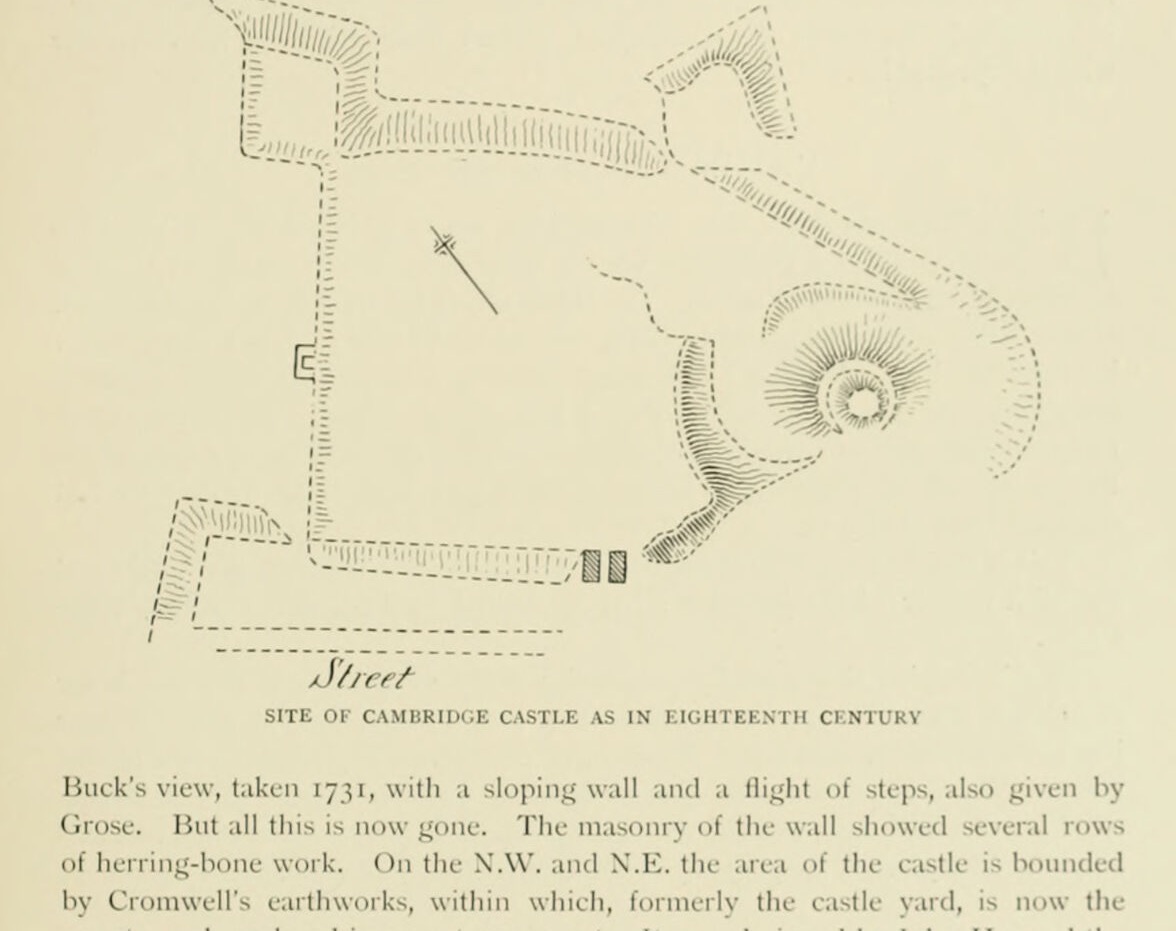
SITE OF CAMBRIDGE CASTLE AS IN EIGHTEENTH CENTURY
1897 · J. D. Mackenzie, The Castles of England, vol. 1 (1897)
Public domain
Nearby
Landmarks within reach of Cambridge Castle.


Questions about Cambridge Castle
What is the history of Cambridge Castle?
What is inside Cambridge Castle?
Why was Cambridge Castle built, and what was it used for?
Where is Cambridge Castle?
When was Cambridge Castle built?
Was Cambridge Castle ever attacked or besieged?
What did Cambridge Castle look like in its prime?
Is Cambridge Castle still standing, or is it a ruin?
Can you visit Cambridge Castle?
More castles of England


Explore the city


