England · Partial ruin
Bungay Castle
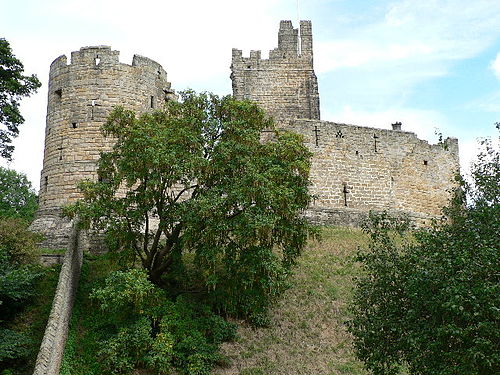
Bungay Castle is a medieval castle site in Bungay, Suffolk, with Norman origins around 1100 and later medieval additions. The surviving remains today include the twin cylindrical gate towers of the gatehouse, stretches of curtain wall and a fragment of the square Norman keep. The site sits on a pronounced curve of the River Waveney and is a Grade I listed monument.
Its prime
1294
Today
Partial ruin
As it stood in 1294
What Bungay Castle looked like in its prime.
A compact medieval fortress sited on a bend of the River Waveney, dominated by two massive cylindrical gate towers set close together to form the gatehouse, with a continuous curtain wall running back from them. Materials are rough flint and pale coursed stone with lower ashlar repairs visible. A large square Norman keep stood within the bailey (now a fragment), the skyline in prime showing intact towers and a continuous stone curtain enclosing a grassy inner ward.
Its story
The story of Bungay Castle.
Roger Bigod's Castle on the Waveney Bend
The Bigods planted a castle at Bungay in about 1100, Roger Bigod taking his defence from the natural protection of a curve in the River Waveney. His son Hugh became a prominent figure in the civil war of 1138–1154 known as the Anarchy, and in the early years of Henry II's reign his loyalty was called into question: the king confiscated Bungay outright.
Mined and Slighted, 1173–1174
Henry returned the castle to Bigod in 1164, and in 1165 Bigod raised a large square Norman keep on the site. Nothing records what it cost; Hugh Braun, the archaeologist who led the excavations here in the 1930s, estimated around £1,400. Bigod then took the losing side in the revolt of 1173–1174. Royal forces besieged Bungay, mined it and slighted it, and by the historian Sidney Painter's count it was one of at least twenty-one castles demolished on Henry II's instructions.
Redeveloped, Then Back to the Crown, 1294–1312
The site was restored to the Bigods once more, and in 1294 Roger Bigod, 5th Earl of Norfolk, developed it again; the massive gate towers are probably his work. He fell out with Edward I, and after his death the castle reverted to the Crown and slid into disrepair and ruin. In 1310 Edward II granted his two younger half-brothers, Thomas of Brotherton and Edmund of Kent, sustenance out of the old Bigod lands, Bungay among them, and in 1312 Thomas came into the vacated earldom of Norfolk and the castle with it.
The Killing of Alice Montagu, 1352
Thomas of Brotherton died in 1338 and Bungay passed to his daughter Alice, who had married Edward Montagu, younger brother of William, 1st Earl of Salisbury. It was at Bungay Castle that Montagu and two of his retainers beat her so violently that she died, in January 1352. The castle stayed in his hands until his own death in 1361.
Quarried for Road Stone, Then Given to the Town, 1766–1987
In 1483 the Dukes of Norfolk re-acquired Bungay and held it into the twentieth century, with one break. That break began in 1766, when the site was sold to Robert Mickleborough, who quarried the keep and the curtain walls for road-building material. In the early 1790s a local solicitor, Daniel Bonhôte, bought what was left, and his wife Elizabeth made the ruin the setting of her Gothic romance Bungay Castle, published in 1796; the Norfolk dukes bought the site back in about 1800. Beyond the removal of dwellings built on it in 1841, little or no repair was attempted for several centuries.
Bungay was scheduled in 1915, one of the first sites protected under the Ancient Monuments Consolidation and Amendment Act 1913, and Grade I listed in 1949. Restoration under Hugh Braun began in 1934, following excavation by the amateur archaeologist Leonard Cane. In 1987 the 17th Duke of Norfolk gave the castle to the town of Bungay, and the Bungay Castle Trust owns it now.
Step inside
7 places to explore in 1294.
The record describes 7 distinct spots at Bungay Castle, including 1 interior: inside the gatehouse passage. Create your own photoreal reconstruction and explore every one, more scenes means more rooms, more angles, and more of the place to stand in.
Build Your Own Castle
Recreate Bungay Castle with AI to explore it.
The artist rebuilds it as it stood in 1294, a photoreal reconstruction that belongs to you alone. Pay with coins, no subscription needed.
Recreate this castle →Defend this castle →Whose castle
Clans who held Bungay Castle.
The families that held Bungay Castle for a decade or more across its history, follow a name to its clan.
Bigod
Built by Roger Bigod c. 1100; developed by Roger Bigod, 5th Earl of Norfolk, who added the great gate towers in 1294.
Montagu
Held by Alice Montagu from her father Thomas of Brotherton's death in 1338 until her own death in 1352.
Nearby