England · Partial ruin
Caister Castle
Caister Castle is a 15th-century moated castle in West Caister, Norfolk, built by Sir John Fastolf between 1432 and 1446. The 100 ft high brick tower survives intact while much of the surrounding domestic ranges and curtain walls fell into ruin after 1600; the tower remained climbable and was a prominent local landmark.
First raised
1432
Its prime
1446
Today
Partial ruin
As it stood in 1446
What Caister Castle looked like in its prime.
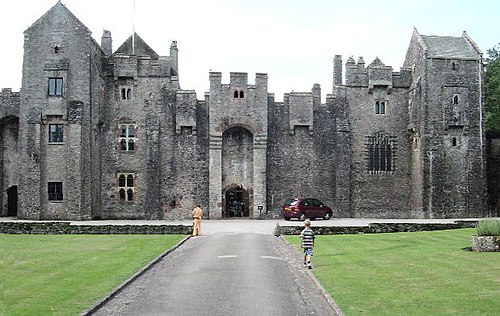
A tall, cylindrical 100-foot brick tower with crenellated parapet dominates the silhouette, flanked by lower red-brown brick curtain walls and domestic ranges forming a roughly rectangular courtyard. The masonry is coursed medieval brick with small square windows and occasional narrow arrow slits; the tower has small projecting corner tourelles at the summit. The castle sits within a full surrounding moat on low Norfolk marshland, approached across open meadow and enclosed by trees, with roofed domestic ranges abutting the inner walls.
Its story
The story of Caister Castle.
Sir John Fastolf's Tower, 1432–1459
Caister Castle was built between 1432 and 1446 by Sir John Fastolf, who, along with Sir John Oldcastle, was an inspiration for Shakespeare's Falstaff. The moated castle stood some 5 km north of Great Yarmouth and was raised around a tower 100 feet high. Fastolf meant Caister to become a chantry where prayers would be said for his soul and those of his nearest and dearest. An inventory taken after his death in 1459 recorded the silver plate, chapel equipment, wardrobe, tapestry and armour kept in its named rooms and chambers.
The Paston Inheritance and the 1469 Siege
Fastolf died childless and intestate, and disputes over his will sent Caister to the Paston family rather than the chantry he had envisaged; the bulk of his fortune instead endowed Magdalen College, Oxford. John Paston, a close confidant of Fastolf's, claimed to be his heir, a claim that put him in direct conflict with the Duke of Norfolk and Sir William Yelverton. In August 1469 the Duke besieged the castle in pursuit of his own claim to it. John Paston junior and about thirty men held out for two months before the defence failed; one of the family's longest-serving servants was killed by a crossbow wound, and the castle passed to the Duke. It was restored to the Pastons some years later; the castle features extensively in the Paston Letters, the family's correspondence from the Wars of the Roses period.
Decline Under the Crow and Bedingfield Families, 1600–1893
After 1600, when a new house was built nearby, everything at Caister beyond the tower fell into ruin. In 1659 the Pastons sold the remains to William Crow, a London upholsterer and money-lender whose memorial survives in Holy Trinity Church, Caister-on-Sea; the castle later descended by marriage to the Bedingfield family. Neglect and the robbing of stonework continued: around 1776 the Reverend David Collyer removed a 122-step newel staircase from the tower and installed it in his own house at Wroxham. The inner moat was filled in between 1842 and 1893, when a lake was formed by widening its south-eastern side.
The Tower Today
Caister Castle is a Grade I listed building and a scheduled monument. Its 100-foot tower still stands intact and can be climbed by visitors; the grounds also house the Caister Castle Motor Museum, created in the 1960s around a private collection of veteran, vintage and classic vehicles, with admission covering the tower, museum and grounds.
Step inside
6 places to explore in 1446.
The record describes 6 distinct spots at Caister Castle, including 2 interiors: tower spiral (newell) stair, chapel interior and altar furnishings. Create your own photoreal reconstruction and explore every one, more scenes means more rooms, more angles, and more of the place to stand in.
Build Your Own Castle
Recreate Caister Castle with AI to explore it.
The artist rebuilds it as it stood in 1446, a photoreal reconstruction that belongs to you alone. Pay with coins, no subscription needed.
Recreate this castle →Defend this castle →Whose castle
Clans who held Caister Castle.
The families that held Caister Castle for a decade or more across its history, follow a name to its clan.
Fastolf
Built by Sir John Fastolf between 1432 and 1446 as his seat.
Paston
Devolved to the Pastons under Fastolf's disputed will; lost to the Duke of Norfolk in the 1469 siege, later returned, and sold in 1659.
Bedingfield
Descended by marriage to the Bedingfield family after the 1659 sale to William Crow.
From the archive
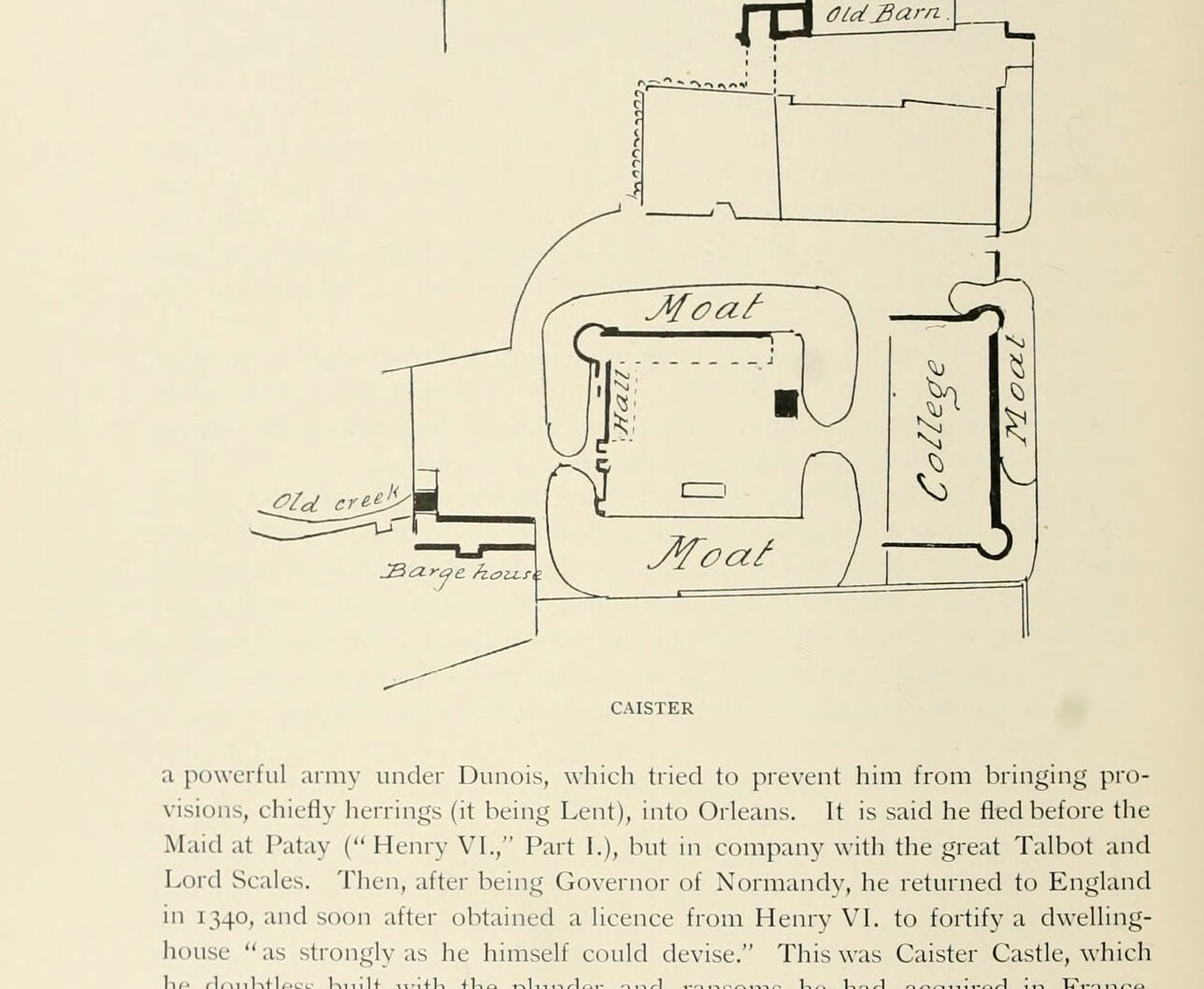
Caister Castle on paper: the measured plan and period views.
The survey plan and photographs below are the ground truth this page's reconstructions are checked against, drawn and photographed while the castle was still a working garrison. Every image is public-domain or openly licensed, with its source named.

Caister Castle, Caister, -i.e., Caister-on-Sea-, England-LCCN2002696433
ca. 1890-1900 · Photochrom Prints Collection (via Wikimedia Commons)
Public domain
CAISTER
1897 · J. D. Mackenzie, The Castles of England, vol. 1 (1897)
Public domain
Nearby