
England · Restored
Carisbrooke Castle
Carisbrooke Castle is a motte-and-bailey castle on a hill above the village of Carisbrooke on the Isle of Wight, historically a royal stronghold and later a prison. The site preserves a medieval keep, a 15th-century entrance gate (the Woodville Gate), domestic buildings around a central courtyard, a chapel, a well-house with a donkey wheel and extensive late-16th-century earthworks.
First raised
1100
Its prime
1600
Today
Restored
As it stood in 1600
What Carisbrooke Castle looked like in its prime.
Broad stone approach over a low-parapet bridge leads to a massive twin drum-towered gatehouse with a pointed arched entrance set between cylindrical towers; the gatehouse wears crenellations and a projecting machicolated parapet above a row of small arches. The masonry is pale ashlar and coursed rubble; through the open arch the rectangular medieval keep and ranges of domestic buildings sit within a defended bailey. Steep grassy earthworks and outer stone ramparts, some ivy-covered, surround the site.
Its story
The story of Carisbrooke Castle.
From Saxon Burh to the de Redvers Keep
No Roman occupation of the hilltop itself has been found, though a ruined wall suggests a building stood there in late Roman times, and a sixth-century cemetery is the earliest direct evidence of activity on the hill. The fortress story begins with the Vikings, who based themselves on the Isle of Wight from 998 to 1009 to raid the south coast; the local response was to build burhs, and Carisbrooke was likely built as the burh for the island. After the Norman conquest William I granted the Isle of Wight to his cousin William FitzOsbern, who probably developed the Saxon burh; the castle is recorded in the Domesday Book of 1086. When FitzOsbern's heir rebelled and was stripped of his lands, Carisbrooke passed directly to the Crown.
From around 1100 Henry I, fearing attack by his brother Robert Curthose, granted the island to Richard de Redvers: almost certainly the builder of the motte-and-bailey castle, whose descendants added stone walls, towers and a keep over the next two centuries. His son Baldwin backed Queen Matilda in the Anarchy and lost his lands to Stephen, recovering them only in 1153. The castle stayed with the family until 1293, when Countess Isabella, last of the de Redvers line, sold it to Edward I on her deathbed.
The French at the Gates, 1377
During the Hundred Years' War the castle became an important stronghold controlling access to the Solent and central-southern England. In 1377 the French attacked the island and besieged Carisbrooke. Sir John Oglander, writing two centuries later, reports that the siege was broken when the local hero Peter de Heyno shot the French commander; the invaders agreed to leave for a payment of 1,000 marks.
The lords who followed had short tenures and rarely visited, and by 1450 the islanders were petitioning Henry VI over a castle without a garrison and in general disrepair. Anthony Woodville, Lord Scales, brother-in-law of Edward IV, obtained a grant of the castle and its lordship in 1467 and added the Woodville Gate, now the Entrance Gate. Richard III had him killed in 1483, but his brother Edward Woodville was given control of the castle on Henry VII's accession in 1485.
Carey, Giambelli and the Spanish Threat
Under Henry VIII Carisbrooke became essentially a munitions store as new forts rose around the island against a feared French attack, which came in 1545, though the raiders soon left. Sir George Carey was appointed captain in 1583, and after the Spanish invasion scare of 1596–97 he commissioned the Mantuan engineer Federigo Giambelli to remodel the defences. The great earthwork ring was mostly complete by 1600 at a cost of £4,000; the outer gate carries the date 1598 and the arms of Elizabeth I. Once peace was made with Spain in 1604, the castle seemingly settled back into life as an arsenal for the rest of the island's defences.
The King at the Window Bars, 1647–1648
At the outset of the Civil War the castle was surrendered to Parliament by the governor's wife, the Countess of Portland, and under the new governor Philip Herbert, 4th Earl of Pembroke, it became a prison for important political prisoners. Charles I was held here from 22 November 1647 to 6 September 1648, wrongly believing Colonel Robert Hammond would help him escape; when he made his attempt in 1648 he could not get through the bars of his window. In 1650 two of his children were confined here: Princess Elizabeth died within weeks of arriving, of an illness contracted after playing bowls, while Prince Henry stayed until February 1653, when he was allowed to join his family in exile. After the Restoration in 1660, Charles II turned the tables and used Carisbrooke to hold Parliamentarians.
Governors, a Princess and the Museum
As the Royal Navy grew and other island defences developed, Carisbrooke's military weight faded and it morphed into more of a country house for the island's governors. From 1853 it trained the Isle of Wight Artillery Militia, and in 1856 it passed to the Office of Works, with restoration by Philip Hardwick that year. Prince Henry of Battenberg became governor in 1894 but died two years later of malaria, returning from the Ashanti War; his widow, Princess Beatrice, lived at Carisbrooke from 1913 until her death in 1944, the main rooms served as the governor's official residence until then. After her death the hall and Constable's Lodging became the Carisbrooke Castle Museum, and the castle is now in the care of English Heritage, drawing 100,605 visitors in 2025.
Step inside
11 places to explore in 1600.
The record describes 11 distinct spots at Carisbrooke Castle, including 6 interiors: gate passage looking inward, great hall, great chamber (upper room) and more. Create your own photoreal reconstruction and explore every one, more scenes means more rooms, more angles, and more of the place to stand in.
Build Your Own Castle
Recreate Carisbrooke Castle with AI to explore it.
The artist rebuilds it as it stood in 1600, a photoreal reconstruction that belongs to you alone. Pay with coins, no subscription needed.
Recreate this castle →Defend this castle →Whose castle
Clans who held Carisbrooke Castle.
The families that held Carisbrooke Castle for a decade or more across its history, follow a name to its clan.
de Redvers
Granted to Richard de Redvers by Henry I c.1100; held by the family until Countess Isabella sold it to Edward I in 1293.
Woodville
Granted to Anthony Woodville, Lord Scales, in 1467; his brother Edward was given control in 1485.
From the archive
Carisbrooke Castle on paper: the measured plan and period views.
The survey plan and photographs below are the ground truth this page's reconstructions are checked against, drawn and photographed while the castle was still a working garrison. Every image is public-domain or openly licensed, with its source named.

Carisbrooke Castle LCCN2017659705
ca. 1890-1900 · Photochrom Prints Collection (via Wikimedia Commons)
Public domain
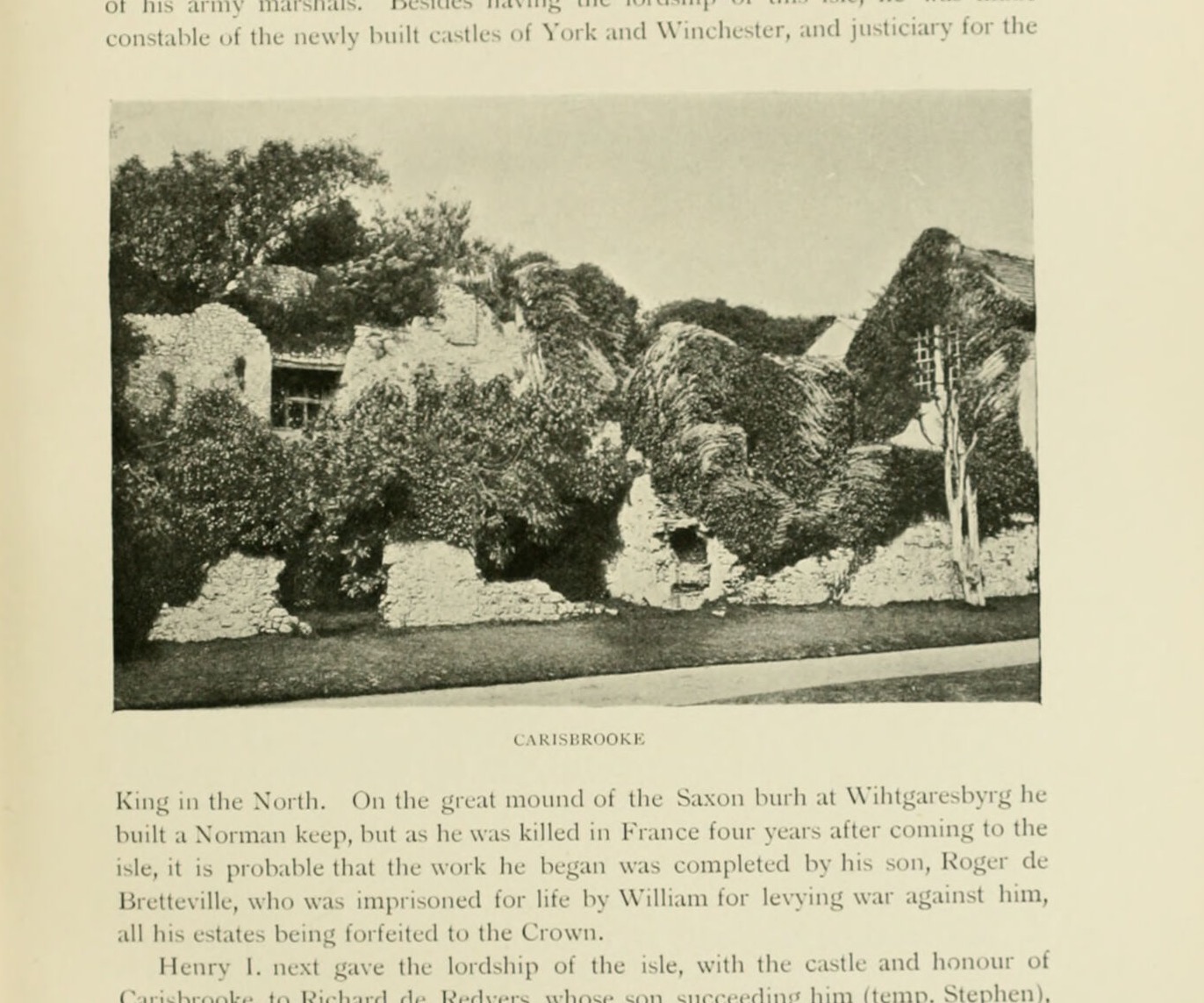
CARISBROOKE
1897 · J. D. Mackenzie, The Castles of England, vol. 1 (1897)
Public domain
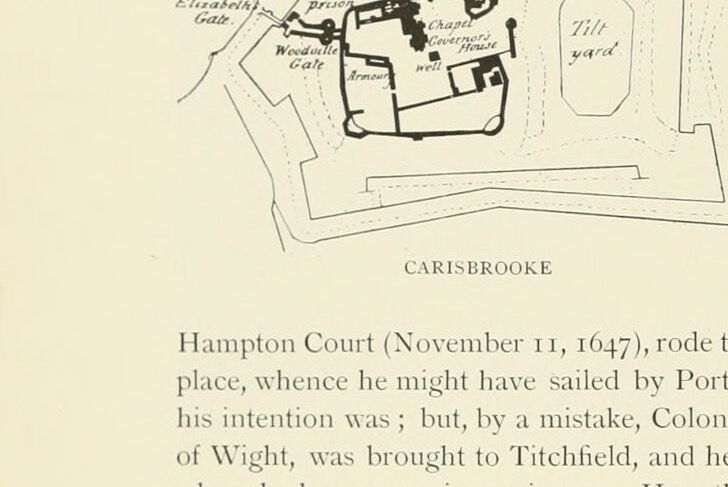
CARISBROOKE
1897 · J. D. Mackenzie, The Castles of England, vol. 1 (1897)
Public domain
Nearby


