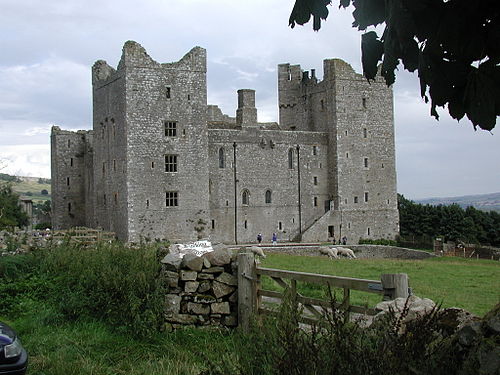
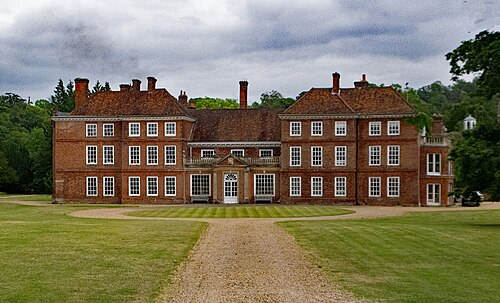
England · Restored
Carlisle Castle
Carlisle Castle is a medieval stone keep fortress occupying a raised site in the centre of the city of Carlisle, adjacent to the remains of Hadrian's Wall. First built as a Norman motte-and-bailey and rebuilt in stone under Henry I, it served as a key military stronghold on the Anglo-Scottish border for many centuries and today is managed by English Heritage and open to the public.
First raised
1093
Its prime
1568
Today
Restored
Ranked among Europe’s castles
As it stood in 1568
What Carlisle Castle looked like in its prime.
A compact stone fortress of red-brown sandstone with a dominant multi-storey Norman keep and flanking drum-like towers set on a raised platform. Thick curtain walls with crenellated parapets and narrow arrow slits connect the towers and an arched gatehouse entrance. Low grassy bailey and parade ground sit before the gateway. Rooflines are low or battlemented rather than steep-pitched; masonry shows large ashlar blocks and coursed rubble, and gun-ports for artillery appear on the outer faces.
Its story
The story of Carlisle Castle.
William Rufus's Fortress on the Roman Fort
Carlisle Castle was begun in 1092 on the orders of William II, 'William Rufus', son of William the Conqueror, at a time when Cumberland was still considered part of Scotland. The Norman motte-and-bailey rose on the site of the Roman fort of Luguvalium, dated by dendrochronology to AD 72, close to the ruins of Hadrian's Wall.
In 1122 Henry I ordered a stone castle with towers to be built on the site; the keep that survives dates from between 1122 and 1135, one of only 104 recorded tower keep castles, most of which stand on the Welsh border. After the Battle of the Standard in 1138 the castle was largely rebuilt by order of David I of Scotland. Henry of Anjou was knighted within its walls in 1149, and David himself died of illness there in 1153.
Bruce Against Comyn, 1296
Driving the Scots from Cumberland guaranteed centuries of retaliation, and Carlisle and its castle would change hands many times over the next 700 years. On 26 March 1296 John 'the Red' Comyn, Lord of Annandale, led a Scottish host across the Solway against Carlisle; the castle's governor, Robert de Brus, the deposed Lord of Annandale, withstood the attack and forced the raiders back through Annandale to Sweetheart Abbey. Scottish forces laid siege again from 22 July to 1 August 1315, but lacked the resources to sustain it and withdrew. From the mid-thirteenth century until the Union of the Crowns in 1603, Carlisle Castle was the vital headquarters of the Western March, the buffer zone protecting the western Anglo-Scottish border.
Mary, Queen of Scots in the Warden's Tower
Henry VIII converted the castle for artillery, employing the engineer Stefan von Haschenperg. For a few months in 1568 Mary, Queen of Scots was imprisoned in the Warden's Tower; Francis Knollys described her watching two football matches on a playing green outside the castle's postern gate. During the Civil War, Parliamentary forces besieged the castle for eight months in 1644.
The Last Siege of an English Fortress, 1745
The last battles for Carlisle came during the Jacobite rising of 1745 against George II, when the forces of Prince Charles Edward Stuart seized and fortified the city and castle on their march south into England, which reached as far as Derby. Driven north again by the Duke of Cumberland, the Jacobites lost Carlisle; the prisoners were jailed and executed. Carlisle thereby became the last English fortress to undergo a siege, and with England and Scotland joined in Great Britain the castle's fighting life was over.
Depot of the Border Regiment
Neglect followed 1746, broken by minor repairs such as the drawbridge in 1783, and in the nineteenth century parts of the castle were demolished for raw materials. In 1851 the barracks held the 33rd Regiment of Foot. Under the Cardwell Reforms the castle became the depot of the 34th (Cumberland) and 55th (Westmorland) Regiments of Foot in 1873, and their amalgamation under the Childers Reforms of 1881, the Border Regiment, kept its depot there until 1959, when it amalgamated with the King's Own Royal Regiment to form the King's Own Royal Border Regiment.
The castle remained that regiment's administrative headquarters until 2006 and was county headquarters of the Duke of Lancaster's Regiment until 2019; the Army Reserve still uses parts of the site, and Cumbria's Museum of Military Life sits within the walls. Scheduled as an ancient monument in August 1996 (a listing that takes in the medieval tower keep, lengths of city wall, a sixteenth-century battery and the buried Roman fort beneath) the castle is managed by English Heritage. A fourteenth-century poem places Sir Gawain at the Castle of Carlisle while hunting in the haunted Inglewood Forest, and by some accounts the fortress is none other than Camelot, the mythical seat of King Arthur's court.
Step inside
9 places to explore in 1568.
The record describes 9 distinct spots at Carlisle Castle, including 3 interiors: keep, great chamber and inner vaults, warden's tower (prison chamber), buried roman fort substructure. Create your own photoreal reconstruction and explore every one, more scenes means more rooms, more angles, and more of the place to stand in.
Build Your Own Castle
Recreate Carlisle Castle with AI to explore it.
The artist rebuilds it as it stood in 1568, a photoreal reconstruction that belongs to you alone. Pay with coins, no subscription needed.
Recreate this castle →Defend this castle →From the archive
Carlisle Castle on paper: the measured plan and period views.
The survey plan and photographs below are the ground truth this page's reconstructions are checked against, drawn and photographed while the castle was still a working garrison. Every image is public-domain or openly licensed, with its source named.
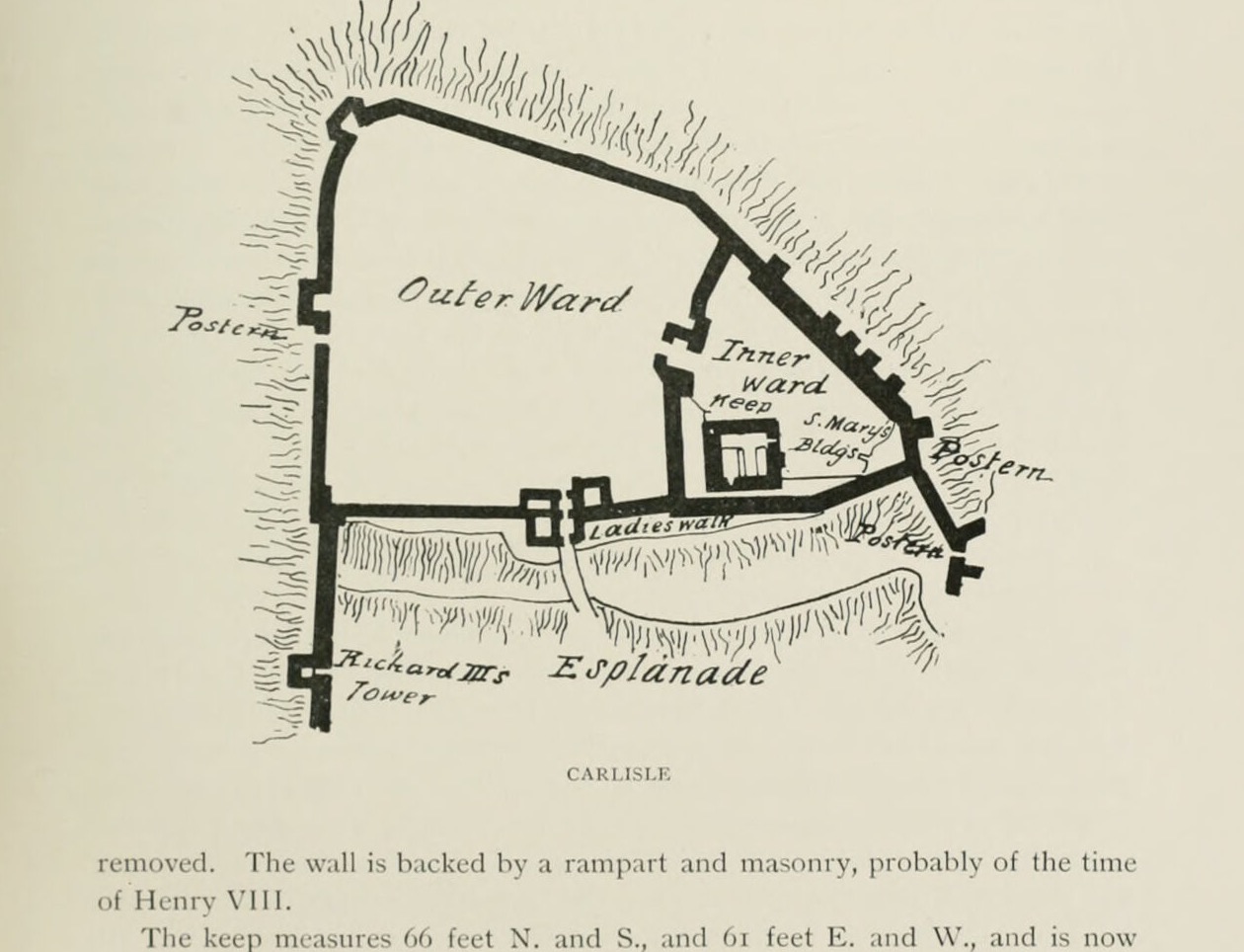
CARLISLE
1897 · J. D. Mackenzie, The Castles of England, vol. 2 (1897)
Public domain