England · Ruin
Castle Rising Castle
Castle Rising is a 12th‑century Norman castle in Norfolk centred on a massive Romanesque stone keep within three concentric baileys and large earthwork defences. Built soon after 1138 by William d'Aubigny II, it later became a principal residence of Queen Isabella in the 14th century and part of the Duchy of Cornwall. Today the substantial keep survives as the dominant feature within the castle's ruined complex and surrounding parkland.
First raised
1138
Its prime
1337
Today
Ruin
As it stood in 1337
What Castle Rising Castle looked like in its prime.
A massive rectangular Romanesque stone keep dominates the inner bailey, its facades articulated with vertical pilaster buttresses and arcading in pale flint and ashlar. A raised forebuilding with a high arched entrance and a steep peaked roof projects from one side; small slit and arched windows puncture the walls. The keep stands within broad grassy inner and outer baileys ringed by large earthen ramparts; service ranges and a timber‑framed, brick kitchen occupied the inner court in its prime.
Its story
The story of Castle Rising Castle.
William d'Aubigny's New Wealth, 1138
William d'Aubigny II held the manor of Snettisham when, in 1138, he married Adeliza of Louvain, the widow of Henry I; the next year he was made Earl of Arundel. A chronicler at Waltham Holy Cross complained that he "became intolerably puffed up ... and looked down upon every other eminence in the world except the King". With the new money he built Castle Rising and New Buckenham, and enlarged Arundel.
The site was not chosen for strategy: the soil was poor and acidic, the country thinly populated, and the castle's only military use would have been as a regional muster point. What recommended it was that a large building and a hunting park could be raised there cheaply - Richard Hulme calls the result a palatial hunting lodge. Three baileys went up behind earthworks covering twelve acres, and in the inner bailey rose a hall-keep whose layout was probably based on Norwich - to Beric Morley and David Gurney, one of the finest of all Norman keeps.
The Mint of 1145 and the Revolt Against Henry II
In 1145 King Stephen granted William permission to open a mint at the castle, and probably because of it a community of Jews settled in the new town in front of it. William had backed Stephen through the Anarchy, yet kept his possessions under Henry II, whose clampdown on the regional mints closed the Rising coinage; its Jews resettled at King's Lynn. A second, rapid phase of building followed, probably in the 1170s and probably an answer to the great rebellion against Henry, in which William fought for the King at Fornham. The earth defences were doubled in height and the west bailey raised into a platform. Yet New Buckenham, not Rising, remained the caput of the family's Norfolk lands, and it is uncertain how often William stayed here.
Queen Isabella's Household, 1331-1358
The castle passed to the de Montalts in 1243. In 1327 the childless Robert de Montalt sold the reversion of his rights to the Crown for 10,000 marks, keeping a life interest for himself and his wife Emma; he died in 1329, and in 1331 Emma sold what remained for £400 to Queen Isabella of France. Isabella had governed England with Roger Mortimer until Edward III toppled Mortimer in 1330; after a short house arrest she resumed a relatively normal life as the King's mother, and Edward granted her several royal castles, Rising among them.
From then until her death in 1358 it was one of her main residences. Her income of £3,000 a year had risen to £4,000 by 1337, and she kept minstrels, huntsmen and grooms, yet still ran up debts locally. Edward and the royal household visited on at least four occasions. New buildings went up in the central bailey, among them a west range and a new private chapel. Isabella lived in the west range, using the great keep only for formal occasions or very senior guests.
The Black Prince and the Disputed Duchy, 1337-1403
Edward III decreed in 1337 that his son would take the castle on Isabella's death, and declared it a permanent part of the Duchy of Cornwall. The Black Prince repaired it in the 1360s, spending £81 in 1365 on the "Nightegale Tower". He died in 1376, and during the 1380s the castle was ordered more than once to raise local forces against the threat of a French invasion; it may have been fitted with two cannons. The charter's permanence proved illusory: Richard II's government traded the castle to John, Duke of Brittany, in 1378 for the Château de Brest and granted its reversion away twice more, until after Richard's overthrow the courts ruled the grants illegal and returned it to the Duchy in 1403, by then held by the future Henry V.
"Evyll Repayred": Decay and Victorian Restoration, 1461-1851
Henry VI mobilised the defences in 1461 during the Wars of the Roses, but by then the place counted for more as a hunting seat. A report of 1482 found the buildings no longer weatherproof, and a survey of 1503-06 called the castle "evyll repayred", the keep's roof rotten. By 1542-43 all but the new guest lodgings were in "greate ruin and decaye", the keep's roof fallen in. Henry VIII bequeathed the property to Thomas Howard, Duke of Norfolk, in 1544.
By the 1570s rabbit warrens had riddled the earthworks; a survey put full renovation at £2,000 and reckoned its materials worth only £66 if it were pulled down. At the end of the century the inner bailey was cleared of nearly all its buildings, leaving the ruined keep. The lands were disparked in 1644, ending Castle Rising Chase, and in 1705 stone was stripped from the castle to mend a sluice gate. Restoration waited until 1822, when Fulke Greville Howard dug out the keep basement and lowered the inner bailey, uncovering the old Norman chapel that Henry Harrod excavated in 1851.
Step inside
11 places to explore in 1337.
The record describes 11 distinct spots at Castle Rising Castle, including 5 interiors: great keep, lord's chamber (interior), great hall, private chapel in the west range and more. Create your own photoreal reconstruction and explore every one, more scenes means more rooms, more angles, and more of the place to stand in.
Build Your Own Castle
Recreate Castle Rising Castle with AI to explore it.
The artist rebuilds it as it stood in 1337, a photoreal reconstruction that belongs to you alone. Pay with coins, no subscription needed.
Recreate this castle →Defend this castle →Whose castle
Clans who held Castle Rising Castle.
The families that held Castle Rising Castle for a decade or more across its history, follow a name to its clan.
d'Aubigny
Built soon after 1138 by William d'Aubigny II, Earl of Arundel, and inherited by his descendants until 1243.
de Montalt
Held by the de Montalt family from 1243 until sold to Queen Isabella.
Sold by Henry VIII to Thomas Howard, Duke of Norfolk; the current owner is Baron Howard of Rising.
From the archive
Castle Rising Castle on paper: the measured plan and period views.
The survey plan and photographs below are the ground truth this page's reconstructions are checked against, drawn and photographed while the castle was still a working garrison. Every image is public-domain or openly licensed, with its source named.
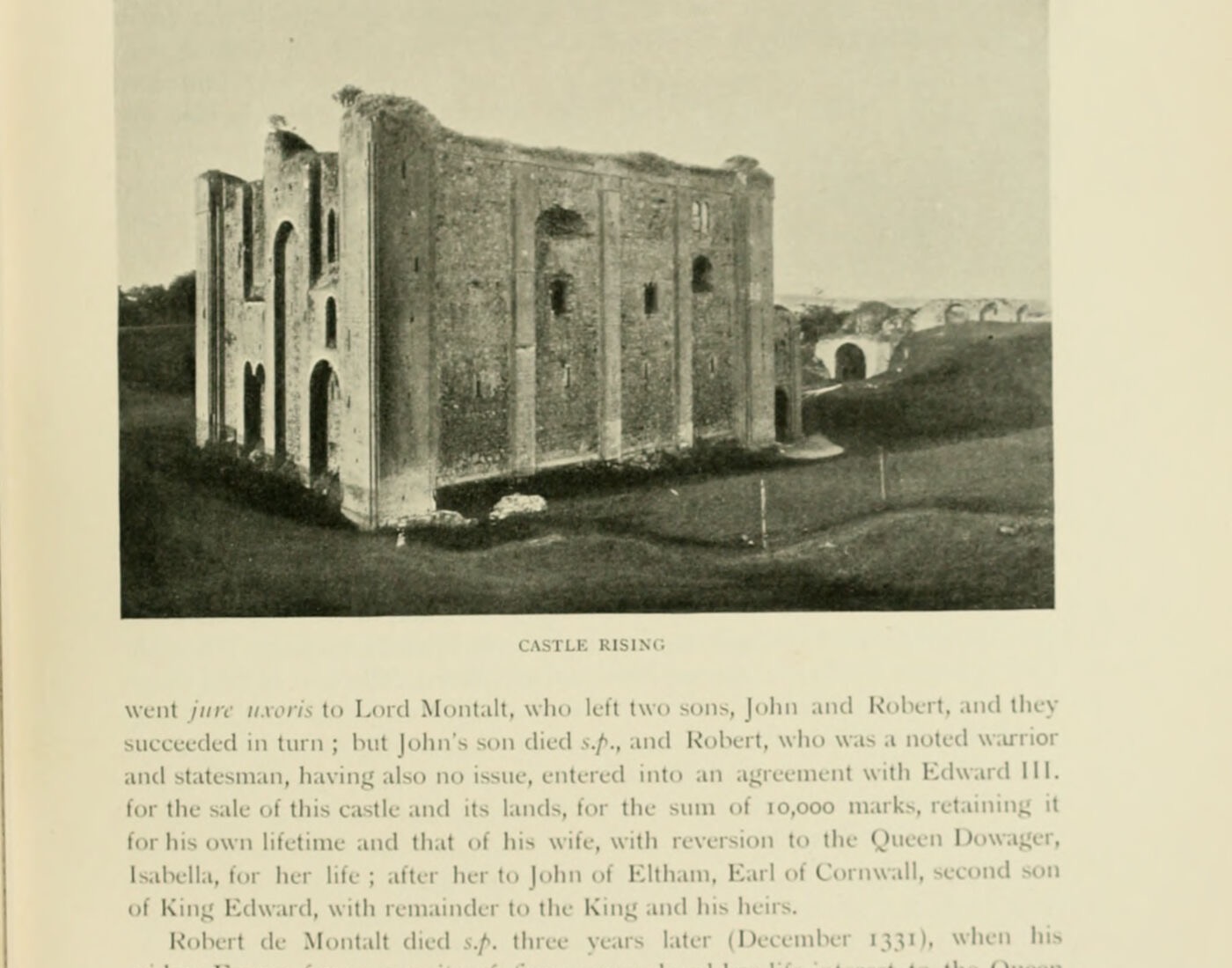
CASTLE RISING
1897 · J. D. Mackenzie, The Castles of England, vol. 1 (1897)
Public domain
Nearby