
England · Partial ruin
Cawood Castle
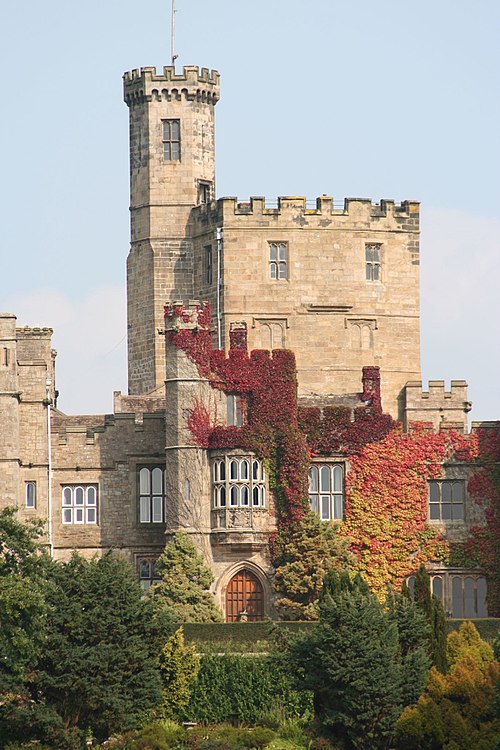
Cawood Castle is a medieval episcopal palace in Cawood, North Yorkshire; only the 15th-century gatehouse and the two-storey banqueting hall survive. The fortified quadrangle was largely dismantled after the English Civil War and stones were reused in local buildings. The gatehouse has been restored for holiday use while the banqueting hall is weatherproof but not habitable.
First raised
1378
Its prime
1465
Today
Partial ruin
As it stood in 1465
What Cawood Castle looked like in its prime.
A crenellated pale limestone gatehouse with a large arched central passage attaches to a long two-storey red-brown brick banqueting range with a steep clay-tiled roof and a regular row of narrow vertical windows set between shallow buttresses. The gatehouse has ashlar stonework and a battlemented parapet; the brick hall shows repeated pointed-arch window openings. The complex faces an open grassy garth with traces of ponds and low foundation lines, set within the village.
Its story
The story of Cawood Castle.
Æthelstan's Fort to Archbishop Kemp's Gatehouse, 10th–15th Centuries
The Saxon king Æthelstan probably built the first fortification at Cawood, on the site later occupied by the castle ruins. It had become a residence of the Archbishops of York by the twelfth century, and a castle here was first recorded in 1181. It drew royal visitors, among them King John, who hunted game in nearby Bishop's Wood in the 13th century, and William de Grenfeld is credited with building the castle's west end in 1306. The palace was converted into a quadrangular castle between 1374 and 1388, and documents show it continued to be improved; its gatehouse, one of the two structures that survive today, was built by Archbishop John Kemp using stone from the Huddlestone quarry near Tadcaster, the same quarry that supplied York Minster.
The Great Feast of Cawood, 1465
When George Neville became Archbishop of York in 1465 he marked it with a feast at the castle, prepared with the help of his brother the Earl of Warwick, who is said to have wanted it larger than the King's own coronation banquet. Guests included the Duke of Gloucester, the King's brother, and the feast ran several days, becoming known as the Great Feast of Cawood for its scale: records list 104 oxen, six wild bulls, 400 swans, 1,000 capons and 104 peacocks consumed, along with 25,000 gallons of wine.
Archbishop Savage's Death and Wolsey's Arrest, 1507–1530
Thomas Savage made Cawood his main residence as Archbishop of York and died there in September 1507. Cardinal Wolsey arrived at Cawood as archbishop in 1530 and made himself popular by putting right years of neglect, but before he could be installed at York the Earl of Northumberland arrested him at the castle on a charge of high treason. Wolsey fell ill at Leicester on the road to London and died there; tradition held that he had thereby fulfilled Mother Shipton's prophecy that he would see the towers of York Minster but never be enthroned within them.
Civil War Capture and Demolition, 1642–1650s
When civil war broke out in 1642 the castle was initially held by the Royalists. It was captured by the Parliamentarians, briefly retaken for the King by the Earl of Newcastle in 1644, and recaptured soon afterwards by Lord Fairfax, who used it as a prisoner-of-war camp. Once the war ended the castle was abandoned and largely destroyed, leaving only farm buildings and parts of the wall standing; its cellar was filled with rubble and soil.
Courthouse to Landmark Trust Holiday Let, 1920s–2000s
The surviving gatehouse served as a courthouse until the 1930s, then as an officers' mess and a Home Guard building during the Second World War. It is now owned by the Landmark Trust, which has restored it as a holiday home, while the two-storey banqueting hall has been left sound and weathertight but not habitable; the castle's foundations and its cellar, excavated in the 19th century, also survive, along with stone from the ruins reused in nearby houses. The castle garth was bought by the parish council in the 1980s to keep it an open space at the heart of the village; the garth is home to a population of great crested newts, and includes a 19th-century skating pond and the remains of medieval fish-ponds; restoration work has drawn funding from the Local Heritage Initiative, launched in 2000. Cawood Castle is a Grade I listed building, designated in 1966, and a scheduled monument since 1928.
Step inside
7 places to explore in 1465.
The record describes 7 distinct spots at Cawood Castle, including 3 interiors: through the gatehouse archway (passage), banqueting hall, great hall interior, subterranean cellar and vaulted storage. Create your own photoreal reconstruction and explore every one, more scenes means more rooms, more angles, and more of the place to stand in.
Build Your Own Castle
Recreate Cawood Castle with AI to explore it.
The artist rebuilds it as it stood in 1465, a photoreal reconstruction that belongs to you alone. Pay with coins, no subscription needed.
Recreate this castle →Defend this castle →Nearby
Landmarks within reach of Cawood Castle.


Questions about Cawood Castle
What is the history of Cawood Castle?
What is inside Cawood Castle?
Who owns Cawood Castle now?
Why was Cawood Castle built, and what was it used for?
Where is Cawood Castle?
When was Cawood Castle built?
Was Cawood Castle ever attacked or besieged?
What did Cawood Castle look like in its prime?
Is Cawood Castle still standing, or is it a ruin?
Who built Cawood Castle?
More castles of England


Explore the city


