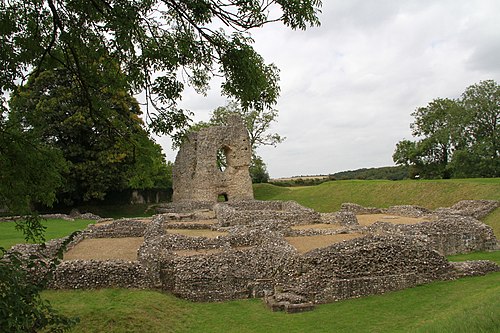
England · Partial ruin
Chichester Castle
Chichester Castle was a Norman timber castle sited in the north‑east corner of the city of Chichester, protected by the medieval city walls. Only the earthwork motte survives today in Priory Park; the castle was ordered destroyed in the early 13th century and the site later became a Greyfriars friary.
Its prime
1210
Today
Partial ruin
As it stood in 1210
What Chichester Castle looked like in its prime.
A compact timber motte-and-bailey castle set against the urban edge: a circular earthen motte with steep grassy slopes topped by a timber palisade and small wooden tower/keep, and an adjoining enclosed bailey with low timber buildings and palisade. The castle sits within the footprint of the city, with nearby stone city walls and the town skyline and church spire visible beyond; surrounding ground is open lawns and park trees, no substantial stone keep survives.
Its story
The story of Chichester Castle.
Shortly after the Norman Conquest, Roger de Montgomery ordered a castle built at Chichester, one of eleven fortified sites established in Sussex before 1100. Inserted into the north-east corner of the walled city, where buildings were probably cleared to make way for it, the timber castle administered the Rape of Chichester, split off from the larger Rape of Arundel; there is no evidence it was ever rebuilt in stone.
The Earls of Sussex owned the castle from 1154 to 1176, after which it passed to the Crown, and early in the 13th century it served as a court and jail, with Oxford, one of the earliest urban castles put to that use. In 1216, amid the First Barons' War, King John ordered its destruction; the orders went unheeded and the castle fell instead to the French under Prince Louis.
The English recaptured it in the spring of 1217, and that same year Henry III ordered the destruction his father had decreed. Between 1222 and 1269 Richard, 1st Earl of Cornwall, gave the site to the Greyfriars for a friary. The motte still shows in Priory Park, protected as a Scheduled Monument, and the ruins were excavated in May and June 2025.
Step inside
7 places to explore in 1210.
The record describes 7 distinct spots at Chichester Castle, including 1 interior: interior of the timber keep (official chamber / jail). Create your own photoreal reconstruction and explore every one, more scenes means more rooms, more angles, and more of the place to stand in.
Build Your Own Castle
Recreate Chichester Castle with AI to explore it.
The artist rebuilds it as it stood in 1210, a photoreal reconstruction that belongs to you alone. Pay with coins, no subscription needed.
Recreate this castle →Defend this castle →Nearby