England · Restored
Chillingham Castle
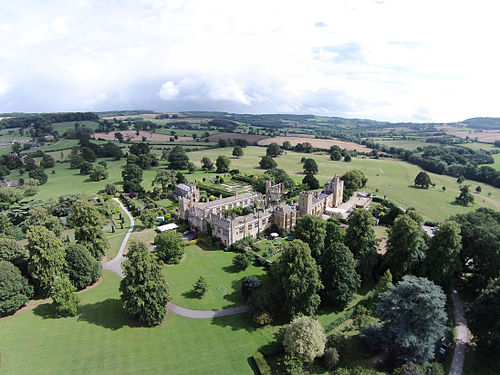
Chillingham Castle is a medieval fortified residence in the village of Chillingham, Northumberland, England, long associated with the Grey and Bennet (Earls of Tankerville) families. The building began as a late 12th-century monastic site, was licensed to be crenellated in 1344 and later transformed into a domestic seat with added halls and a library; the estate includes listed lodges, gateways and gardens and a park that houses the rare Chillingham cattle.
First raised
1344
Its prime
1617
Today
Restored
As it stood in 1617
What Chillingham Castle looked like in its prime.
A broad, quadrangular stone house with two projecting square towers at the flanking ends and a crenellated parapet along the roofline; the central three-storey projecting entrance bay has a stone doorway beneath mullioned windows and a carved coat of arms. Walls are of weathered grey sandstone ashlar with regularly spaced rectangular mullioned windows. The façade faces out over a formal lawn with a rectangular fountain and statuary; at its prime the battlements and residential wings were complete and in use.
Its story
The story of Chillingham Castle.
Edward I on the Road to Wallace, 1298
Chillingham began as a monastery in the late twelfth century. In 1298 Edward I broke his march there on his way into Scotland to fight the army led by William Wallace, and a glazed window was fitted in a frame especially for the king, a rarity in such buildings at the time.
The castle stood on the border between two feuding nations: English armies moving into Scotland used it as a staging post, while Scottish armies and raiding parties driving south attacked and besieged it repeatedly. The site carried a moat, and in places the fortifications ran twelve feet, some 3.7 metres, thick. Successive rounds of strengthening culminated in a licence to crenellate issued by Edward III in 1344, which allowed battlements to be raised and turned what had been a stronghold into a fully fortified castle of quadrangular plan; the work was commissioned by Sir Thomas Heton. From the fifteenth century Chillingham was the seat of the Grey family and of the Bennets, later Earls of Tankerville.
Anne of Denmark's Journey South, 1603
The Union of the Crowns brought royal households through the gates instead of armies. On 6 June 1603 Anne of Denmark, Queen of Scotland, stopped at Chillingham with her children on the road to London, and a poem celebrating her welcome there was probably written by her secretary, William Fowler; in 1617 James I, who was also James VI of Scotland, stayed at the castle while travelling between his two kingdoms.
As relations between the two countries settled, the need for a military stronghold in the area fell away and the castle was steadily remade as a house. The moat was filled in, the battlements were converted into residential wings, and a banquet hall and a library were built. Landscaping of the grounds followed through the eighteenth and nineteenth centuries, some of it carried out by Sir Jeffry Wyattville, and the Prince and Princess of Wales stayed at Chillingham on their way to Scotland in 1872.
Barracks, Decay and the Wakefield Restoration
The Second World War turned the castle back into a barracks, and much of the decorative woodwork is said to have been stripped out and burned by the soldiers billeted there. Disrepair set in after the war: lead was taken from the roof, and large parts of the building suffered heavy weather damage. Chillingham was listed Grade I in 1951. Its link with the Earls of Tankerville held until the 10th Earl succeeded in 1980, and soon afterwards the landed estate was broken up and sold.
In 1982 the castle was bought by Sir Humphry Wakefield, 2nd Baronet, whose wife Catherine is descended from the Greys of Chillingham, and he set about a painstaking restoration. In 1997 it served as a filming location for Elizabeth, standing in for Leith Castle and for the hunting lodge; the fibreglass fireplaces built for the production remain in the great hall, where they cover eighteenth-century white marble fireplaces taken from the demolished Wanstead House in east London. Sections of the castle are now open to the public, and its owners market it as the most haunted castle in Britain: a reputation resting on the "blue", or radiant, boy, who by their account used to haunt the Pink Room.
A large enclosed park in the grounds holds the Chillingham cattle, a rare breed of about 130 head of white animals whose fame travelled well beyond Northumberland: in The Bride of Lammermoor of 1819 Walter Scott singled out Chillingham as a last refuge for an ancient breed of Scottish cattle, and castle and herd together gave Eva Ibbotson the starting point for her 2005 children's book The Beasts of Clawstone Castle.
Step inside
11 places to explore in 1617.
The record describes 11 distinct spots at Chillingham Castle, including 4 interiors: great hall, banquet hall, library and more. Create your own photoreal reconstruction and explore every one, more scenes means more rooms, more angles, and more of the place to stand in.
Build Your Own Castle
Recreate Chillingham Castle with AI to explore it.
The artist rebuilds it as it stood in 1617, a photoreal reconstruction that belongs to you alone. Pay with coins, no subscription needed.
Recreate this castle →Defend this castle →Whose castle
Clans who held Chillingham Castle.
The families that held Chillingham Castle for a decade or more across its history, follow a name to its clan.
Seat of the Grey family from the 15th century; their descendants hold it still.
Bennet
Held by the Bennets, Earls of Tankerville, into the 20th century.