England · Ruin
Clifford Castle and Barbican
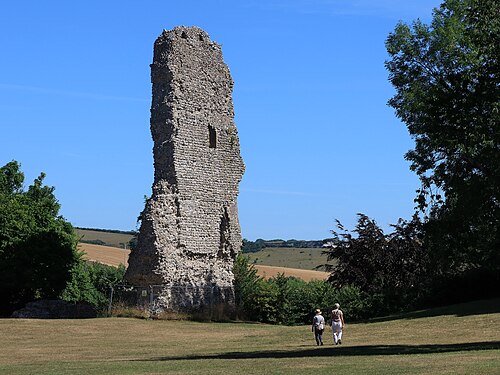
Clifford Castle is a medieval motte-and-bailey fortress on a cliff above the River Wye in Herefordshire. In its prime it comprised a large motte crowned by an ovoid stone shell keep with five D-shaped towers, a bailey to the east and a twin-towered mid-13th-century gatehouse. The site is now a ruin within private grounds with limited public access.
Its prime
1250
Today
Ruin
As it stood in 1250
What Clifford Castle and Barbican looked like in its prime.
Perched on a steep cliff above the River Wye, the site is dominated by a large earthen motte surmounted by an ovoid stone shell keep punctuated by five D-shaped towers in its circuit. To the east lies the bailey with fragments of curtain wall and the bases of domestic ranges; the approach is defended by a twin-towered gatehouse and an outer barbican, and a broken earthwork dam to the west once flooded the surrounding marshy plain.
Its story
The story of Clifford Castle and Barbican.
William FitzOsbern's Motte on the Wye, 1070
In 1070 William FitzOsbern, 1st Earl of Hereford, built a motte-and-bailey castle on a cliff above a ford on the River Wye, intended to protect a planned Norman settlement of around 200 plots running half a mile uphill towards Llanfair, where St Mary's church was sited on the hilltop and still stands today, much altered since. The river's seasonal flooding, assisted by a dam on the upstream side, could turn the flood plain around the castle into a shallow lake, adding a further layer of defence.
The Tosnys, the Cliffords and a King's Siege, 1075–1250s
After FitzOsbern was killed fighting in Flanders, the castle passed to his son Roger de Breteuil, 2nd Earl of Hereford, who forfeited his lands for rebelling against the king in 1075. It was then granted to Ralph Tosny, who held it directly from the Crown and, in a style resembling the Tosnys' own Conches Castle in Normandy, rebuilt it in stone; because Ralph spent most of his time in Normandy, the castle was let to Gilbert, Sheriff of Hereford, for 60 shillings. Ralph's daughter Margaret married Walter Fitz Richard, who became steward of the estate and later claimed it as his own, taking the name Walter de Clifford before 1162. Walter's daughter Rosamund Clifford, remembered for her beauty as "Fair Rosamund", became the mistress of Henry II until her death in 1176 or 1177; a nearby property is still called Rosamund House, and one of the castle's surviving towers is known as Rosamund's Tower.
In 1233 Walter's grandson, also named Walter de Clifford, rebelled against Henry III. The king marched on the castle in early September and besieged it, forcing the garrison to surrender within days; Clifford then made peace with the Crown and turned his troops against his own father-in-law, Prince Llywelyn ab Iorwerth, who had just taken the field against the king in Clifford's support. Some twenty years later Clifford forced a royal messenger to eat a royal writ and its wax seal, an insult that cost him many of his Marcher Lord privileges.
Matilda Clifford's Abduction and the Mortimers, 1260s–1299
Walter left no male heir, and the lordship fell to his daughter Matilda Clifford, widow of the Earl of Salisbury's grandson, some time in the 1260s. During the Second Barons' War, John Giffard of Brimpsfield took the castle, then kidnapped, raped and forcibly married Matilda. Giffard was fined, but Matilda declined further action and accepted her abductor as her husband; they lived together on the Clifford estate until Giffard's death in 1299, when the king granted Clifford to the Mortimers of Wigmore.
Decline After the Welsh Conquest and the 1402 Rising
Once Wales had been conquered, Clifford Castle's value fell sharply and it was left to deteriorate. It was garrisoned against Owain Glyndŵr's rebellion in 1402, but saw no further military use; the damage from that episode went unrepaired, and the castle was abandoned and pillaged for stone used in the village's older properties; large dressed blocks from it can still be seen in garden walls.
Excavation and Preservation, 1920s to Today
The site's then-owner, O. Trumper, excavated between 1925 and 1928, uncovering the bases of twin towers flanking the entrance, a large building with an annexe east of the castle, and evidence of a southern tower, guardroom and portcullis. Further excavations between 1950 and 1953 found the foundations of a tower on the motte, additional curtain wall, and a fully excavated barbican with a roadway, along with pottery, iron arrowheads, a knife, a bullet mould, a key, nails and a bridle bit.
The castle's present owners have worked with English Heritage to stabilise the structure, and it is no longer on the Heritage at Risk Register. Clifford Castle has been a Grade I listed building since 17 January 1949 and is a scheduled monument; it stands within the grounds of a private house and is open to the public only on dates published by its owners.
Step inside
9 places to explore in 1250.
The record describes 9 distinct spots at Clifford Castle and Barbican, including 2 interiors: site of the principal hall (north wall remains), guardroom and portcullis at the gate. Create your own photoreal reconstruction and explore every one, more scenes means more rooms, more angles, and more of the place to stand in.
Build Your Own Castle
Recreate Clifford Castle and Barbican with AI to explore it.
The artist rebuilds it as it stood in 1250, a photoreal reconstruction that belongs to you alone. Pay with coins, no subscription needed.
Recreate this castle →Defend this castle →Whose castle
Clans who held Clifford Castle and Barbican.
The families that held Clifford Castle and Barbican for a decade or more across its history, follow a name to its clan.
Tosny
Granted to Ralph Tosny after 1075; the Tosnys rebuilt the castle in stone.
Clifford
Caput of the barony of Clifford, held to Walter's heiress Matilda Clifford, until granted away in 1299.
Mortimer
Granted to the Mortimers of Wigmore in 1299.
Nearby