England · Ruin
Clun Castle
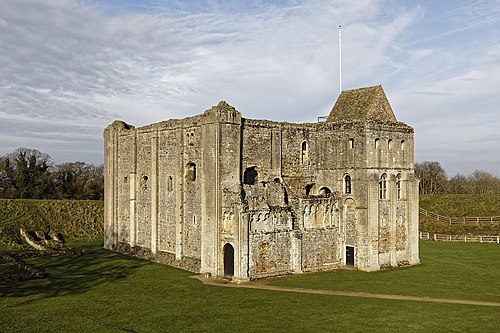
Clun Castle is a medieval motte-and-bailey castle overlooking the small town of Clun in Shropshire, England. Its dominant feature is a tall, rectangular late-Norman keep on a large motte, with associated baileys, towers and domestic buildings; by the 16th century it was largely ruined and was slighted in 1646. Today the site is a protected scheduled monument and Grade I listed building managed by English Heritage.
Its prime
1350
Today
Ruin
As it stood in 1350
What Clun Castle looked like in its prime.
Perched on a large, scarped motte at a bend in the River Clun, the castle is dominated by an off-centre, four-storey rectangular stone great keep with pilaster buttresses and round-headed Norman windows. On the motte summit a fragmentary earlier square keep wall survives. A stone bridge links the main motte to a south-west mound leading to the gatehouse; the south-west shows the footings of a large round tower, and two solid turrets line the west front. Domestic ranges and bailey earthworks lie within the inner court and pleasure gardens sit beyond the river.
Its story
The story of Clun Castle.
Picot de Say and the Castle-Guard of Clun
Before the Conquest the manor of Clun belonged to Eadric the Wild. The Norman baron Robert de Say, known as Picot, seized the territory and raised a substantial motte castle with two baileys, holding it from the Earl of Shrewsbury until the Shrewsbury rebellion of 1102, after which he and his descendants held directly from the Crown. Picot's son Henry de Say inherited in 1098, and Henry's son Helias held the castle until his death in 1165.
Henry I gave Clun a castle-guard system, probably answering the Welsh attacks that followed Gruffudd ap Cynan's rebellion of 1094: knights from a group of fiefs running eastwards from the frontier each owed forty days' service a year, and twenty-five Welsh settlements owed the castle military duty as well. Henry II spent heavily here between 1160 and 1164. The surrounding lands became a Marcher barony, known in the 13th century as the Honour of Clun and governed by its own law rather than English law: its lord could execute criminals in his own name rather than the king's, and men were brought from as far as Shrewsbury for it.
Isabella de Say and the Fitz Alan Keep
Under Helias the barony of Say was divided in two, his daughter Isabella receiving an enlarged estate centred on Clun. She married William Fitz Alan, lord of Oswestry and High Sheriff of Shropshire, who in the Anarchy declared for the Empress Maud, held Shrewsbury Castle for four weeks against Stephen in 1138, escaped before the city fell, and spent fifteen years in exile until Henry II's return in 1153.
Isabella married twice more, but at her death in 1199 the castle went to her son by her first husband, the second William Fitz Alan, joining Oswestry and Clun into a single lordship. This William built the tall off-centre keep on the motte; he had been with Richard I while Château Gaillard was going up in Normandy, and the round towers he raised to defend the new keep appear to have been modelled on those there.
King John Takes Clun, 1216
William died in 1210, and King John demanded 10,000 marks before his eldest son, another William, could inherit; unable to pay, the family lost Clun, which was assigned instead to Thomas de Eardington. William died at Easter 1215, and his brother John Fitz Alan, a close friend of Llywelyn the Great, took up arms against the king and seized Clun and Oswestry back from royal control. The king answered in 1216, burning the town of Oswestry before besieging Clun and taking it by surprise attack. John Fitz Alan came to terms with Henry III in 1217, having finally paid the 10,000 marks.
Suspicion fell on him again during the fighting of 1233-34 between Henry III, the Earl Marshal and Llywelyn the Great, and royal troops were put into Clun in 1233 to guarantee it. The castle held out when Llywelyn attacked that year, though the town was destroyed. When another John Fitzalan died in 1272 leaving a young son, Richard, Roger Mortimer of Wigmore held the castle through the minority; the commissioners who inspected it called it small but strongly built, though needing repair to the bridge and to the roof of one of the towers.
Arundel, the Horse Stud and Richard II's Forfeiture
Edward I's invasion of North Wales in the 1280s took much of the danger out of the border, and with it the need for a strong fortress at Clun. The FitzAlans had acquired Arundel Castle by marriage in 1243, which proved a far more amenable seat. By the 14th century Clun had become a hunting lodge with pleasure gardens, and the family kept a large horse stud there. Richard II set out to break Arundel power in the region, taking Clun when Richard FitzAlan was executed in 1397 and granting it to the Duke of York with the intention that it join the Earldom of Chester; the king's own fall restored Thomas FitzAlan to favour, and the castle to his family.
Glyndŵr, Leland's Ruin and the Slighting of 1646
Interest in Clun revived during the Glyndŵr Rising of 1400-15. Thomas FitzAlan played a key part in suppressing the revolt, and the castle was refortified and saw some service against Owain Glyndŵr's rebels. By the 16th century the antiquary John Leland was noting how ruinous it had become. Philip Howard, 20th Earl of Arundel, died under attainder in 1595, and James I granted Clun to Henry Howard, 1st Earl of Northampton.
The castle was already abandoned when civil war came in 1642 and saw no military action at all, but Parliament had it slighted in 1646 to prevent any possible use as a fortress. It passed through several hands afterwards, Clive of India among them, and in 1894 the Duke of Norfolk, a descendant of the FitzAlans, bought the site and began the conservation that stabilised what was left.
Step inside
12 places to explore in 1350.
The record describes 12 distinct spots at Clun Castle, including 1 interior: upper chamber of the great keep. Create your own photoreal reconstruction and explore every one, more scenes means more rooms, more angles, and more of the place to stand in.
Build Your Own Castle
Recreate Clun Castle with AI to explore it.
The artist rebuilds it as it stood in 1350, a photoreal reconstruction that belongs to you alone. Pay with coins, no subscription needed.
Recreate this castle →Defend this castle →Whose castle
Clans who held Clun Castle.
The families that held Clun Castle for a decade or more across its history, follow a name to its clan.
de Say
Established by Robert de Say after the Norman invasion; his descendants held it from the Crown after 1102.
Fitzalan
Owned for many years by the Fitzalan family, before abandonment in favour of Arundel Castle.
Nearby