England · Partial ruin
Conisbrough Castle
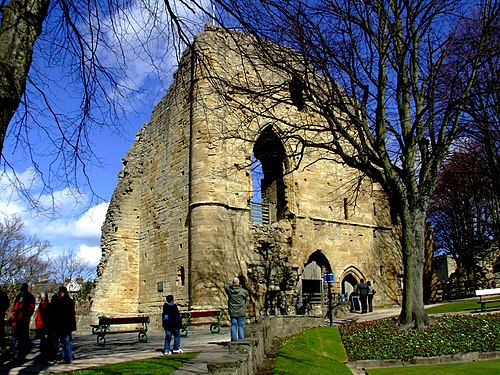
Conisbrough Castle is a medieval fortification in Conisbrough, South Yorkshire, centred on a distinctive late-12th-century stone keep. The site comprises an inner and outer bailey with surviving lengths of curtain wall and several ruined mural towers; the circular keep with six massive buttresses dominates the hill. The property is managed as a historic site and the keep was re-roofed and re-floored in the late 20th century.
First raised
1100
Its prime
1190
Today
Partial ruin
As it stood in 1190
What Conisbrough Castle looked like in its prime.
Built of pale Magnesian limestone on a rocky spur, the castle presents a low ring of ruined curtain wall and round mural towers encircling an oval inner bailey, with a much taller, cylindrical stone keep to one side. The keep rises about four storeys and is reinforced by six massive vertical buttresses that give it a lobed silhouette; narrow slit windows puncture the thick walls and a crenellated parapet tops the tower. The site sits above steep grassy banks and open valley.
Its story
The story of Conisbrough Castle.
The King's Fortress Becomes Warenne Land
William de Warenne, the first Earl of Surrey, fought in the Norman Conquest of 1066 and was rewarded by his father-in-law, William the Conqueror, with sweeping estates across Yorkshire, Norfolk and Sussex. Among them was the manor of Conisbrough, previously held by the late Saxon king Harold II, an estate of 28 townships whose name came from the Old English Cyningesburh, "the king's fortress".
William raised his castle on a rocky magnesian limestone spur about 175 feet above the river, dominating that stretch of the Don Valley: a motte, an inner bailey behind earth bank and palisades, an outer bailey and possibly a timber keep, set directly opposite the village that probably held the old Anglo-Saxon burh. Three successive Williams de Warenne held it until 1147, when the earldom passed through the heiress Isabel.
Hamelin Plantagenet and the Six-Buttressed Keep, c. 1180–1190
In 1163 Isabel de Warenne took as her second husband Hamelin Plantagenet, the illegitimate half-brother of King Henry II, who had arranged the match himself. The marriage brought Hamelin great wealth, and around 1180 to 1190 he rebuilt Conisbrough in stone. His keep (a circular central tower 62 feet across, braced by six massive solid buttresses into a hexagonal plan unique in England, 28 metres tall with walls up to 15 feet thick) has been judged one of the finest examples of late Norman defensive architecture.
Yet as a fortress it was poor: the buttresses introduced twelve vulnerable corners, and the keep had no arrow slots for its defenders. It was built to proclaim rather than to fight, a parvenu lord's statement of his new rank. King John visited in 1201, and Hamelin's son William, who inherited in 1202, was probably responsible for replacing the earthwork defences with stone curtain walls and building a stone hall and service buildings within the inner bailey.
A Kidnapped Countess and the Crown, 1304–1461
In 1304 a later John de Warenne married Joan de Barr. The marriage failed, and when John's attempt at divorce collapsed in the law courts in 1316 he blamed Thomas, Earl of Lancaster, and kidnapped Thomas's wife. Thomas retaliated by seizing Conisbrough Castle, and Edward II confirmed him as its new owner. When Thomas rebelled in 1322 he was executed, and the King took Conisbrough for himself, visiting that year and spending 40 marks repairing it alongside neighbouring Pontefract. After Edward's overthrow in 1326 the castle went back to John, who hoped to leave it to his mistress and two illegitimate sons; he outlived them all, and on his death in 1347 Conisbrough reverted to the Crown.
Edward III gave the castle to his son Edmund of Langley, Duke of York, who held it until 1402. Edmund's eldest son Edward owned it until 1415, when it passed to Maud Clifford, widow of Edmund's younger son Richard, who lived there until 1446. Richard of York inherited next; on his death in 1460 during the Wars of the Roses it went to his son Edward, whose seizure of the throne in 1461 carried Conisbrough back into royal ownership.
Collapse, Ivanhoe and the Keep Re-roofed
A royal survey of 1537–38 found the gates, bridge and stretches of wall brought down in a spectacular land slippage, with one floor of the keep fallen in; the clay of the topsoil had washed away, leaving the sandstone beneath cracked and unstable. Henry VIII gave the ruins to the Carey family, and the castle sat out the English Civil War, escaping the slighting that wrecked so many others, probably because the collapsed walls had already left it indefensible. In 1737 Thomas Osborne, Duke of Leeds, bought castle and manor for £22,500.
Sir Walter Scott passed by in 1811 and set part of Ivanhoe (1819) here, believing, like many 19th-century commentators, that the castle was Saxon; the novel's events are fictitious. The local council bought the site in the 1940s and placed it in state guardianship in 1949; excavations of 1967–69 exposed the inner bailey foundations. The keep was re-floored and re-roofed between 1993 and 1995 with European Union funding, English Heritage resumed direct management in 2008, and a £1.1 million Heritage Lottery-funded renovation begun in 2013 added a new visitor centre.
Step inside
10 places to explore in 1190.
The record describes 10 distinct spots at Conisbrough Castle, including 4 interiors: main chamber inside the keep, private chamber on the upper floor, great hall in the inner bailey and more. Create your own photoreal reconstruction and explore every one, more scenes means more rooms, more angles, and more of the place to stand in.
Build Your Own Castle
Recreate Conisbrough Castle with AI to explore it.
The artist rebuilds it as it stood in 1190, a photoreal reconstruction that belongs to you alone. Pay with coins, no subscription needed.
Recreate this castle →Defend this castle →Whose castle
Clans who held Conisbrough Castle.
The families that held Conisbrough Castle for a decade or more across its history, follow a name to its clan.
Warenne
Held by the de Warenne Earls of Surrey from the 11th century, the line continuing through Hamelin Plantagenet into the 14th.
Carey
Given the ruined castle in the 16th century.
Nearby