
England · Ruin
Corfe Castle
Corfe Castle is a medieval stone fortress on a steep hill in a gap in the Purbeck Hills, overlooking the village of Corfe on the Isle of Purbeck, Dorset. Built from Purbeck limestone with a prominent central stone keep and multiple baileys, it served as a royal fortress through the medieval period before being slighted in the 17th century and is now a preserved ruin open to the public.
First raised
1100
Its prime
1236
Today
Ruin
Ranked among Europe’s castles
As it stood in 1236
What Corfe Castle looked like in its prime.
Perched on a steep chalk hill cutting through the Purbeck Hills, the castle presents a tall, rectangular stone keep rising above an encircling stone curtain wall and inner ward; additional lower walls define a west and outer bailey that extend down the slope. Structures are built of pale Purbeck limestone; the hill is grass-covered and the roofline at its prime would show pitched roofs on halls and domestic ranges within the inner ward, with intact towers and crenellated parapets.
Its story
The story of Corfe Castle.
Edward the Martyr and William's Castle of Stone
The name comes from the Old English ceorfan, 'a cutting', for the gap that two streams eroded through a long line of chalk hills. Building the medieval castle destroyed most of the evidence for what stood on the hill before, but postholes of a Saxon hall survive, and contemporary writing shows that Anglo-Saxon nobility used the place as a residence, among them Queen Ælfthryth, wife of Edgar. That hall may be where the boy-king Edward the Martyr was assassinated in 978, possibly aged sixteen; contemporaries record that he had gone to Corfe to visit Ælfthryth and his brother.
A castle was founded here soon after the Norman conquest of 1066, in the royal forest of Purbeck where William the Conqueror liked to hunt, one of 36 he established in England between 1066 and 1087. The hill stands 55 metres high and the castle rose another 21 metres above it, holding the gap on the route between Wareham and Swanage. Unusually for the 11th century it was built partly in stone, a mark of high status at a time when the great majority of English castles were earth and timber: a stone wall enclosed the hilltop as the inner ward, while the further enclosures to west and south were ringed with timber palisades. The Domesday Book of 1086 records a single castle in Dorset, in an entry that names Wareham but is thought to mean Corfe; if so, Corfe is one of only four the survey attributes to William, the most prolific of the seven builders it names.
Henry I began a stone great tower here, its dating unsettled but placed somewhere between about 1100 and 1130. The chalk of the hill was no use as building material, so Purbeck limestone quarried a few miles away was brought in, and the work is reckoned to have risen at three to four metres a year for the best part of a decade. By the reign of Stephen Corfe was already a strong fortress with keep and inner enclosure both of stone, and in 1139, during the civil war of that reign, it withstood a siege by the King himself; the earthworks 290 metres to the south-south-west known as The Rings, the remains of a 12th-century motte-and-bailey, are taken to mark the siege castle he raised against it.
King John's Prisoners and the Pipe Rolls
Henry II's reign probably changed the castle little, and the records of Richard's show maintenance rather than new work. Under John and Henry III, by contrast, towers, halls and walls went up in quantity, and both kings had reason to keep the place strong. Both held Eleanor, rightful Duchess of Brittany and a potential threat to their crowns, in confinement at Corfe until 1222. John also kept the Scottish hostages Margaret and Isabella there, and in 1203 imprisoned Savari de Mauléon, who reputedly escaped by getting his gaolers drunk and then overpowering them.
The Pipe Rolls, the records of royal expenditure, show over £750 spent at Corfe between 1201 and 1204, probably on rebuilding the defences of the west bailey, with £275 of it going on the Gloriette in the inner bailey. The west bailey's stone wall and three towers belong to that refortification of 1202 to 1204 and resemble the bailey of Château Gaillard, built for Richard I in Normandy in 1198. Building at Corfe tracked periods of unrest: John lost Normandy to the French early in the reign, and at least £500 more went into the castle between 1212 and 1214, amid the political disturbances of his later years. Only nine of the 95 castles he spent on took more than £500; Corfe was one of them, and took over £1,400.
Whitewash, Crossbow Bolts and the Wars of the Roses
Henry III spent over £1,000 in his turn, £362 of it on the keep in 1235 and 1236, and in 1244 ordered that keep whitewashed, four years after giving the same order for the keep of the Tower of London, which is how that came to be called the White Tower. Corfe also served as a magazine: in 1224 Henry sent to the castle for 15,000 crossbow bolts to be used at the siege of Bedford Castle. The camp put up outside the walls to house the building workers outlasted the works, grew into a settlement in its own right, and was granted a market and fair by royal permission in 1247.
The castle stayed useful as a prison and worth taking as a prize. Michael de la Pole, 1st Earl of Suffolk, was held there for a few weeks in November 1386 after his impeachment by the Wonderful Parliament, and on 10 December 1450 tenants of Richard of York ransacked Corfe because it had been the chief residence of his political rival Edmund Beaufort, Duke of Somerset. In December 1460 Henry Beaufort marched an army out of the castle for the Battle of Wakefield, splitting it at Exeter so the cavalry could reach the north faster.
Lady Bankes and the Sieges of 1643 and 1645
Corfe remained a royal fortress until 1572, when Elizabeth I sold it to her Lord Chancellor, Sir Christopher Hatton, whose steward Ralph Treswell drafted the plans that remain the oldest surviving survey of it. Sir John Bankes, Attorney General to Charles I, bought the castle in 1635. War broke out in 1642 and by 1643 most of Dorset was under Parliamentarian control, with Bankes away in Oxford with the King, his men holding Corfe in the royal cause, and his wife Mary living in the castle with their children.
The Parliamentarians first tried to get inside by joining a May Day hunting party riding out from the garrison, and failed. They then gave orders that anyone joining the garrison would have their house burned and that no supplies were to reach the castle. Lady Bankes, with five defenders at the outset, got food through and built the garrison up to eighty. A besieging force of between 500 and 600 settled to a more thorough siege that ran six weeks before Royalist troops relieved her; the defenders suffered two casualties, and among the besiegers there were at least a hundred deaths.
By 1645 Corfe was one of a few strongholds in southern England still under royal control, and a force under Colonel Bingham came against it. One of the royalist garrison's own officers, Colonel Pitman, was colluding with Bingham: he proposed to Bankes that he go to Somerset and bring back a hundred royalist men as reinforcements, and returned instead with Parliamentarians in disguise, who waited inside until the besieging force attacked and then struck, so that the defenders were fighting from without and within at once. The castle was taken, and Lady Bankes and the garrison were allowed to leave.
Slighted for Poole, and the Keep Reopened
In March of that year the town of Poole petitioned Parliament to demolish the castle and to set aside the proceeds, along with any fines levied on Lady Bankes, for the "relief and Maintenance of the Soldiers and poor Inhabitants of the said Town of Poole, and other Garrisons of that County" that had held for Parliament. Parliament voted to slight it, which gave Corfe the appearance it has now, and its stone became a supply of building material for the villagers below. When the monarchy was restored in 1660 and the Bankes family recovered their property, they chose not to rebuild, putting up a new house instead at Kingston Lacy on their other Dorset estate.
Ralph Bankes, who died in 1981, bequeathed the whole Bankes estate to the National Trust: the castle, much of the village, Kingston Lacy and substantial holdings elsewhere. The keep was closed as dangerous in mid-2006 and reopened after conservation work in 2008; during that work an "appearance" door built for Henry I came to light in it, which the Trust takes as a sign that Corfe was among the most important castles in England of its day. A £2 million project completed in 2024 opened the keep, the King's Tower, to the public for the first time since its destruction.
Step inside
8 places to explore in 1236.
The record describes 8 distinct spots at Corfe Castle, including 1 interior: gloriette (inner bailey). Create your own photoreal reconstruction and explore every one, more scenes means more rooms, more angles, and more of the place to stand in.
Build Your Own Castle
Recreate Corfe Castle with AI to explore it.
The artist rebuilds it as it stood in 1236, a photoreal reconstruction that belongs to you alone. Pay with coins, no subscription needed.
Recreate this castle →Defend this castle →Whose castle
Clans who held Corfe Castle.
The families that held Corfe Castle for a decade or more across its history, follow a name to its clan.
Hatton
Sold by Elizabeth I to her Lord Chancellor, Sir Christopher Hatton, in 1572.
Bankes
Bought by Sir John Bankes in 1635 and defended by Lady Bankes in the Civil War.
From the archive
Corfe Castle on paper: the measured plan and period views.
The survey plan and photographs below are the ground truth this page's reconstructions are checked against, drawn and photographed while the castle was still a working garrison. Every image is public-domain or openly licensed, with its source named.

(Castle, Corfe Castle, England) (LOC)
ca. 1890-1900 · Photochrom Prints Collection (via Wikimedia Commons)
Public domain
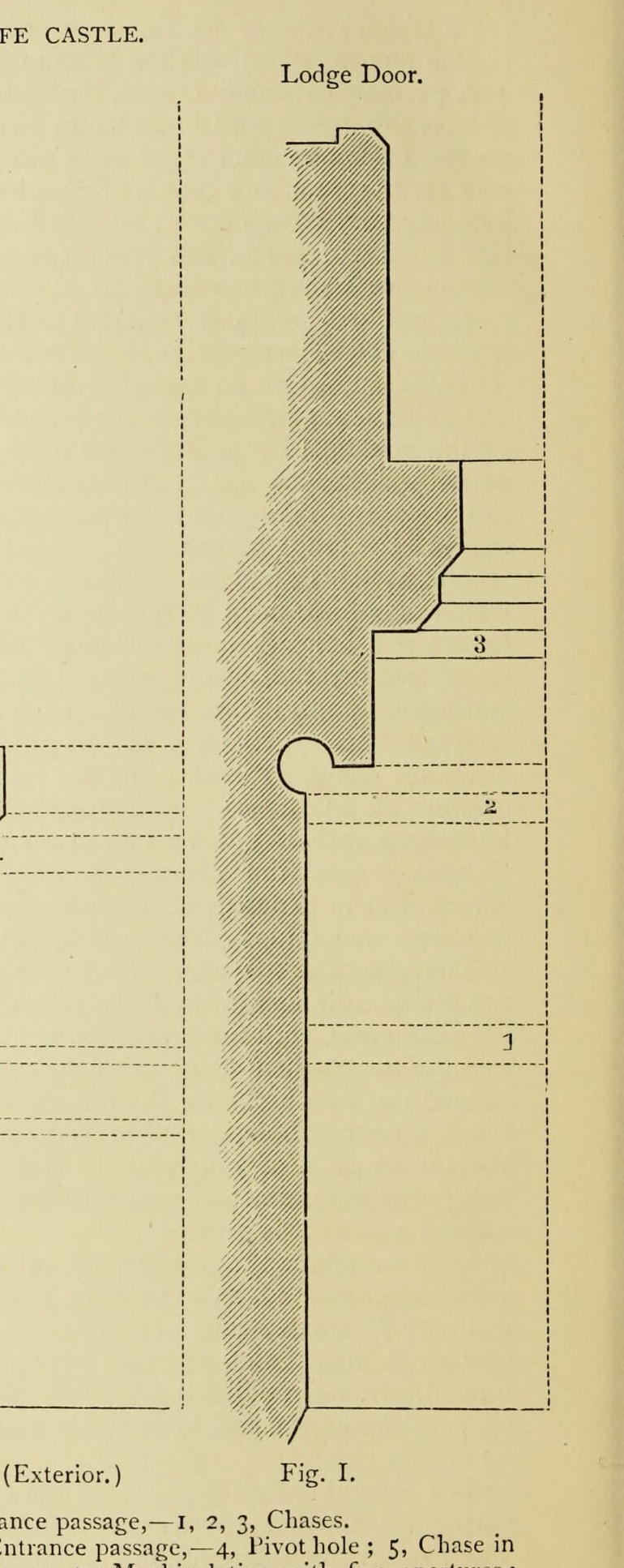
Fig. II. (Exterior.): Fig. II. Middle Gatehouse. Entrance passage, 4, Pivot hole; 5, Chase in vault; 6, Portcullis groove and chase; 7, Machicolation with five apertures; 8, Bar-hole.
1884 · G. T. Clark, Mediaeval Military Architecture, vol. 1 (1884)
Public domain
Fig. I. Fig. I. Great Gatehouse: Entrance passage, 1, 2, 3, Chases.
1884 · G. T. Clark, Mediaeval Military Architecture, vol. 1 (1884)
Public domain
Nearby


