
England · Restored
Dover Castle
Dover Castle is a large medieval fortress on a chalk promontory above the town of Dover, Kent. Its core plan, a massive Norman keep with inner and outer baileys, extensive curtain walls and a surviving Roman-era lighthouse on the cliff edge, dates to the 12th century and later additions reflect centuries of continued military use.
First raised
1179
Its prime
1188
Today
Restored
Ranked among Europe’s castles
As it stood in 1188
What Dover Castle looked like in its prime.
A massive rectangular Norman keep rises at the castle's centre, surrounded by concentric inner and outer baileys with continuous stone curtain walls punctuated by round and rectangular towers and gatehouses. The whole complex sits on a steep chalk cliff above the English Channel with grassy glacis sloping to the town. Near the cliff edge stands an octagonal Roman lighthouse tower of layered masonry. Rooflines are low; courtyards and bailey interiors are open and paved or grassy.
Its story
The story of Dover Castle.
The Roman lighthouse and William's eight days at Dover
The headland may have carried earthworks in the Iron Age or earlier, before the Roman invasion of AD 43; their layout does not match the plan of the medieval castle. Inside the later walls stands one of Dover's two Roman lighthouses, raised in the early 2nd century as a five-level, eight-sided tower of tufa, Kentish ragstone and red brick. One of only three Roman-era lighthouses left in the world, it survived by staying useful, converted into a belfry around the year 1000 and given a new upper stage around 1430.
Dover has been a chief member of the Cinque Ports since their foundation in 1050. After Hastings in October 1066 William the Conqueror reached his Westminster coronation by a roundabout road through Romney, Dover and Canterbury. William of Poitiers records the place as "reported impregnable and held by a large force", but its defenders' nerve failed: while the inhabitants prepared to surrender unconditionally, Normans "greedy for money" fired the castle and much of it burned. William paid for the repairs, then spent eight days adding fortifications of his own. In 1088 eight knights, Fulbert de Dover and Hugh Crevecoeur among them, were appointed to keep the castle under the tenure known as castle-guard.
Henry II's keep and the siege of 1216
The castle took recognisable shape under Henry II, whose reign gave it the inner and outer baileys and the great keep, begun in 1179 and built by Maurice the Engineer. Between 1179 and 1188 the king spent over £6,500 at Dover, against an annual revenue likely to have been around £10,000.
In 1216, during the First Barons' War, rebel barons invited the future Louis VIII of France to come and take the English crown. He besieged Dover twice and had some success breaching the walls, but was never able to take it; the defenders answered underground, tunnelling outwards from their own works to attack the French.
The near miss was written back into the stone: the breached north gate became an underground forward-defence complex including St John's Tower, and two new gates (Fitzwilliam's Gate and Constable's Gate) were cut through the outer curtain wall.
Henry VIII's bulwark and the keys taken in 1642
By the Tudor age gunpowder had made the medieval walls obsolete. Henry VIII made a personal visit and improved them, adding the Moat Bulwark.
During the English Civil War the castle was held for the king, then lost in 1642 without a shot being fired. Knowing it was lightly guarded, a local merchant named Richard Dawkes took ten men up the cliffs, rushed the porter's lodge, seized the keys and was inside before the garrison could be summoned.
William Twiss and the barracks under the cliff
The Napoleonic Wars brought massive rebuilding. William Twiss, Commanding Engineer of the Southern District, added the Horseshoe, Hudson's, East Arrow and East Demi-Bastions for extra gun positions on the eastern side and Constable's Bastion to cover the west, strengthened the Spur at the northern end with a redan, and took the roof off Henry II's keep, replacing it with brick vaults so heavy artillery could be mounted on top.
Dover was now a garrison town. Twiss and the Royal Engineers cut a complex of barracks tunnels about 15 metres below the cliff-top, and the first troops were accommodated in 1803. When the wars ended the tunnels were partly converted for the Coast Blockade Service's war on smuggling, but that headquarters moved shorewards in 1827 and the workings lay abandoned for more than a century.
Operation Dynamo and the tunnels below
The outbreak of the Second World War in 1939 put the tunnels back to work, first as an air-raid shelter, then as a military command centre and underground hospital. In May 1940 Admiral Sir Bertram Ramsay directed Operation Dynamo, the evacuation of British and French soldiers from Dunkirk, from his headquarters in the cliff tunnels; a statue of him stands outside them. A military telephone exchange installed in 1941 was in such constant use that a new tunnel had to be cut alongside for its batteries and chargers.
Afterwards the tunnels were earmarked as a shelter for the Regional Seats of Government in the event of nuclear attack, a plan dropped once it was accepted that the chalk of the cliffs would not stop radiation and that the form and condition of the workings were against it. Of its lettered levels, Annexe and Casemate are open to the public, Bastion is lost, and Dumpy is closed.
English Heritage owns and operates the castle, and spent £2.45 million between 2007 and 2009 recreating its interiors; 368,243 people visited in 2019. It is a scheduled monument, Grade I listed since 7 March 1974. The Lord Warden of the Cinque Ports remains officially head of the castle as Constable of Dover Castle, and the Deputy Constable lives in Constable's Gate, the gate built in answer to Louis of France.
Step inside
7 places to explore in 1188.
The record describes 7 distinct spots at Dover Castle, including 2 interiors: royal chapel within the keep, st mary in castro (saxon church). Create your own photoreal reconstruction and explore every one, more scenes means more rooms, more angles, and more of the place to stand in.
Build Your Own Castle
Recreate Dover Castle with AI to explore it.
The artist rebuilds it as it stood in 1188, a photoreal reconstruction that belongs to you alone. Pay with coins, no subscription needed.
Recreate this castle →Defend this castle →From the archive
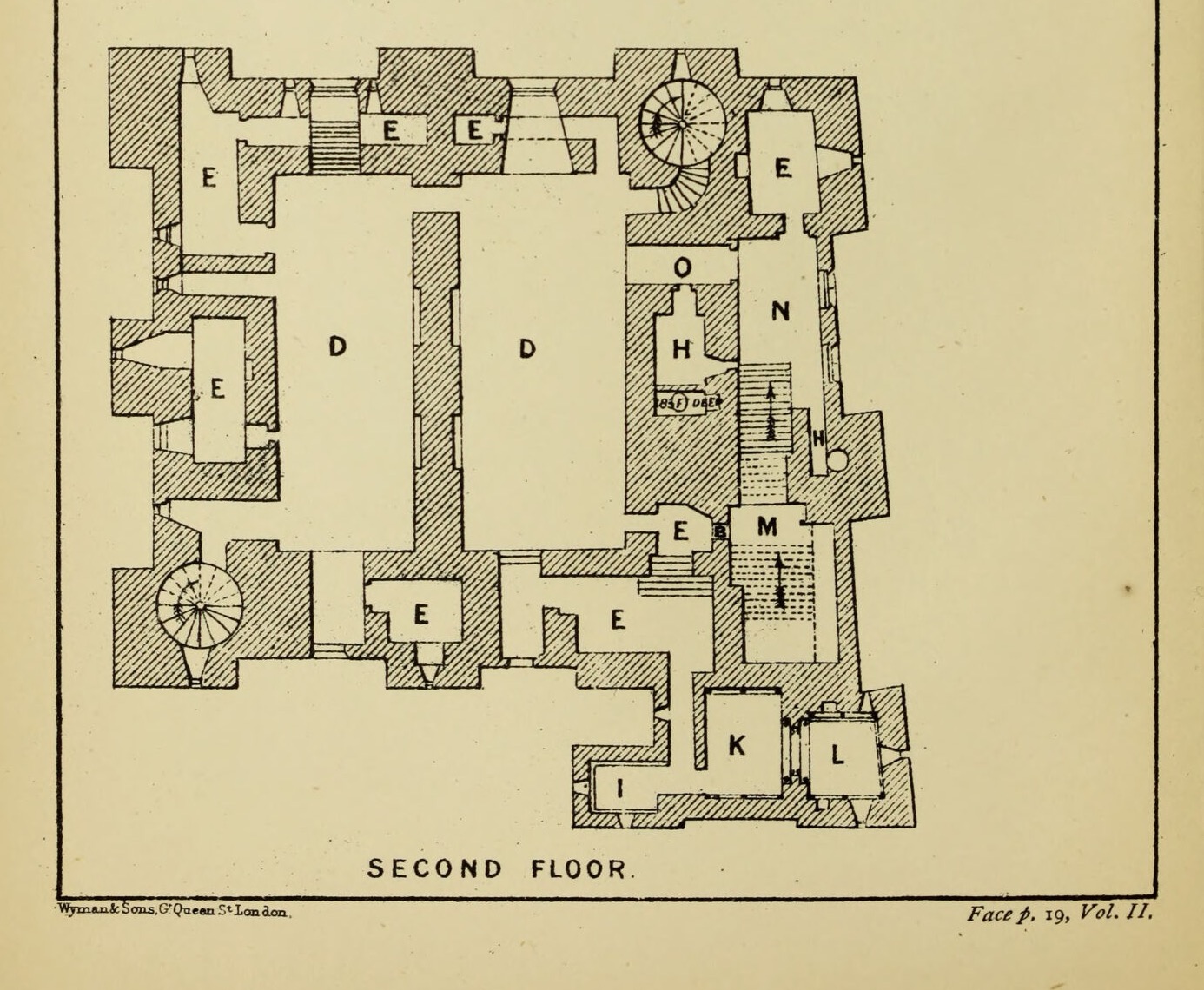
Dover Castle on paper: the measured plan and period views.
The survey plan and photographs below are the ground truth this page's reconstructions are checked against, drawn and photographed while the castle was still a working garrison. Every image is public-domain or openly licensed, with its source named.
DOVER KEEP. (label at right) ; SECOND FLOOR GALLERY. (label under plan)
1884 · G. T. Clark, Mediaeval Military Architecture, vol. 2 (1884)
Public domain
SECOND FLOOR. (label under plan)
1884 · G. T. Clark, Mediaeval Military Architecture, vol. 2 (1884)
Public domain
Nearby


