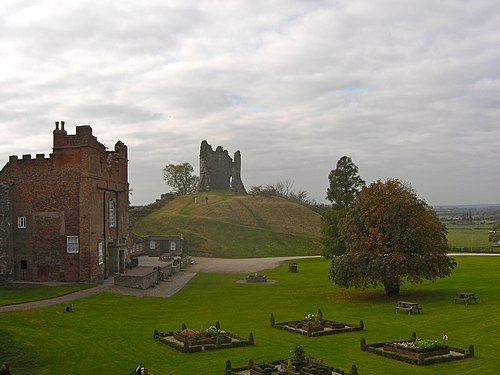
England · Ruin
Dunstanburgh Castle
Dunstanburgh Castle is a 14th-century fortress on a coastal promontory in Northumberland, England, built for Thomas, 2nd Earl of Lancaster and later expanded by John of Gaunt. The site occupies a headland defended by sea cliffs and long stone curtain walls; today the structure survives as large ruinous masonry and is protected as a historic monument.
First raised
1313
Its prime
1384
Today
Ruin
As it stood in 1384
What Dunstanburgh Castle looked like in its prime.
A massive three-storey Great Gatehouse with a wide central pointed entrance arch dominates the western approach, flanked by tall, partly collapsed cylindrical towers; a long low stone curtain wall extends east with rectangular towers set along its length. The castle perches on a grassy coastal headland above the Northumberland shore; the stone is pale-brown weathered masonry, much of the roof and upperwork is gone, leaving ruinous stacks, exposed wall-walks and large window and arrow-slit voids. Artificial meres occupied the enclosed low ground.
Its story
The story of Dunstanburgh Castle.
Thomas of Lancaster's Fortress Against the King, 1313–1322
Dunstanburgh was begun in 1313 by Thomas, 2nd Earl of Lancaster, the second richest man in England after the king, and a ringleader in the killing of Edward II's favourite Piers Gaveston the year before. The castle rose on a prominent Northumberland headland, over the earthworks of an Iron Age fort. Thomas probably intended a secure retreat at a safe distance from Edward's forces in the south, and a statement of wealth challenging the king's own, its Lilburn Tower positioned to be provocatively visible from royal Bamburgh nine miles up the coast. Thomas, who used the pseudonym "King Arthur" in his correspondence with the Scots, may even have meant the water-ringed fortress as an allusion to Camelot.
The work was overseen by Master Elias, a mason who had worked on Conwy Castle; £184 had been spent by the end of the first year, and Edward II issued a licence to crenellate in 1316. By 1322 the castle was probably complete: a curtain wall enclosing 9.96 acres, the largest castle in Northumberland, with six towers, a harbour, and a massive three-storey Great Gatehouse.
Boroughbridge and the King's Garrison, 1322–1326
Thomas may have visited it only once, in 1319. When civil war broke out in 1321, he fled the south for Dunstanburgh but was intercepted by Sir Andrew Harclay at the Battle of Boroughbridge in 1322, captured, and executed. The castle passed to the Crown, which found it useful against the Scots: garrisoned with 40 men-at-arms and 40 light horsemen, its men fought at the Battle of Old Byland in 1322, and the garrison was raised to 130. By 1326 it had been returned to Thomas's brother Henry, 3rd Earl of Lancaster.
John of Gaunt Turns the Gatehouse into a Keep, 1380–1384
John of Gaunt, 1st Duke of Lancaster, acquired Dunstanburgh in 1362 through his marriage to Blanche, granddaughter of Henry of Lancaster. The Peasants' Revolt of 1381 exposed the castle's limits: hated by the rebels and stranded in the north, Gaunt judged Dunstanburgh insufficiently secure to shelter in and turned instead to Alnwick, which refused to let him in. Over the next two years his constable Thomas of Ilderton and the mason Henry of Holme expanded the defences, blocking the entrance of the Great Gatehouse to turn it into a keep and adding a new gatehouse beside it. In 1384 a Scottish army attacked but, lacking siege equipment, could not take the walls. When Gaunt's son took the throne as Henry IV in 1399, the castle passed with the Duchy of Lancaster to the Crown.
Changing Hands in the Wars of the Roses, 1461–1464
Dunstanburgh formed part of a chain of fortifications guarding the eastern route into Scotland, and in the Wars of the Roses it was held for Lancaster; its constable Sir Ralph Babthorpe died fighting for Henry VI at St Albans in 1455. Sir Ralph Percy, one of the joint constables, held out until September 1461, when he surrendered the castle to the Yorkists, then declared for Lancaster again after Margaret of Anjou landed at Bamburgh with a French army in 1462. A Yorkist army under the Earl of Warwick besieged the castle that November and took its surrender at Christmas; left in charge as a gesture of reconciliation, Percy changed sides once more. He died at Hedgeley Moor in 1464, and Warwick reoccupied Dunstanburgh that June after a short siege.
The castle never recovered. Its roof was robbed of lead by the 1520s, by 1538 a royal report called it "a very ruinous house and of small strength", and in 1550 the Warden of the Marches, Sir Robert Bowes, found it "in wonderfull great decaye". A 1584 report judged it too far from the border to be worth the £1,000 of repairs; local farmers paid six pence a year to shelter cattle in the outer bailey during Scottish raids.
Sold by the Crown, Painted by Turner, Manned Against Invasion
After the union of the crowns in 1603, James I sold the castle in 1604; within a year it passed to Sir Ralph Grey, a nearby landowner, and it descended through the Greys and their heirs the Earls of Tankerville until 1869. The ruin drew artists: Thomas Girtin painted it amid wild waves, and J. M. W. Turner painted it repeatedly from 1797 into the 1830s, making it one of the most common subjects in his work.
Sir Arthur Sutherland, a shipowner who bought the estate in 1919, could not sustain the castle's upkeep and placed it in state guardianship in 1930. In 1940, with German invasion feared, the headland was fortified once more: Royal Armoured Corps observers occupied the castle itself, while barbed wire, trenches, pillboxes, an anti-tank ditch and a minefield were laid across the beaches and approaches around it. Sutherland's son passed the estate to the National Trust in 1961, and the castle is run today by English Heritage.
Step inside
9 places to explore in 1384.
The record describes 9 distinct spots at Dunstanburgh Castle, including 2 interiors: great gatehouse passage (interior), inner ward and ruined domestic ranges. Create your own photoreal reconstruction and explore every one, more scenes means more rooms, more angles, and more of the place to stand in.
Build Your Own Castle
Recreate Dunstanburgh Castle with AI to explore it.
The artist rebuilds it as it stood in 1384, a photoreal reconstruction that belongs to you alone. Pay with coins, no subscription needed.
Recreate this castle →Defend this castle →Whose castle
Clans who held Dunstanburgh Castle.
The families that held Dunstanburgh Castle for a decade or more across its history, follow a name to its clan.
Lancaster
Built by Thomas, 2nd Earl of Lancaster, 1313–22; expanded by John of Gaunt, 1st Duke of Lancaster, in the 1380s.
Owned by the Grey family for several centuries after James I sold the castle in 1604.
From the archive
Dunstanburgh Castle on paper: the measured plan and period views.
The survey plan and photographs below are the ground truth this page's reconstructions are checked against, drawn and photographed while the castle was still a working garrison. Every image is public-domain or openly licensed, with its source named.
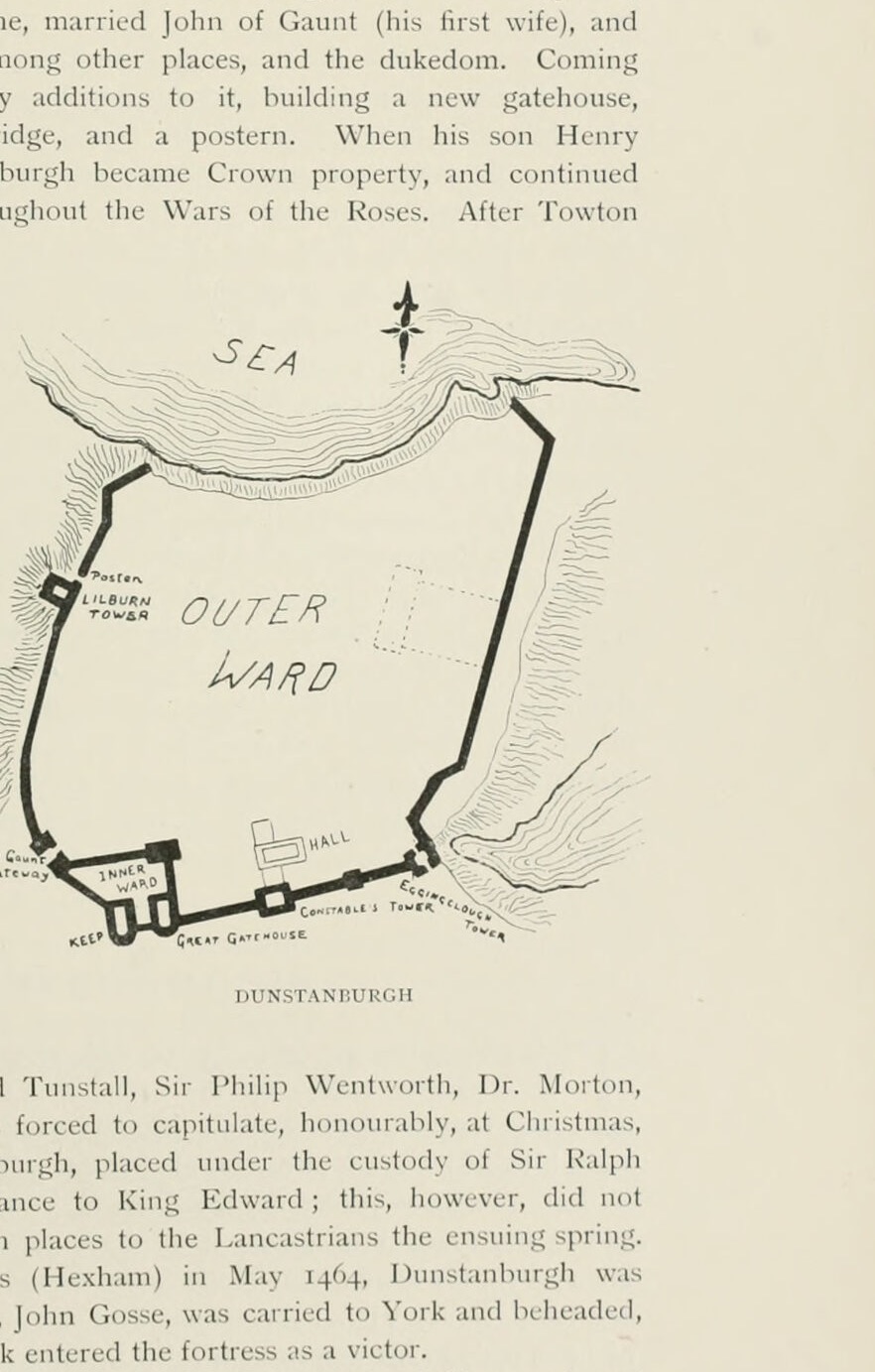
DUNSTANBURGH
1897 · J. D. Mackenzie, The Castles of England, vol. 2 (1897)
Public domain