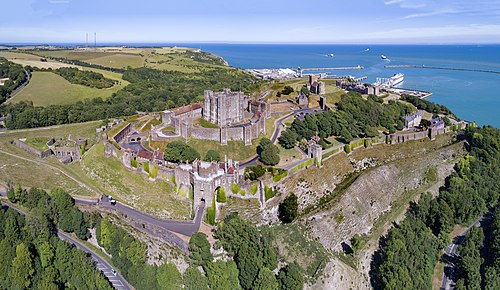
England · Ruin
Fotheringhay Castle
Fotheringhay Castle was a Norman motte-and-bailey fortress on the northern bank of the River Nene in Northamptonshire, England, founded around 1100. In its prime it consisted of a large water-encircled motte topped by a polygonal stone keep, with inner and outer baileys containing a great hall, chapel and domestic ranges. The castle was dismantled in the 17th century and today survives only as earthworks and occasional masonry remains.
Its prime
1452
Today
Ruin
As it stood in 1452
What Fotheringhay Castle looked like in its prime.
A very large, flat-topped motte rises about 7 m above the surrounding ground, its base some 70 m across, historically ringed by a water-filled moat; atop the motte sits a polygonal stone keep. To the south and east are concentric baileys: an inner rectangular bailey with ranges including a great hall and small chapel, and an outer bailey protected by stone curtain walls and a gatehouse reached by a bridge across the moat. The stone is weathered grey and the castle crowns the Nene valley.
Its story
The story of Fotheringhay Castle.
Simon de Senlis's Motte by the Nene, c.1100
William the Conqueror granted this stretch of Northamptonshire to Judith of Lens, wife of Waltheof, Earl of Northumbria, and their eldest daughter Maud inherited the lordship of Fotheringhay. Around 1090 Maud married Simon de Senlis, and about 1100 he raised a motte-and-bailey castle on the northern bank of the River Nene. Simon was dead by 1113, when Henry I arranged Maud's marriage to Prince David of Scotland; through his wife David, later King of Scots, took Fotheringhay along with other properties in Huntingdonshire, and the castle descended with the Scottish princes for the next century.
King John's Hostage Demand and Albemarle's Raid, 1212–1221
Shortly after his excommunication King John began demanding hostages from his barons as surety for their loyalty, and in 1212 he used that leverage against David, Earl of Huntingdon and Prince of Scotland. "You have given us your son as a hostage," John wrote, "therefore we require you to yield to us your castle at Fotheringhay", the castle's first documented mention. The confiscations of these years proved so unpopular that John began reversing them in 1215, and Fotheringhay was among the castles handed back. David then rebelled, and his property went to William Marshal, 2nd Earl of Pembroke, who was ordered to return the earl's estates in 1218 but held on to Fotheringhay, and still had it when David died in June 1219. Henry III wanted it back (his sister Joan was to carry the castle to Alexander II of Scotland in her dowry), and Marshal gave it up on 3 December 1219.
William II de Forz, 3rd Earl of Albemarle, rose against Henry III late in 1220 and in January the following year seized Fotheringhay and installed his own garrison. A royal letter accused him of taking the castle "furtively and seditiously ... devastating and plundering our land and violently disturbing and infringing our peace and that of our kingdom". He struck at several other castles that same month, and Fotheringhay was his only success; with a royal army massing he fled north, and Henry III recovered both Fotheringhay and Castle Bytham. According to the Barnwell chronicler, custody passed in 1221 to Hubert de Burgh, 1st Earl of Kent, on his marriage to the Scottish king's sister; for all Joan's dowry, the castle never passed into Scottish hands. It stayed in royal hands until the reign of Edward II, but for the year from 1264 to 1265 when Robert de Ferrers, 6th Earl of Derby, held it and Chester Castle during the Second Barons' War.
Principal Seat of the House of York, 1385–1482
Edward II granted the castle to John of Brittany, Earl of Richmond, and on his death in 1334 it passed to his niece Marie de St Pol, the widowed Countess of Pembroke. She died in 1377, Edward III made the property over to his son Edmund Langley, and Langley, created Duke of York in 1385, took Fotheringhay as his principal seat and, as John Leland recorded in 1540, spent a great deal on it. He died in 1402, his eldest son Edward died without children of his own in 1415, and the castle went to his nephew Richard.
Richard, Duke of York, and Cecily Neville had two sons who became kings, Edward IV and Richard III; the younger was born at Fotheringhay in 1452. On 27 March 1454 the duke was named "protector and defender of the realm" during Henry VI's mental illness, holding the office until 9 February 1455, and he was killed at the Battle of Wakefield in 1460 in the wars between York and Lancaster. The family kept the house afterwards: Cecily entertained there, Edward IV's queen Elizabeth Woodville stayed in 1469, and on 11 June 1482 the Scottish prince Alexander Stewart, Duke of Albany, sealed a treaty at Fotheringhay with Edward IV to supplant his own brother on the throne of Scotland.
The Trial in the Great Hall, 1586–87
Fotheringhay and nearby Collyweston Palace were repaired in 1566 for Elizabeth I, who came to the castle on 22 July that year. Twenty years on it was serving as a state prison. Mary, Queen of Scots had spent much of her eighteen years of captivity at Sheffield Castle and Sheffield Manor before she was brought here for the end of it. She attended her own trial in the great hall in October 1586; it ran two days and convicted her of treason. She then waited more than two months for Elizabeth to sign the death warrant, and was told the sentence would be carried out only the day before it was. She spent her last night praying in the castle's small chapel, and was beheaded on a scaffold in the Great Hall on 8 February 1587.
Ruinous by 1635, and Carried Away
The castle was left to decay through the later Elizabethan years. By 1635, less than fifty years after the execution, it was reported to be in a ruinous state, and it was demolished outright soon afterwards, most of the masonry carried away. What survived the clearance was the ground itself (the motte, 70 metres across at the base and some 7 metres high, and the rectangular inner bailey of roughly 50 by 65 metres) protected as a scheduled monument on 9 October 1981.
The name outlived the building. Gaetano Donizetti set three scenes of his 1835 opera Maria Stuarda at Fotheringhay, and Sandy Denny wrote "Fotheringay", about Mary's imprisonment, for her first album with Fairport Convention in 1969; the band she formed after leaving them took the castle's name as its own.
Step inside
9 places to explore in 1452.
The record describes 9 distinct spots at Fotheringhay Castle, including 2 interiors: great hall interior, small chapel interior. Create your own photoreal reconstruction and explore every one, more scenes means more rooms, more angles, and more of the place to stand in.
Build Your Own Castle
Recreate Fotheringhay Castle with AI to explore it.
The artist rebuilds it as it stood in 1452, a photoreal reconstruction that belongs to you alone. Pay with coins, no subscription needed.
Recreate this castle →Defend this castle →Whose castle
Clans who held Fotheringhay Castle.
The families that held Fotheringhay Castle for a decade or more across its history, follow a name to its clan.
de Senlis
Founded around 1100 by Simon de Senlis, Earl of Northampton.
York
A favoured residence of the Dukes of York; Richard III was born here in 1452.
From the archive
Fotheringhay Castle on paper: the measured plan and period views.
The survey plan and photographs below are the ground truth this page's reconstructions are checked against, drawn and photographed while the castle was still a working garrison. Every image is public-domain or openly licensed, with its source named.
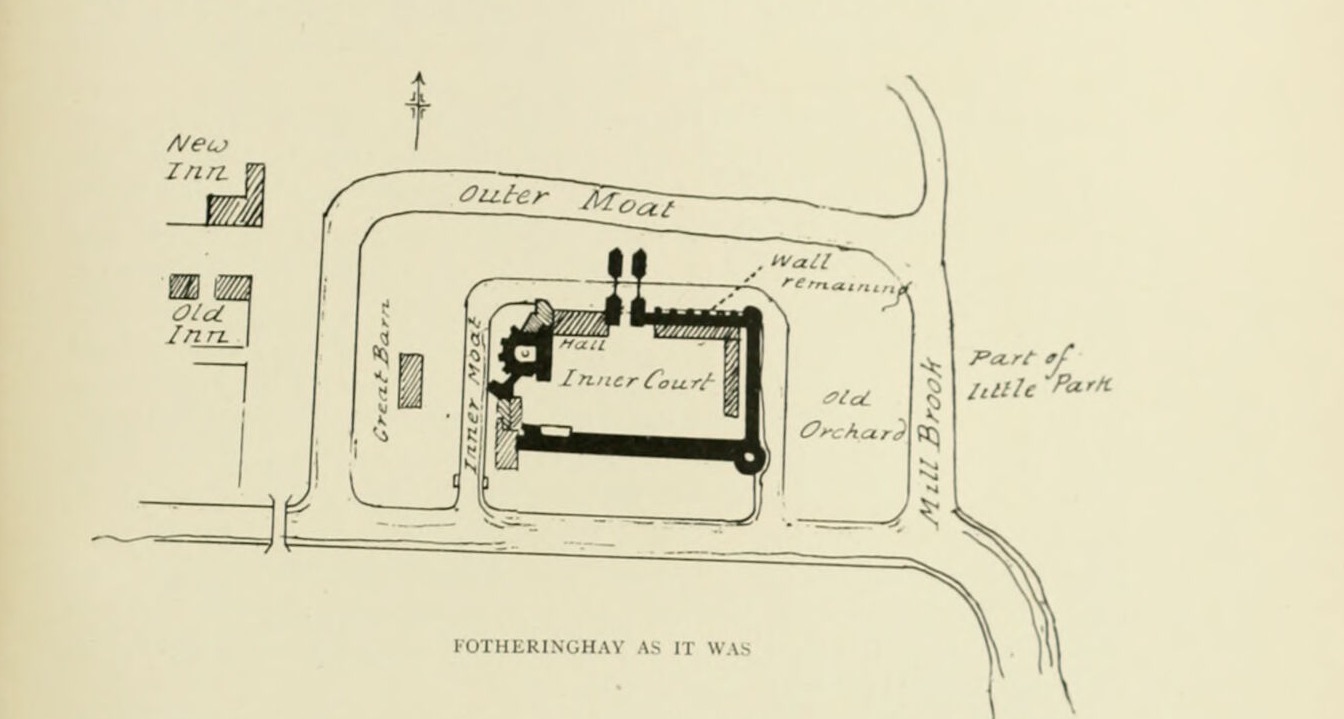
FOTHERINGHAY AS IT WAS
1897 · J. D. Mackenzie, The Castles of England, vol. 1 (1897)
Public domain
Nearby