
England · Partial ruin
Framlingham Castle
Framlingham Castle is a medieval curtain-walled castle in Framlingham, Suffolk, notable for its lack of a central keep and its ring of mural towers. The surviving stone curtain and towers enclose an Inner Court, with an adjacent Lower Court and larger timber-defended Bailey; artificial meres and extensive parkland lie beside it. The site is today an English Heritage property and a protected scheduled monument.
Its prime
1500
Today
Partial ruin
Ranked among Europe’s castles
As it stood in 1500
What Framlingham Castle looked like in its prime.
A broad, high stone curtain wall pierced by a sequence of tall, rectangular mural towers forms a continuous defended rectangle with no central keep; crenellated parapets and arrow slits punctuate the wall. The castle sits on a raised grassy mound with water of a mere in the foreground reflecting the pale-buff stone. Tower profiles are blocky and vertical, rooflines low or absent, and the outer face shows coursed medieval masonry with occasional brick repair bands.
Its story
The story of Framlingham Castle.
Hugh Bigod, the Revolt of 1173 and the King's Engineer
Framlingham grew after the Norman Conquest into a town of at least 600 people, its lands held by Roger Bigod, Sheriff of Suffolk. A ringwork or motte-and-bailey castle stood here by the early 12th century; the first written mention is in 1148. By the late 12th century the Bigods dominated Suffolk, holding Bungay, Walton and Thetford as well.
Henry II, set on breaking that dominance, confiscated all four Bigod castles from Hugh Bigod in 1157 and returned Framlingham and Bungay in 1165 only on payment of a fine of £666. When Hugh joined the revolt of the King's sons in 1173 and it failed, Henry ordered his castles destroyed. The royal engineer Alnoth threw down the fortifications and filled in the moat between 1174 and 1176 at a cost of £16 11s 12d. It was one of at least twenty rebel castles slighted after the war.
Thirteen Towers, and King John Before Them in 1216
Hugh's son Roger was denied the family earldom and estates until Richard I came to the throne in 1189. He then built a new castle here, complete by 1213. It had no central keep, a break with Anglo-Norman practice, relying instead on a curtain wall of local flint and septaria ringed by thirteen open-backed mural towers, its garrison found by local lords holding land under a castle-guard system.
The First Barons' War began in 1215, and Roger, who had quarrelled with King John over military levies, was among his chief opponents. John's army reached Framlingham on 12 March 1216 and the King himself the following day. With his permission, messages went from the castle on the 14th to Roger, who, mindful of the fate of Rochester Castle the previous year, authorised the garrison (26 knights, 20 sergeants, 7 crossbowmen and a priest) to surrender without a fight; the episode is elsewhere recorded as a castle taken after a short siege. John moved on into Essex, and Roger appears to have regained the castle.
Mowbray Ale and Howard Brick
Framlingham passed to the Crown in 1306 on the death of Roger Bigod, the 5th Earl, who had led the baronial opposition to Edward I's taxes and been forced to promise the King his lands. It came in time to the Mowbrays, whose main seat it seems to have been for most of the 15th century. As many as 83 people lived there; over twelve months in 1385–6 the household spent more than £1,000, including 28,567 gallons of ale and 70,321 loaves of bread.
In 1476 the castle passed to John Howard, Duke of Norfolk, and the Howards modernised it in fashionable brick, with ornamental chimneys and their arms on the gatehouse. John Howard was killed fighting for the Yorkists at Bosworth in 1485; his son Thomas was attainted and held in the Tower. Thomas regained Henry VIII's favour by fighting at Flodden in 1513, recovered the castle and retired there, decorating his table with plate seized from the Scots.
Mary Gathers Her Forces, 19 July 1553
The 3rd Duke, another Thomas, preferred Kenninghall and was attainted in 1547 on misplaced fears that the Howards aspired to the throne. Henry VIII died the day before the Duke was due to be executed; Edward VI kept him in the Tower and gave Framlingham to Mary. Contesting the throne against Lady Jane Grey, Mary collected her forces at the castle before marching successfully on London, and was proclaimed Queen of England here on 19 July 1553.
The 4th Duke was executed for treason by Elizabeth I in 1572 and the castle returned to the Crown. A survey in 1589 found stone, timber and brickwork in urgent need of repair. From 1580 it held prisoners again: by 1600 there were 40, Roman Catholic priests and recusants.
The Red House and the Poorhouse, 1635–1839
Derelict by the time James I returned it to the Howards in 1613, the castle was sold with its estate and the Great Park by the debt-ridden Theophilus Howard to Sir Robert Hitcham in 1635 for £14,000. Hitcham died the following year and left them to Pembroke College, Cambridge, on condition that the college destroy the buildings inside the castle and construct a workhouse there under the Poor Relief Act 1601.
Litigation delayed work until the late 1650s, by which time the interior was being broken up for its stone. The Red House, the workhouse raised in the Inner Court, was mismanaged, closed and became a public house. A second attempt in 1699 destroyed the Great Chamber; a third in 1729 pulled down the Great Hall for the poorhouse built on its site. After the Poor Law reform of 1834 the poorhouse closed by 1839, its inhabitants moved to Wickham Market.
It served as an isolation ward in the plague of 1666, later as a drill hall and county court, and in 1913 Pembroke College placed it in the guardianship of the Commissioner of Works.
Step inside
10 places to explore in 1500.
The record describes 10 distinct spots at Framlingham Castle, including 3 interiors: inner court, prison tower interior, great hall frontage. Create your own photoreal reconstruction and explore every one, more scenes means more rooms, more angles, and more of the place to stand in.
Build Your Own Castle
Recreate Framlingham Castle with AI to explore it.
The artist rebuilds it as it stood in 1500, a photoreal reconstruction that belongs to you alone. Pay with coins, no subscription needed.
Recreate this castle →Defend this castle →From the archive
Framlingham Castle on paper: the measured plan and period views.
The survey plan and photographs below are the ground truth this page's reconstructions are checked against, drawn and photographed while the castle was still a working garrison. Every image is public-domain or openly licensed, with its source named.
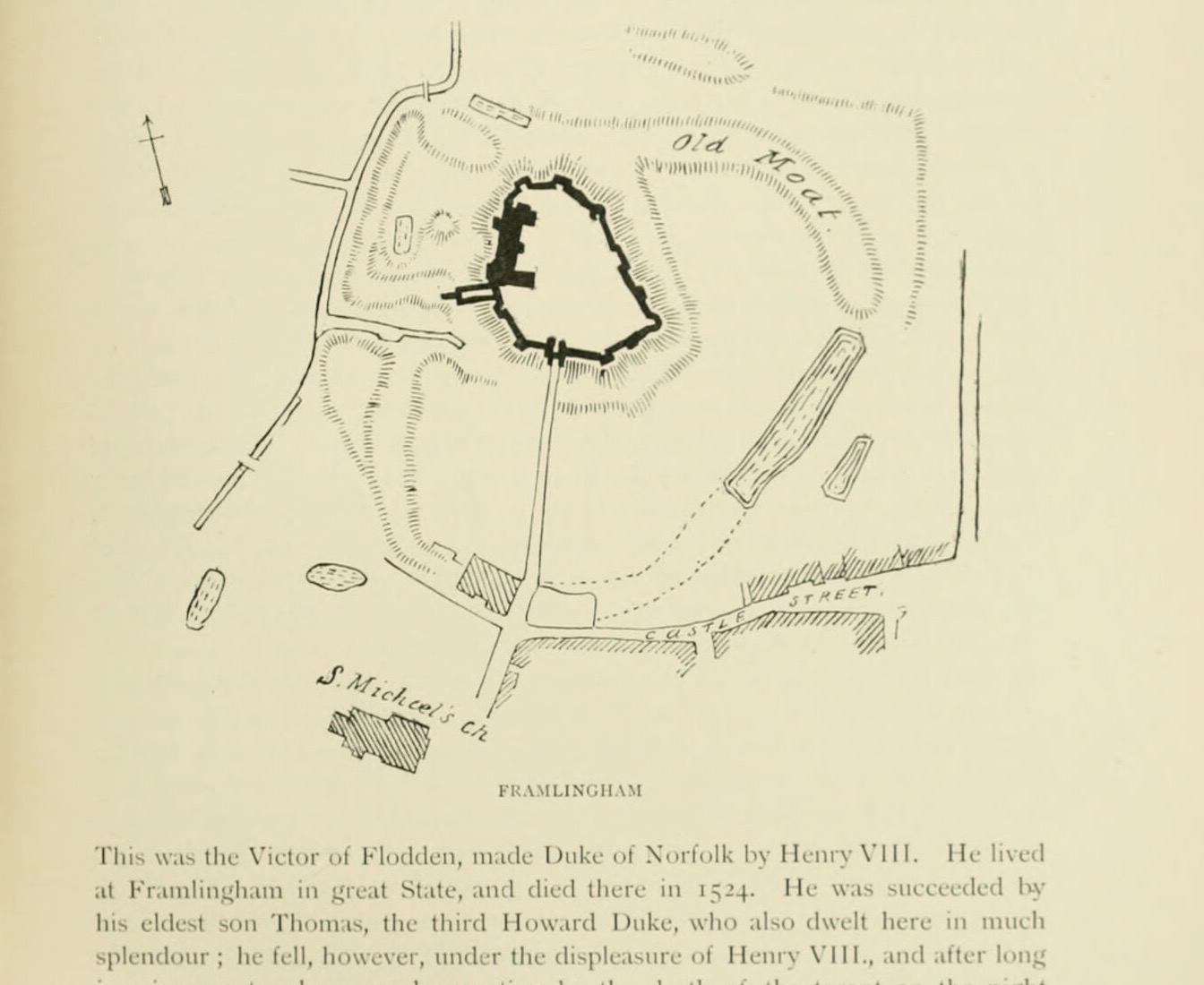
FRAMLINGHAM
1897 · J. D. Mackenzie, The Castles of England, vol. 1 (1897)
Public domain
Nearby


