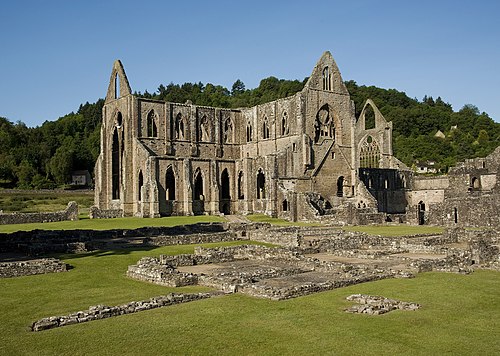
England · Ruin
Goodrich Castle
Goodrich Castle is a medieval Norman castle on a sandstone outcrop above the River Wye in Herefordshire, England. Originating with an early 12th-century square keep, it was expanded in the late 13th century into a concentric fortress combining strong round towers, an asymmetrical gatehouse and domestic ranges; it was later slighted in the 17th century and now survives as a ruin under English Heritage.
First raised
1001
Its prime
1300
Today
Ruin
As it stood in 1300
What Goodrich Castle looked like in its prime.
At its prime Goodrich presented a compact, essentially square curtain enclosing an earlier light-grey, square Norman keep at the heart and defended by three large, darker sandstone round towers with characteristic angular spurs where square-based pyramids meet the circular tower bases. The fourth corner is occupied by an asymmetrical gatehouse with two unequal towers, a stone causeway and a projecting barbican. The whole complex sits on a high reddish-brown sandstone rock outcrop overlooking the River Wye, with continuous curtain walls pierced by windows and arrow slits.
Its story
The story of Goodrich Castle.
Godric's Castle and the Anarchy
Goodrich appears to have existed by 1101, when it was known as Godric's Castle, named, probably, after Godric of Mappestone, an Anglo-Saxon thane recorded in the Domesday Book of 1086. His earth and timber fortification commanded a crossing of the Wye on the old Roman road from Gloucester into Wales; though Goodrich lay on the English side of the Marches, the threat of Welsh raids ran through most of the medieval period.
In the mid-12th century the timber castle was replaced with a tall, small square keep of grey sandstone, later nicknamed "Macbeth's Tower". Who built it is uncertain; the work may date anywhere between 1120 and 1176. By the 1120s the castle had passed from Godric to William Fitz Baderon, thought to be his son-in-law, then to Baderon of Monmouth, who is recorded seizing Goodrich during the fighting between Stephen and the Empress Matilda. It then came to Gilbert de Clare and his son Richard "Strongbow", until Henry II took it into royal hands in 1154 over the family's support for Stephen.
William Marshal's Border Fortress, 1203–1245
In 1203 King John granted Goodrich to William Marshal, Earl of Pembroke, in part-compensation for estates lost in France. Marshal, a knight famed as a heroic warrior, ringed the old keep with a towered stone curtain wall; in 1216 he left Henry III's coronation feast at Gloucester to hurry back and reinforce Goodrich against Welsh attack.
Marshal's sons held the castle after him, not always loyally. His second son Richard led the baronial opposition to Henry III and allied with the Welsh, prompting the king to besiege and retake Goodrich in 1233. Walter Marshal recovered it, but died in 1245.
The Valence Rebuilding, 1280s–1324
In 1247 the castle passed by marriage to William de Valence, half-brother of Henry III, through the Marshal heiress Joan de Munchensi. With Llywelyn ap Gruffudd's raids sharpening the danger in the Wye valley, Valence demolished Marshal's work from the 1280s and built a concentric castle around the Norman keep, similar in design to his nephew Edward I's castles in north Wales and a rarity in England. Three great spur-based towers guarded against undermining, and his son Aymer added an outer barbican before his death in 1324, inspired by the Tower of London's and possibly built by the same workmen. The result (a fortress made a great dwelling without weakening its defences) influenced the later conversion at Berkeley.
A Kidnapped Heiress and the Talbots
Aymer's niece Elizabeth de Comyn inherited next. Hugh Despenser the Younger, Edward II's favourite, kidnapped her in London, imprisoned her in her own castle at Goodrich, and under threat of death forced her to sign it over in April 1325. Her husband Richard Talbot seized the castle back in 1326, shortly before Queen Isabella deposed the Despensers and the king; they regained legal title the following year.
Goodrich remained the Talbots' favourite home for generations. Gilbert Talbot fought back the Welsh advance when Owain Glyndŵr's forces invaded the area in 1404 and 1405. The family became Earls of Shrewsbury in 1442; John Talbot died in the Lancastrian defeat at Northampton in 1460 and the castle was forfeited, though his son regained it before 1473. After Gilbert Talbot died without a male heir in 1616 it passed to the Greys, Earls of Kent.
Roaring Meg and the Siege of 1646
In the Civil War the Earl of Stamford garrisoned Goodrich for Parliament until December 1643, when Royalist pressure forced his withdrawal; Sir Henry Lingen's garrison of 200 men then raided Parliamentary forces from defences still essentially medieval. In March 1646 Colonel John Birch burned the stables in a night attack, and in June laid siege in earnest. His attacks broke the pipe carrying water into the castle, and in a local forge he built the mortar "Roaring Meg", firing gunpowder-filled shells of 85–90 kilograms. When Lingen counter-mined beneath Parliament's tunnel under the north-west tower, Birch brought the mortar forward by night and collapsed the tower onto the counter-mine. Down to four barrels of powder and thirty of beer, the garrison surrendered: marching out, tradition says, to "Sir Henry Lingen's Fancy".
The castle was slighted the next year; the Countess of Kent took £1,000 in damages rather than rebuild. Goodrich became a celebrated "picturesque" ruin: Wordsworth, who first visited in 1793 and called it the "noblest ruin in Herefordshire", drew his 1798 poem "We are Seven" from an encounter with a girl in the ruins. Granted to the Commissioners of Works in 1920, the ruin is now in English Heritage's care, and Roaring Meg has been returned to the site.
Step inside
12 places to explore in 1300.
The record describes 12 distinct spots at Goodrich Castle, including 5 interiors: keep single-floor chamber, great hall overlooking the river, gatehouse chapel and more. Create your own photoreal reconstruction and explore every one, more scenes means more rooms, more angles, and more of the place to stand in.
Build Your Own Castle
Recreate Goodrich Castle with AI to explore it.
The artist rebuilds it as it stood in 1300, a photoreal reconstruction that belongs to you alone. Pay with coins, no subscription needed.
Recreate this castle →Defend this castle →Whose castle
Clans who held Goodrich Castle.
The families that held Goodrich Castle for a decade or more across its history, follow a name to its clan.
Talbot
Seat of the powerful Talbot family until it fell out of favour as a residence in late Tudor times.
From the archive
Goodrich Castle on paper: the measured plan and period views.
The survey plan and photographs below are the ground truth this page's reconstructions are checked against, drawn and photographed while the castle was still a working garrison. Every image is public-domain or openly licensed, with its source named.
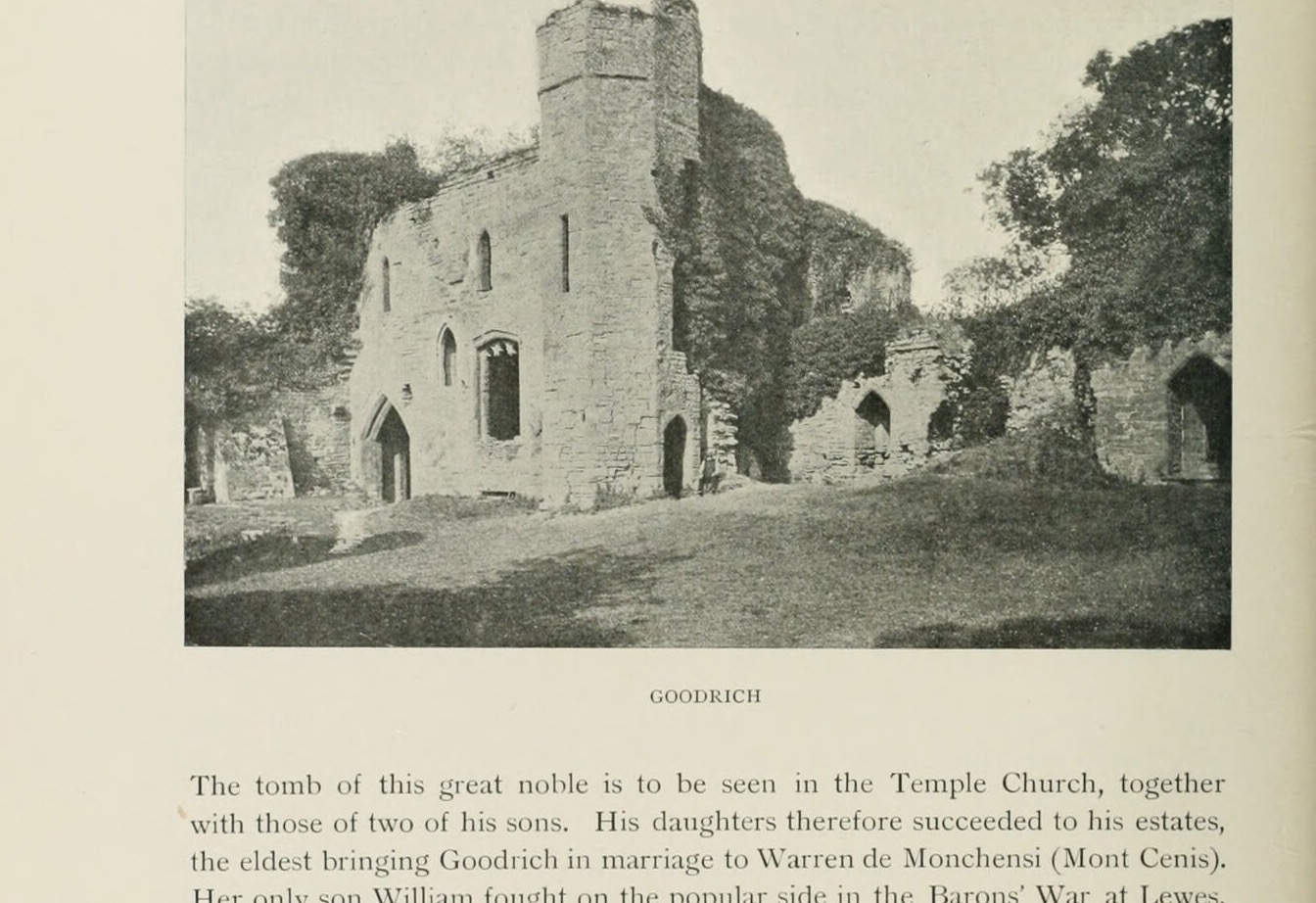
GOODRICH
1897 · J. D. Mackenzie, The Castles of England, vol. 2 (1897)
Public domain
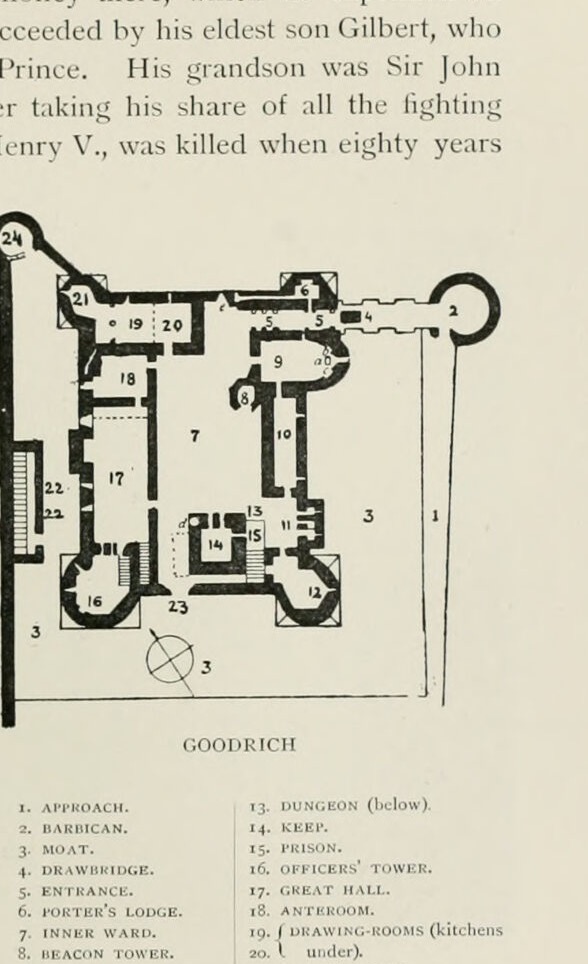
GOODRICH
1897 · J. D. Mackenzie, The Castles of England, vol. 2 (1897)
Public domain
Nearby