England · Partial ruin
Halton Castle
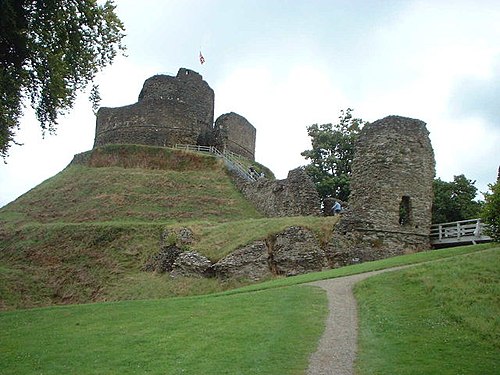
Halton Castle is a medieval sandstone castle on the summit of Halton Hill in Runcorn, Cheshire. Built as a 13th‑century stone replacement for an earlier motte‑and‑bailey, its curtain walls and ranges later fell into ruin while a courthouse was inserted on the site of the medieval gatehouse; the castle remains a scheduled monument and Grade I listed building.
First raised
1001
Its prime
1323
Today
Partial ruin
As it stood in 1323
What Halton Castle looked like in its prime.
A compact sandstone castle crowning a steep, exposed sandstone hill; an encircling curtain wall follows the irregular summit with many breaks where wall-tops are collapsed, and higher ruined ranges rise above the wall with tall, pointed arched window openings and broken parapets. A low, rectangular two-storey stone gatehouse/courthouse stands at the main entrance and survives largely intact. Vegetation grows in joints and along wall-tops; the site commands broad views over the surrounding plain.
Its story
The story of Halton Castle.
From Motte to Sandstone, 1071–1323
Halton Hill, a sandstone prominence above the village, carries evidence of settlement in prehistoric times, before the Normans fortified it. Construction began in 1071, after Hugh d'Avranches, Earl of Chester, gave the land to Nigel of Cotentin, who raised a wooden motte-and-bailey on the summit. In the 13th century the timber work was replaced by a sandstone castle, which still stands.
King John visited in 1207 and gave £5 towards the upkeep of the castle chapel. Edward II stayed three days in November 1323, and during that visit also went to Norton Priory.
From the Barons of Halton to a Prison for Recusants
The castle was the seat of the Barons of Halton from the 11th century until the 14th. When the 15th baron, Henry Bolingbroke, became King Henry IV, the castle followed him to the crown, becoming property of the Duchy of Lancaster in the 15th century. A new gate tower was built between 1450 and 1457.
Under the Tudors it served less as a fortress than as a prison, an administrative centre and a court of law, and in 1580–81 it was designated a prison for Catholic recusants. Alterations to the fabric continued until at least 1609, but a survey of the royal palaces that year recorded the castle as already fallen into disrepair.
Two Sieges and the Council of War, 1643–1650
At the outbreak of the Civil War the castle was garrisoned for the King under Captain Walter Primrose, appointed by Earl Rivers. Parliamentary forces under Sir William Brereton besieged it in 1643 and, after several weeks' fighting, the Royalists surrendered. They regained it under Colonel Fenwick once the Parliamentarians abandoned the place to concentrate against Prince Rupert.
A second siege followed in 1644, but with Royalist fortunes failing elsewhere the garrison withdrew from Halton and Brereton's men re-occupied it. In 1646 a "Council of War" held at Warrington decided that the defences of the castles at Halton and Beeston should be dismantled. Halton served no military function afterwards, and by 1650 it was said to be "very ruinous".
A Courthouse on the Gatehouse, 1728–1908
The building went on decaying, though the gatehouse remained in use as a court. In 1728 George Cholmondeley, 2nd Earl of Cholmondeley, leased the site from the Crown, and in 1737 a courthouse was raised where the medieval gatehouse had stood. Henry Sephton, a Liverpool architect and builder, and John Orme, a joiner from Prescot, were appointed to carry out the work; the courtroom took the first floor and prisoners were held in the basement. By 1792 the courthouse had itself fallen into disrepair and money was found to repair it. The court continued to sit there until 1908.
Around 1800 three folly walls were added to the ruined walling on the east side, to make the castle look more impressive from Norton Priory, the home of Sir Richard Brooke; one of them was demolished in about 1906. During the Victorian era a sunken garden and two bowling greens were laid out inside the castle enclosure.
The Duchy's Tenants, 1977 Onward
The castle was leased to Halton Borough Council in 1977, and the site was excavated in 1986–87. It remains the property of the Duchy of Lancaster, leased by the council with support from the Norton Priory Museum Trust, and is both a scheduled monument and a Grade I listed building. The 18th-century courthouse, listed Grade II*, is now a public house, The Castle.
Step inside
7 places to explore in 1323.
The record describes 7 distinct spots at Halton Castle, including 3 interiors: courthouse / gatehouse courtroom (interior), gatehouse basement / cells (interior), castle chapel (interior/ruin). Create your own photoreal reconstruction and explore every one, more scenes means more rooms, more angles, and more of the place to stand in.
Build Your Own Castle
Recreate Halton Castle with AI to explore it.
The artist rebuilds it as it stood in 1323, a photoreal reconstruction that belongs to you alone. Pay with coins, no subscription needed.
Recreate this castle →Defend this castle →Nearby