
England · Restored
Hedingham Castle
Hedingham Castle is a Norman stone keep in Castle Hedingham, Essex, built by the de Vere family in the early 12th century. The massive nearly-square keep survives as the principal medieval structure, sitting on a raised ringwork and open to the public; later outer buildings and two corner turrets were lost in subsequent centuries.
Its prime
1140
Today
Restored
As it stood in 1140
What Hedingham Castle looked like in its prime.
A nearly square, towering Norman stone keep faced in pale Barnack ashlar over flint rubble, roughly 16–18 m to a side and over 21 m tall, with very thick walls and four original corner turrets (two later lost). Narrow rounded-arch and paired windows puncture the façades, some with chevron/arch moulding; a principal arched entrance reached by external steps; set on an artificial ringwork above the Colne valley with inner and outer baileys around it. At prime the keep carried a steep pyramid-shaped roof and complete corner turrets.
Its story
The story of Hedingham Castle.
Aubrey de Vere's Manor and the Great Keep
The manor of Hedingham was awarded to Aubrey de Vere I by William the Conqueror; the Domesday Book records him holding it by 1086, and he ordered vineyards planted. It was one of the largest manors Aubrey acquired and became the seat of the Vere barony. The castle may occupy the site of an earlier stronghold believed to have been raised by Aubrey himself. To accommodate the castle, a large ditch was cut through a natural spur westward into the Colne Valley, forming a ringwork and inner bailey, with an outer bailey extending south into what is now the village of Castle Hedingham.
The great stone keep followed in the 1130s and 1140s. Aubrey II and Aubrey III are both candidates for initiating it, possibly to reflect the family's enhanced status: in 1133 Aubrey II was created master chamberlain of England by Henry I, and in 1141 his son and heir Aubrey was granted the earldom of Oxford by Empress Matilda, having already been Count of Guînes for several years in right of his wife's inheritance. The keep is nearly square, its main body more than 70 feet tall with turrets rising 15 to 25 feet above the parapets, its walls 11 feet thick at the base: flint rubble bound with lime mortar but faced, very unusually for an Essex castle, with ashlar carted from a quarry at Barnack in Northamptonshire.
A Queen's Death and the Sieges of 1216–1217
Matilda, wife of King Stephen, died at Castle Hedingham on 3 May 1152. The castle's test in war came two generations later: it was besieged twice, in 1216 and 1217, during the dispute between King John, the rebel barons and the French prince. Both sieges were short, and both ended in success for the besiegers.
Lost and Regained in the Wars of the Roses
The de Veres held Hedingham for centuries, broken only once. When John de Vere, 12th Earl of Oxford, was executed for treason against Edward IV in 1462, the castle was taken from the family. Edward awarded it to his brother Richard, Duke of Gloucester, the future Richard III, who bestowed it on Henry Barley, Sheriff of Essex and Hertfordshire. On Barley's death in 1475 it passed to Sir John Howard, a Yorkist partisan later created 1st Duke of Norfolk, and, as it happened, cousin of the executed earl's wife, Elizabeth Howard. After Richard III fell at Bosworth Field in 1485, the new king Henry VII returned Hedingham to the Lancastrian John de Vere, 13th Earl of Oxford.
The Tudor years reshaped the castle. Two of the keep's four corner turrets were lost to Henry VII's ambitious building plans, which required vast amounts of stone, and the outer buildings (hall, drawbridge and the rest) were replaced in the Tudor period, though those replacements have since been lost too. The one exception is the four-span red-brick bridge linking the inner and outer baileys, built in the late 15th or early 16th century and restored several times since.
Ashhursts, Majendies and a de Vere Return
Around 1700 Sir William Ashhurst, an MP and former Lord Mayor of London, built a Queen Anne red-brick mansion in the outer bailey. After his death the estate passed to his great-great-granddaughter Margaret Elizabeth Lindsay, wife of Lewis Majendie, and the Majendie family owned Hedingham for 250 years, until Musette Majendie left it to her cousin, The Honourable Thomas Lindsay, descended from the de Veres through both his maternal and paternal lines. The keep, a Grade I listed building and scheduled monument, is open to the public from Easter to October, and has been described as the best preserved Norman keep in England.
Step inside
6 places to explore in 1140.
The record describes 6 distinct spots at Hedingham Castle, including 2 interiors: great (banqueting) hall, inner bailey south: chapel site. Create your own photoreal reconstruction and explore every one, more scenes means more rooms, more angles, and more of the place to stand in.
Build Your Own Castle
Recreate Hedingham Castle with AI to explore it.
The artist rebuilds it as it stood in 1140, a photoreal reconstruction that belongs to you alone. Pay with coins, no subscription needed.
Recreate this castle →Defend this castle →Whose castle
Clans who held Hedingham Castle.
The families that held Hedingham Castle for a decade or more across its history, follow a name to its clan.
de Vere
Seat of the Vere barony from before 1086; held by the de Vere Earls of Oxford for centuries, bar a Wars of the Roses hiatus.
From the archive
Hedingham Castle on paper: the measured plan and period views.
The survey plan and photographs below are the ground truth this page's reconstructions are checked against, drawn and photographed while the castle was still a working garrison. Every image is public-domain or openly licensed, with its source named.
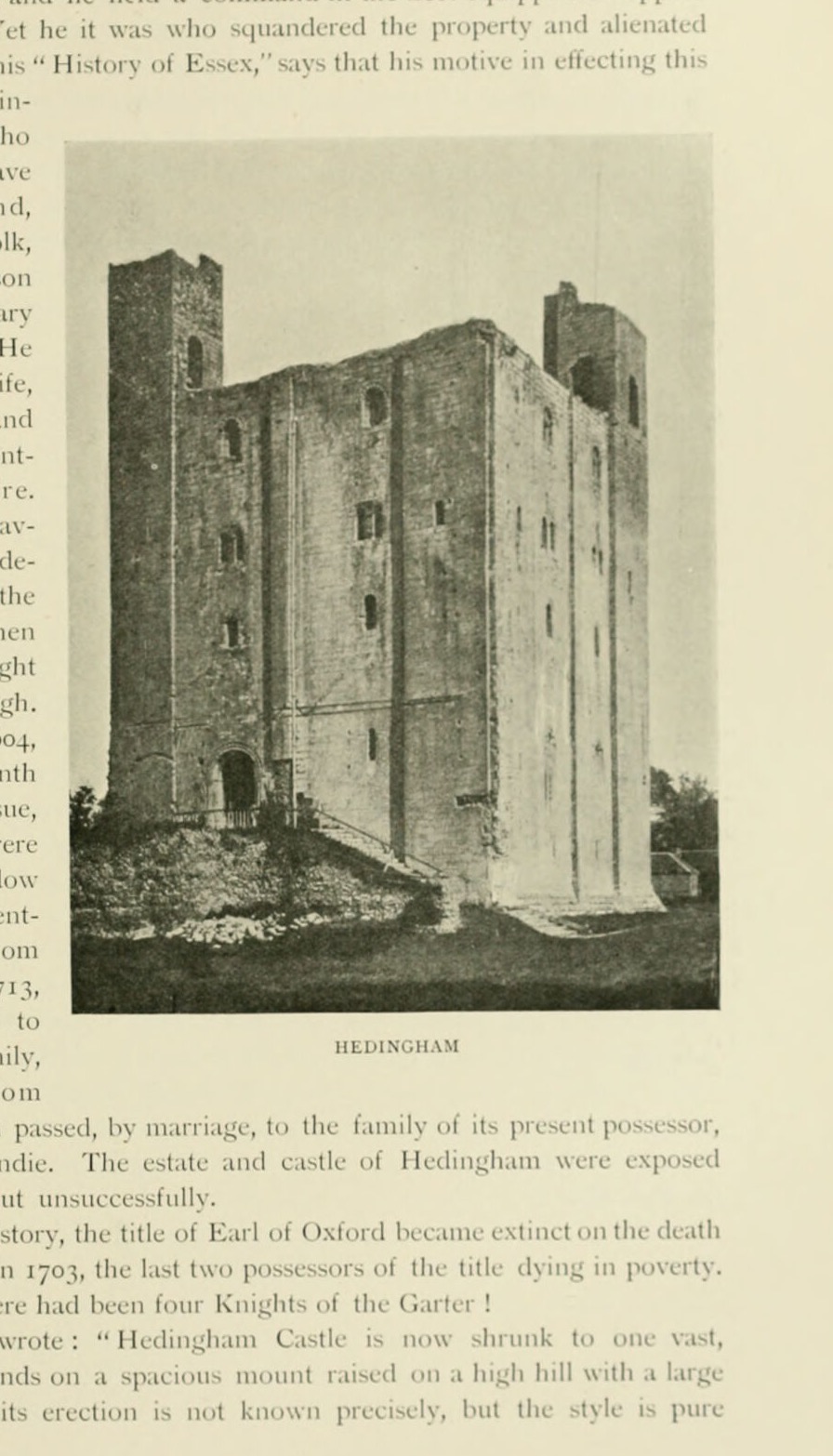
HEDINGHAM
1897 · J. D. Mackenzie, The Castles of England, vol. 1 (1897)
Public domain
Nearby


