
England · Ruin
Kendal Castle
Kendal Castle is a medieval stone castle ruin standing on a grassy mound above the town of Kendal in Cumbria, United Kingdom. The site comprises a prominent rectangular keep remnant and fragments of surrounding curtain walls set on an elevated motte beside a modern approach path.
Its prime
1400
Today
Ruin
As it stood in 1400
What Kendal Castle looked like in its prime.
Perched on a grassy mound above a town, the ruin shows a tall, roughly rectangular stone keep remnant with a collapsed top and adjoining lower curtain-wall fragments. Walls are built of irregular grey-brown rubble stone with areas of thicker masonry at corners. The castle sits on a sloping motte with a gravel approach path and a simple wooden fence on the slope; no roofs remain today but in its prime the keep would have been a multi-storey stone tower within continuous curtain walls.
Its story
The story of Kendal Castle.
A Drumlin Stronghold for the Barons of Kendal
The earliest reference to a castle at Kendal comes from 1216, though it is unclear whether the record points to the stone castle that survives today or to the older Castle Howe in the town. The stone castle's own date is given inconsistently (the late 12th century by one account, the 13th century by another), but it was raised as the caput of the Barony of Kendal, home to the Lancaster family who held the barony, atop a glacial drumlin east of the town. Built of limestone, its curtain wall ran roughly circular around a ditch 26 metres wide, defended by three unevenly spaced mural towers and a gatehouse on the north side; inside, a hall east of the entrance (assessed by the Royal Commission on Historical Monuments as 14th-century) stood with a further tower beyond it.
The Parr Family and a Queen's Corrected Birthplace
The castle's best-known owners were the Parr family, who had held Kendal since their ancestor Sir William Parr married the Kendal heiress, Elizabeth Ros, during the reign of Edward III. Their descendant Catherine Parr, sixth wife of Henry VIII, was long said to have been born at the castle, but her family had by then deserted it: her father, Sir Thomas Parr, preferred to live at the centre of the court in London, and her grandfather, Sir William Parr, appears to have been the last of the family to live at Kendal. By the 16th century the castle was in such disrepair that modern research suggests she was most likely born not at Kendal but at Blackfriars in London. The Parrs' properties, Kendal Castle among them, were confiscated by the Crown in 1566.
Keats's Walking Tour and Twentieth-Century Excavations
The poet John Keats visited the ruins in the summer of 1818 during a walking tour of the Lakes, having stayed the previous night at Endmoor with his companion Charles Brown before the pair walked on to Windermere. The site was later examined archaeologically: a small excavation at the gatehouse in 1951 involved pupils from Heversham Grammar School under J. E. Spence, Barbara Harbottle led further excavations in 1967–69 and 1971, and a geophysical survey in 2001 identified a possible ditch.
Step inside
5 places to explore in 1400.
The record describes 5 distinct spots at Kendal Castle, including the full exterior approach. Create your own photoreal reconstruction and explore every one, more scenes means more rooms, more angles, and more of the place to stand in.
Build Your Own Castle
Recreate Kendal Castle with AI to explore it.
The artist rebuilds it as it stood in 1400, a photoreal reconstruction that belongs to you alone. Pay with coins, no subscription needed.
Recreate this castle →Defend this castle →Whose castle
Clans who held Kendal Castle.
The families that held Kendal Castle for a decade or more across its history, follow a name to its clan.
Lancaster
Built as the home of the Lancaster family, Barons of Kendal.
Parr
Owned by the Parrs, the family of Queen Catherine Parr, by the 15th century; confiscated by the Crown in 1566.
From the archive
Kendal Castle on paper: the measured plan and period views.
The survey plan and photographs below are the ground truth this page's reconstructions are checked against, drawn and photographed while the castle was still a working garrison. Every image is public-domain or openly licensed, with its source named.
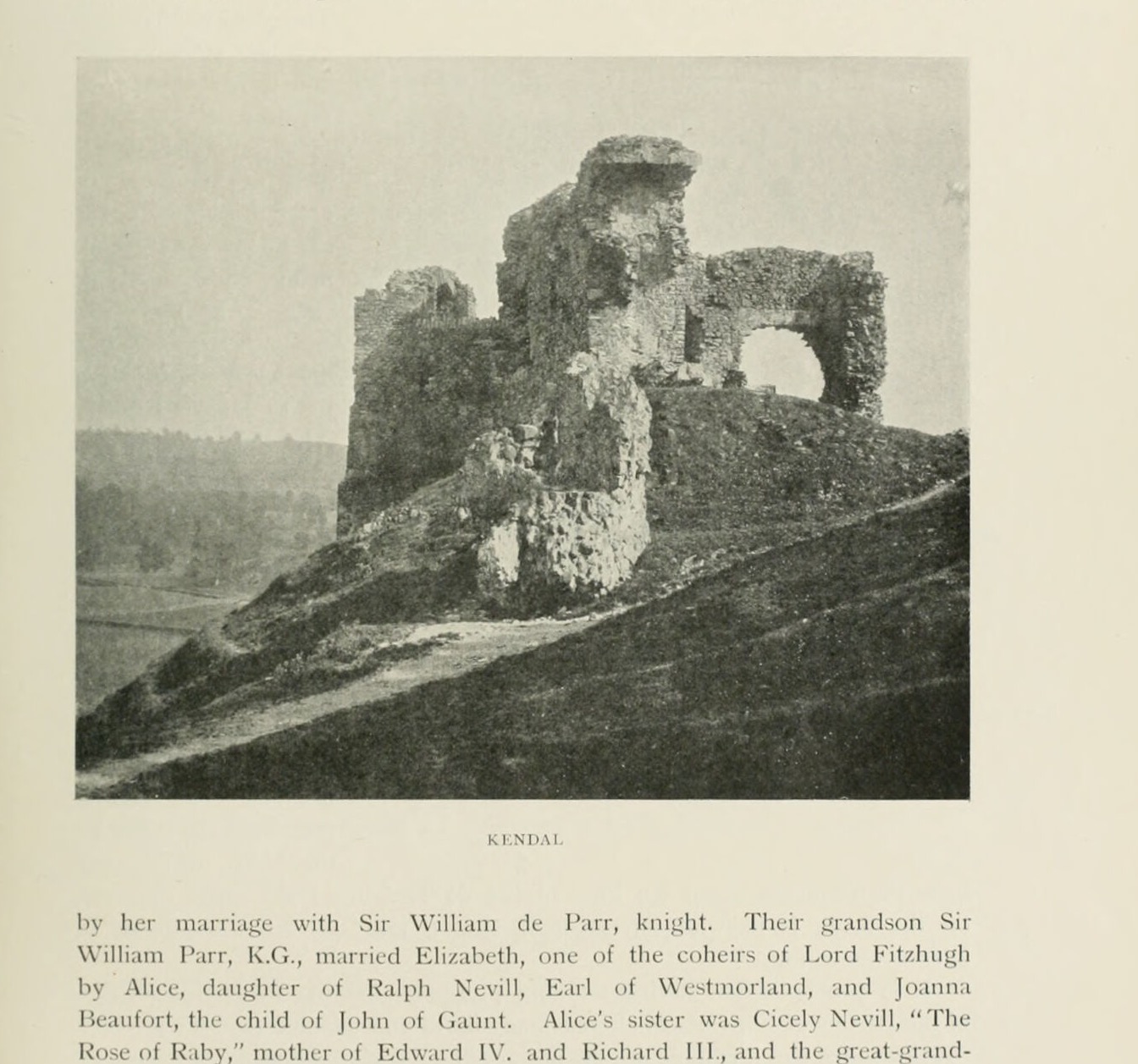
KENDAL
1897 · J. D. Mackenzie, The Castles of England, vol. 2 (1897)
Public domain
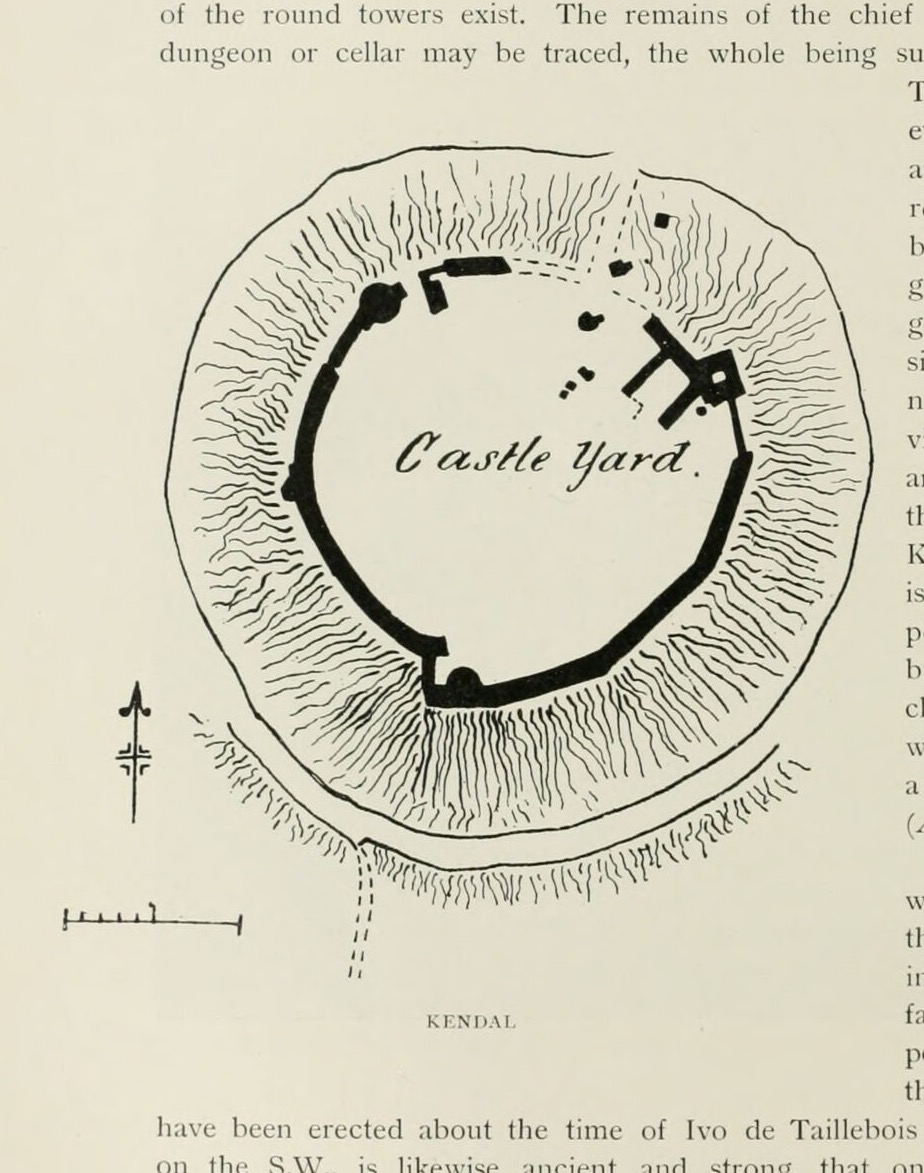
KENDAL
1897 · J. D. Mackenzie, The Castles of England, vol. 2 (1897)
Public domain


