
England · Partial ruin
Pickering Castle
Pickering Castle is a Norman motte-and-bailey castle in Pickering, North Yorkshire, later rebuilt in stone and developed with an inner ward, shell keep, curtain wall and towers. The site is owned by the Duchy of Lancaster and managed by English Heritage and is open to the public.
Its prime
1326
Today
Partial ruin
As it stood in 1326
What Pickering Castle looked like in its prime.
As it stood in 1326 Pickering Castle reads as a compact motte-and-bailey stronghold: a raised motte topped by a low stone shell keep, an inner ward (the former bailey) enclosed by a continuous pale-grey limestone curtain wall punctuated by three square towers and a gatehouse, and an outer ward beyond a second ditch. Stone is coursed local limestone with narrow vertical arrow-slits and crenellated parapets; roofs and internal buildings are largely timber. The west side falls away on a steep natural scarp.
Its story
The story of Pickering Castle.
Norman Foundations After the Harrying of the North, 1069–1070
Pickering Castle was raised by the Normans under William the Conqueror in 1069–1070, its earthworks (a great central motte, an enclosing bailey palisade, and ditches dug to make assault on the walls difficult) built to hold the district after the Harrying of the North. A keep crowned the motte from the outset, the castle's purpose being to maintain control of a newly conquered area.
Rebuilding in Stone, 1180–1326
The timber castle was rebuilt in stone over more than a century. The bailey became the present inner ward between 1180 and 1187, and between 1216 and 1236 the keep was raised again as a stone shell keep, with a chapel added alongside it, a reconstruction of which now stands on the site.
By 1322 the defences had been re-fortified on the orders of Edward II, who had narrowly escaped capture by the Scots during that year's fighting, and the garrison strengthened against the threat of further Scottish invasions. The outer ward and curtain wall followed between 1323 and 1326, built with three towers and two ditches (one outside the curtain wall, one within the outer ward), and completed with a gatehouse, ovens, a hall and storehouses.
A Deposed King's Prison, 1399
The castle stands in the Vale of Pickering behind a steep cliff on its west side, which would have been a considerable defensive asset. It was here that Richard II was held prisoner after his deposition, around 1399, before being moved to Pontefract.
The Civil War Breach
Pickering's remains survive comparatively well preserved: it was one of only a few castles largely unaffected by the Wars of the Roses in the fifteenth century or by the Civil War in the seventeenth. It did not escape entirely, though, during the Civil War it was held for the king and breached on its west side, and most of that side was then dismantled. Three mounds to the west of the castle are said to mark where Cromwell's forces placed the cannon that broke the wall.
Parliamentary troops later occupied the site, and Sir Hugh Cholmeley stripped the lead, timber and iron from its towers to strengthen the defences of Scarborough Castle.
Into State Care
The Ministry of Works, predecessor of English Heritage, took possession of Pickering Castle in 1926. It is a Scheduled Monument today, owned by the Duchy of Lancaster, managed by English Heritage, and open to the public.
Step inside
10 places to explore in 1326.
The record describes 10 distinct spots at Pickering Castle, including 3 interiors: chapel interior, great hall and service range, interior chamber of a curtain tower. Create your own photoreal reconstruction and explore every one, more scenes means more rooms, more angles, and more of the place to stand in.
Build Your Own Castle
Recreate Pickering Castle with AI to explore it.
The artist rebuilds it as it stood in 1326, a photoreal reconstruction that belongs to you alone. Pay with coins, no subscription needed.
Recreate this castle →Defend this castle →From the archive
Pickering Castle on paper: the measured plan and period views.
The survey plan and photographs below are the ground truth this page's reconstructions are checked against, drawn and photographed while the castle was still a working garrison. Every image is public-domain or openly licensed, with its source named.
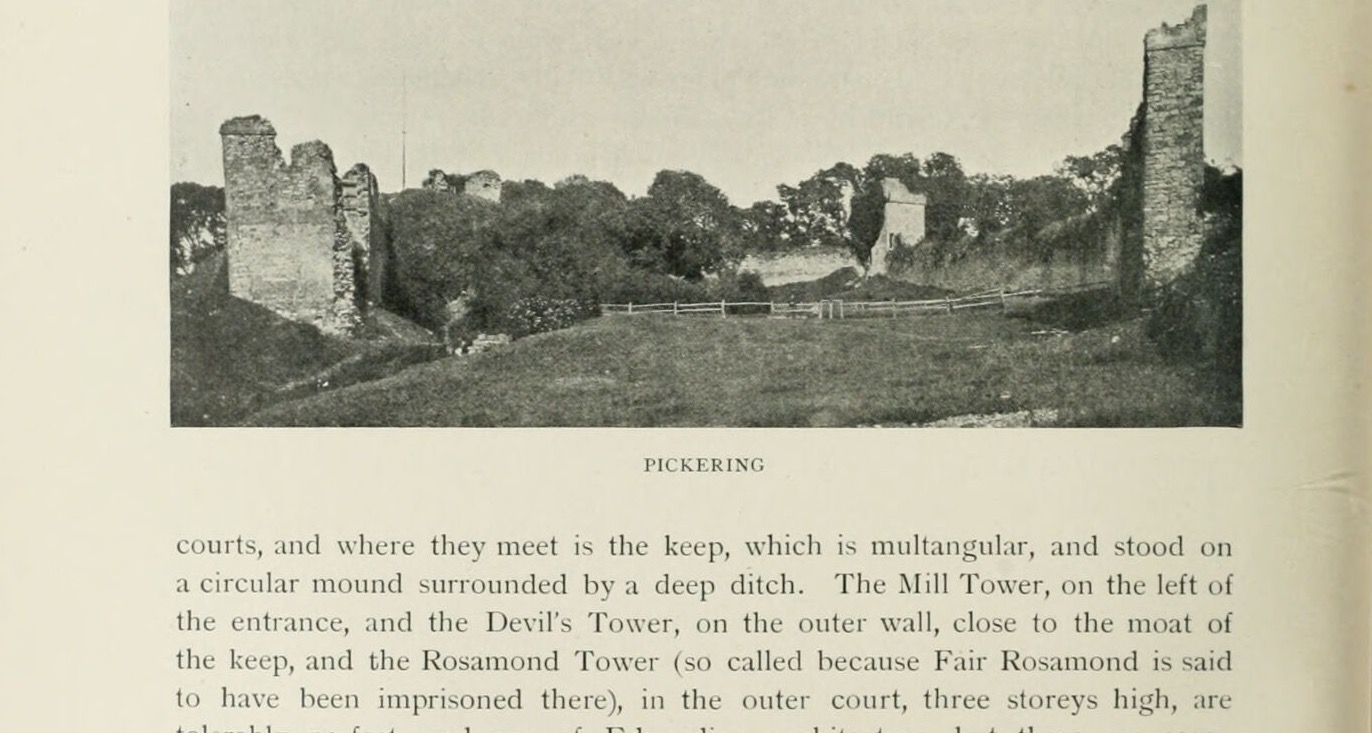
PICKERING
1897 · J. D. Mackenzie, The Castles of England, vol. 2 (1897)
Public domain
Nearby


