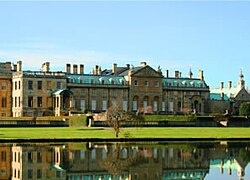
England · Ruin
King John's Palace
King John's Palace is the remains of a medieval royal residence at Kings Clipstone in north-west Nottinghamshire, set within Sherwood Forest. The surviving fabric is the stone chamber of a much larger complex that served as a royal lodging and administrative centre from the late 12th century onward.
Its prime
1360
Today
Ruin
As it stood in 1360
What King John's Palace looked like in its prime.
A compact Romanesque stone chamber built of thick, coursed rubble with a pronounced, buttressed central doorway and a raised timber upper floor with ornately carved window openings facing the deer park. In its prime the chamber formed part of a larger, multi-building complex of stone halls, chapels, a gatehouse and long stone stables roofed in Mansfield slate, arranged around open courtyards within an emparked landscape of Sherwood Forest.
Its story
The story of King John's Palace.
Henry II's £500 and the Deer Park at Clipstone
The King's Houses at Clipstone first appear in the record in 1164, under Henry II, in the royal forest of Sherwood, where forest law reserved the deer to the king. Between 1176 and 1180 Henry ordered £500 spent on the site and laid out a deer park at Clipstone.
The one building still standing is a Romanesque chamber of about 1180, entered through a large buttressed central doorway and carrying a timber upper floor whose carved windows looked over the park. Philip Rahtz assigned the surviving fabric to Henry III's reign; on Romanesque detail identified since his fieldwork, James Wright argues for the earlier campaign of 1176-80.
Richard I, King John and Edward I at Clipstone, 1194-1300
In 1194 Richard I arranged a meeting with William, King of Scots, at Clipstone. King John, whose name the ruin has carried since the 18th century, spent only nine days here in all across five visits between 1200 and 1215 - the first a single night on 19 March 1200 - and how the site came to be associated with him is not known. His reign saw the endowment of the chapel of St Edwin in 1205, and he is said to have held a parliament at the nearby Parliament Oak.
In 1282 Edward I ordered a stable able to hold 200 horses, intended in John Steane's view for the whole royal Household entourage. Edward convened Parliament at Clipstone in 1290; his first wife, Queen Eleanor, was taken ill at the palace and moved to Harby. Excavation and survey describe a far larger complex than the surviving chamber - gatehouse, tower, separate hall and chambers for king and queen, chapels, kitchens and lodgings for royal retainers.
The Peel, the Petitions and the Great Repairs, 1315-1375
The Great Pond gave up 100 pike and 1,600 roach for Edward II's visit in December 1315. Edward built a peel at Clipstone. An extension of the park under Edward II and Edward III led to petitions from the men of Clipstone, Warsop and Mansfield Woodhouse over lost husbote and haybote - timber for building and for hedging - and lost pasture; the petitions brought the reversal of most of Edward II's changes. Custody of manor and park went in 1340 to Robert de Mauley, almost certainly Robert de Morley, 2nd Baron Rodyn, who fought at Boroughbridge, Halidon Hill, Sluys and Crécy and finished as Constable of the Tower of London between 1355 and 1359.
The works of 1348-9 rebuilt the knight's chamber and repaired the great hall, the royal kitchens, Rosamund's Chamber, the great chapel and the great gateway, roofed in Mansfield slate. Over £140 went on general repairs in 1360-3, and William Elmeley, clerk of the works from 1360, carried out further considerable repairs between 1367 and 1375.
Decay, the Duke of Clarence and the Sale of the Manor, 1478-1630
The manor passed to George, Duke of Clarence, and reverted to the crown on his execution in 1478. Royal interest fell away through the 15th century, fitting a national pattern of royal residence concentrated in south-east England and of fewer, grander palaces. A survey of 1525 found the high chamber "in great dekay & ruyne in stonework tymber lede and plaster", part of its roof and floor fallen in and the chapel with no covering on it.
Clipstone left royal hands for the last time on 11 October 1603, when James I granted the manor and park to Charles Blount, Lord Mountjoy; it was sold on the following year to Gilbert Talbot, Earl of Shrewsbury. William Cavendish, Earl of Newcastle, bought the estate in 1630.
From the Civil War Park to Waterfield Farm
Cavendish took the Royalist side and went into exile in 1644; in his absence the park pale and its trees were used to fuel the Parliamentary war effort and the deer stocks were depleted. Margaret, Duchess of Newcastle, put the losses at £20,000. Robert Thoroton in 1677 found "scarcely any ruins left at all of the king's old house, except a piece of thick Stone Wall". Much of the rest was probably robbed piecemeal for building in the village and on the estate, and in 1816, during the 4th Duke of Portland's flood-meadow scheme along the River Maun, a great part of the buried foundations and vaults was dug up for draining work.
Known as Castle Field, the site stayed with the Welbeck Estate until November 1945, when the local farmers Fred and Molly Bradley bought it; it has remained in the family since, and was scheduled as a monument in 1954. In 2009 Paul Mendham Stonemasons completed a full consolidation of the ruin, funded by English Heritage and Nottinghamshire County Council. Excavation in 2012 traced a probable boundary ditch enclosing roughly 7.5 acres, which would make the King's Houses one of the largest palace sites in England. Visits are by advance application to the Bradley family at Waterfield Farm.
Step inside
10 places to explore in 1360.
The record describes 10 distinct spots at King John's Palace, including 5 interiors: romanesque chamber, interior, great hall, king's and queen's chambers and more. Create your own photoreal reconstruction and explore every one, more scenes means more rooms, more angles, and more of the place to stand in.
Build Your Own Castle
Recreate King John's Palace with AI to explore it.
The artist rebuilds it as it stood in 1360, a photoreal reconstruction that belongs to you alone. Pay with coins, no subscription needed.
Recreate this castle →Defend this castle →Whose castle
Clans who held King John's Palace.
The families that held King John's Palace for a decade or more across its history, follow a name to its clan.
Talbot
Bought by Gilbert Talbot, Earl of Shrewsbury, in 1604, the year after the manor left royal ownership.
Purchased by William Cavendish, Earl of Newcastle, in 1630.
Nearby