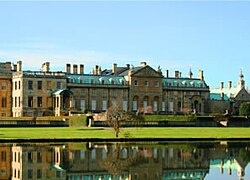
England · Partial ruin
Tickhill Castle
Tickhill Castle is a medieval motte-and-bailey castle in Tickhill, South Yorkshire, notable as a stronghold in the late 12th and early 13th centuries. Its stone keep and curtain wall were built in the late 1100s; much of the fortress was slighted in the 17th century and only the Norman gatehouse survives integrated into later buildings.
Its prime
1192
Today
Partial ruin
As it stood in 1192
What Tickhill Castle looked like in its prime.
A motte-and-bailey silhouette: a high earthen motte crowned by an eleven-sided or near-circular stone keep, surrounded by a continuous stone curtain wall enclosing the bailey. A prominent Norman gatehouse fronts the approach, reached by a short stone bridge across the entrance ditch. Within the bailey are compact ranges of stone buildings including a small chapel; masonry is weathered pale grey-brown local stone with crenellated parapets along the keep and curtain walls.
Its story
The story of Tickhill Castle.
Roger de Busli's Castle on the Border, 1086–1153
Tickhill began as an 11th-century motte-and-bailey earthwork called Blythe Castle, raised by Roger de Busli on land granted him by William the Conqueror. Domesday Book in 1086 listed Roger as the holder of 174 estates in Nottinghamshire, and he set the castle deliberately on the Nottingham–Yorkshire border, where his authority ran on both sides. After a siege in 1102 Robert Bloet added a curtain wall to the rampart around the bailey, the first part of the castle to be built in stone. From 1151 to 1153 it was held by Ranulf de Gernon, 4th Earl of Chester, until his death by poisoning.
Henry II's Keep and John's Stronghold, 1180–1194
In 1180 Henry II began an eleven-sided or circular keep on the summit of the motte, completed in 1192 along with a stone bridge and a chapel built by his queen, Eleanor of Aquitaine. In 1189 Richard I granted his brother John the land around Tickhill but withheld the castle itself, together with Launceston, Rougemont, Exeter, Gloucester and Nottingham, distrusting John's loyalty while he was away on the Third Crusade. The fear proved well founded: in 1191 John seized the kingdom from William Longchamp, the regent Richard had chosen. With Windsor, Tickhill became John's main stronghold against a suspected invasion by Philip II of France.
Tickhill and Nottingham became John's last strongholds. Under the command of Robert de la Mare, Tickhill was besieged in 1194 by Hugh de Puiset, its garrison keeping the walls until word reached them that Richard had returned to England. With Hugh's permission they sent two knights out to learn the truth of it, and the knights at once offered to restore the castle to the king. Richard would take nothing but unconditional surrender; on their return the knights negotiated exactly that, handing Tickhill to Hugh de Puiset in exchange for the defenders' lives.
Lancaster's Failed Siege to John of Gaunt, 1321–1372
Thomas, 2nd Earl of Lancaster, laid siege to Tickhill in 1321 during his rebellion against Edward II, and failed to take it. In 1343 Joanna of Flanders, Duchess of Brittany, was imprisoned in the castle after being declared insane, while she and her son were given asylum by Edward III. In 1372 Edward III granted Tickhill to John of Gaunt in exchange for the Earldom of Richmond, which went to Joanna's son, John IV, Duke of Brittany.
Hansby's Repairs and the Razing of 1648
By 1540 the castle was in poor repair. Sir Ralph Hansby took the lease in 1612 and had it repaired and fortified, and in the Civil War Tickhill held for the crown, Major Monckton taking charge after Hansby's death in 1643. In 1644 John Lilburne marched on the place with 200 dragoons from the Earl of Manchester's army and accepted its surrender on 26 July. In 1648 the castle was razed to prevent its use as a stronghold in future.
The Duchy of Lancaster's Scheduled Monument
After the war the Hansby family built a large house on the site, keeping the fortified Norman gatehouse and perhaps incorporating parts of the old hall; the bailey is now garden ground. Tickhill has remained a property of the Duchy of Lancaster, which maintains the scheduled monument, and the house is a private residence. It opens to the public on one day a year, the second Sunday in June, between two and four in the afternoon.
Step inside
8 places to explore in 1192.
The record describes 8 distinct spots at Tickhill Castle, including 3 interiors: gatehouse passage (throughway), chapel interior, great hall / hall range. Create your own photoreal reconstruction and explore every one, more scenes means more rooms, more angles, and more of the place to stand in.
Build Your Own Castle
Recreate Tickhill Castle with AI to explore it.
The artist rebuilds it as it stood in 1192, a photoreal reconstruction that belongs to you alone. Pay with coins, no subscription needed.
Recreate this castle →Defend this castle →Whose castle
Clans who held Tickhill Castle.
The families that held Tickhill Castle for a decade or more across its history, follow a name to its clan.
Busli
Built by Roger de Busli, the Domesday magnate, on land granted by William the Conqueror in the 11th century.
From the archive
Tickhill Castle on paper: the measured plan and period views.
The survey plan and photographs below are the ground truth this page's reconstructions are checked against, drawn and photographed while the castle was still a working garrison. Every image is public-domain or openly licensed, with its source named.
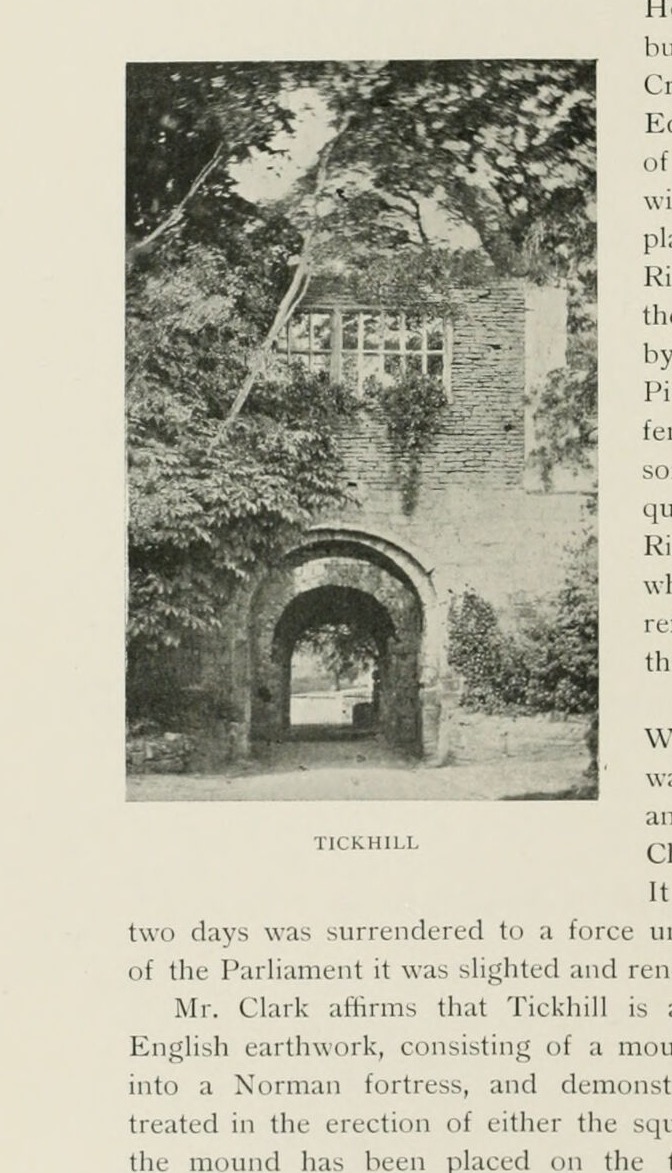
TICKHILL
1897 · J. D. Mackenzie, The Castles of England, vol. 2 (1897)
Public domain
Nearby