England · Partial ruin
Kirby Muxloe Castle
Kirby Muxloe Castle is a late 15th-century fortified manor house in Kirby Muxloe, Leicestershire, begun by William, Lord Hastings in 1480 and left largely incomplete after 1484. The site is a rectangular quadrangular castle surrounded by a water-filled moat; today the gatehouse and the west tower survive as partially intact brick structures. It is managed by English Heritage and protected as a Grade I listed building.
First raised
1480
Its prime
1484
Today
Partial ruin
As it stood in 1484
What Kirby Muxloe Castle looked like in its prime.
A rectangular quadrangular castle set within a broad water-filled moat and approached by an oak bridge; the north-west gatehouse and the west corner tower survive. Both surviving buildings are of red brick with stone dressings and patterned darker-brick diapering forming symbols; the gatehouse is rectangular with four polygonal turrets, and the west tower projects into the moat with two slightly taller internal corner turrets. Ground-floor gunports puncture the walls; an inner range forms a central lawned courtyard.
Its story
The story of Kirby Muxloe Castle.
Hastings, Ashby and the Licence to Crenellate, 1462-1474
William, Lord Hastings, chamberlain of the royal household and a favourite of Edward IV, acquired extensive estates across the Midlands during the Wars of the Roses, much of it confiscated from his enemies. His father, Sir Leonard, had kept his seat at Kirby Muxloe, though William moved his own to Ashby de la Zouch in 1462. In 1474 Edward granted him the right to crenellate four of his manors and to build deer parks around them, Kirby Muxloe among them, authorised to be turned into a castle and surrounded by a park of 2,000 acres.
Roger Bowlott's Building Site and the Halt, 1480-1484
Work began in October 1480 under Roger Bowlott, Hastings's steward, who became clerk of works for the project. Antony Yzebrond, from Flanders, built a workshop able to make up to 100,000 bricks a week, and a brook was redirected to feed the new moat. Work intensified in early 1481 with the stonework supervised by the master mason John Cowper, and at peak periods over 40 men were on the site. How much was built is uncertain, though at least one corner tower had been nearly completed by 1483 and the ground floor of the gatehouse laid down.
Edward IV died in 1483, leaving the kingdom to his young son Edward V, whose uncle Richard, Duke of Gloucester, had his own ambitions for the throne. Hastings was unwilling to support the deposition of Edward V and, as a consequence, Richard summarily executed him that June, ahead of his own coronation. Kirby Muxloe and Hastings's other estates were restored to his widow Katherine, who after a short pause continued some work until the summer of 1484, concentrating on making the corner tower and the partially finished gatehouse habitable before the project was halted. About 1,000 pounds had been spent by then, and 1.3 million bricks laid.
A Brick Quadrangle and Its Gunports
The castle was designed as a rectangle 245 by 175 feet, with a square tower at each corner, lesser side towers on three edges and a large gatehouse to the north-west, all behind a water-filled moat crossed by an oak bridge. Six gunports for early gunpowder artillery were built into the ground-floor walls of both the gatehouse and the west tower, then temporarily filled with bricks, probably against vermin and draughts. Any guns would have had limited range, set low to the ground, and historians are uncertain how useful they would have been: the ports are of early design and may have been intended as symbols rather than practical defences, though they were well placed and might well have been meant to deter a serious attack.
Abandoned, Robbed and Overgrown, 1630 to the Early 20th Century
The Hastings family held Kirby Muxloe until around 1630, when it was purchased by Sir Robert Banaster, and then by William Wollaston. Over the rest of the century the castle was abandoned, robbed for its building materials and put to agricultural use. Clement Winstanley bought it from the Wollaston family in 1788; in 1790 the remains of the north tower were still standing, albeit in very poor condition. Winstanley reportedly wanted to pull the northern ruins down and reuse the bricks to make a barn, but his son, also called Clement, intervened and carried out repairs. By the early 20th century trees were growing out of the tops of the walls, much of the moat had silted up and the remains of the bridge lay buried under debris.
Guardianship, Peers's Restoration and English Heritage, 1911-2015
By 1911 the owner, Major Richard Winstanley, could not pay for the castle's upkeep and proposed placing it in the guardianship of the Commissioners of Works. A survey by the architect Sir Frank Baines showed the ruins to need immediate repairs, and the Commissioners took the castle over the following year. Sir Charles Peers, the Inspector of Ancient Monuments, restored it between 1912 and 1913, clearing away the farm remains and the vegetation on the walls, repairing the brickwork, re-cutting the moat and reconstructing a replica of the medieval bridge. His excavations uncovered the foundations of the original manor house but little else. The castle's complete financial records turned up in the Hastings family archives, found by the historian Thomas Fosbrooke while investigating Ashby de la Zouch and passed to Peers; John Goodall describes them as “a fascinating insight” into medieval building work.
English Heritage manages Kirby Muxloe as a tourist attraction, and the castle received 2,461 visitors in 2015; substantial restoration work in 2006 replaced much of the brickwork. It is protected as a scheduled monument and, since February 1987, as a Grade I listed building, and Historic England considers it a “spectacular example of a late medieval quadrangular castle of the highest status”.
Step inside
9 places to explore in 1484.
The record describes 9 distinct spots at Kirby Muxloe Castle, including 3 interiors: gatehouse ground-floor passage and porter's lodges, gatehouse first floor with portcullis mechanism, west tower single chamber (lodging) with fireplace. Create your own photoreal reconstruction and explore every one, more scenes means more rooms, more angles, and more of the place to stand in.
Build Your Own Castle
Recreate Kirby Muxloe Castle with AI to explore it.
The artist rebuilds it as it stood in 1484, a photoreal reconstruction that belongs to you alone. Pay with coins, no subscription needed.
Recreate this castle →Defend this castle →Whose castle
Clans who held Kirby Muxloe Castle.
The families that held Kirby Muxloe Castle for a decade or more across its history, follow a name to its clan.
Hastings
Begun by William, Lord Hastings, in 1480; after his execution in 1483 the estates were restored to his widow Katherine.
From the archive
Kirby Muxloe Castle on paper: the measured plan and period views.
The survey plan and photographs below are the ground truth this page's reconstructions are checked against, drawn and photographed while the castle was still a working garrison. Every image is public-domain or openly licensed, with its source named.
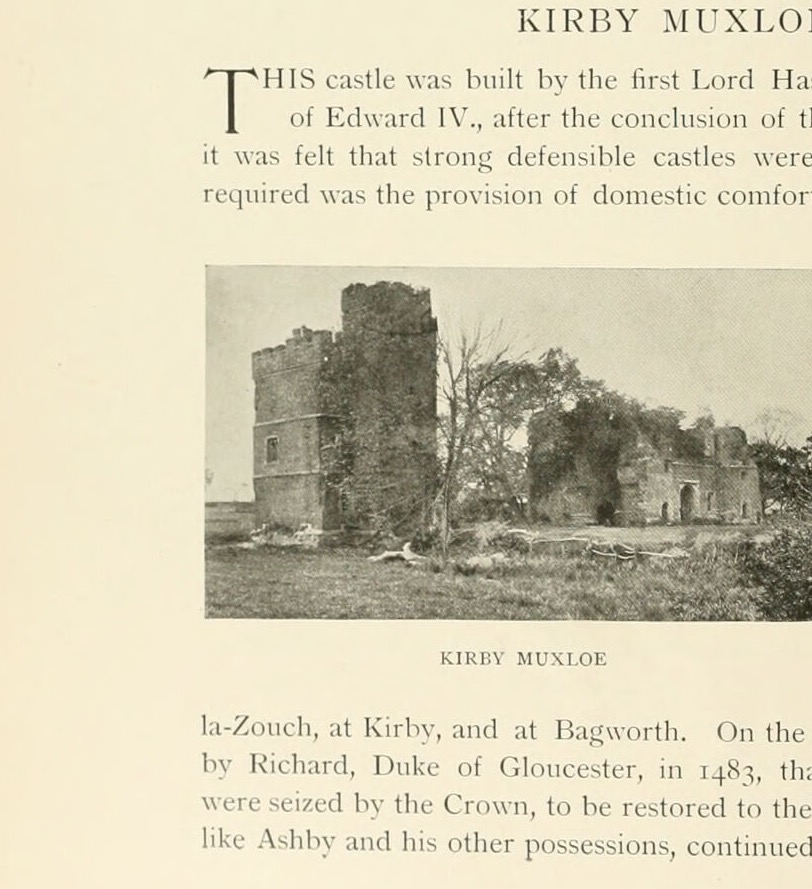
KIRBY MUXLOE
1897 · J. D. Mackenzie, The Castles of England, vol. 1 (1897)
Public domain
Nearby