England · Restored
Lancaster Castle
Lancaster Castle is a medieval castle in Lancaster, Lancashire, long used for administration and as a county gaol; it sits on a hill overlooking the town near the River Lune. The complex contains a Norman keep, a large fifteenth-century gatehouse and later eighteenth-century additions including the Gaoler's House and the Shire Hall/Crown Court.
First raised
1093
Its prime
1798
Today
Restored
As it stood in 1798
What Lancaster Castle looked like in its prime.
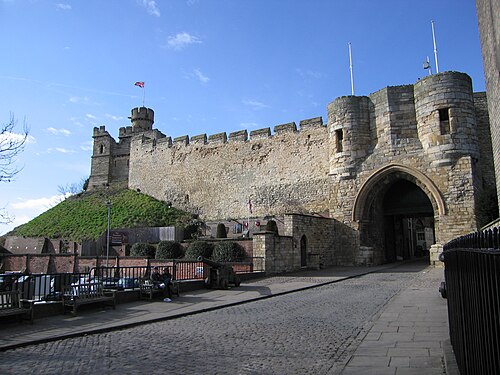
A monumental twin-towered stone gatehouse dominates the approach: two broad cylindrical drum towers linked by a crenellated parapet and a central pointed arched entrance. Walls are of warm-brown sandstone ashlar, with corbelled machicolations under the battlements. Behind and beside the gatehouse rise a massive rectangular keep with small rounded romanesque windows low on the north face, and a row of later Georgian stone buildings with sash-window openings and chimneys. The castle sits on a raised, cobbled approach with curtain walls extending along the slope toward the town.
Its story
The story of Lancaster Castle.
Roger de Poitou's Keep and King John's Ditch
No document records the castle's foundation. The likeliest builder is Roger de Poitou, the Norman lord who held the Honour of Lancaster: two Romanesque windows low in the keep's north wall have been compared to those of the Exchequer Hall at Caen of about 1090, built by masons of southern Normandy, where Roger's own roots lay. He founded Lancaster Priory in 1094, and the keep is thought to have been begun in 1092–4, on the site of a Roman fort commanding the crossing of the Lune.
Roger fled England in 1102 after a failed rebellion in support of Robert Curthose against Henry I, and the king confiscated the Honour. During the Anarchy Stephen of Blois secured his northern frontier by letting David I of Scotland occupy it in 1141; David may have refortified Lancaster, and so little of the fabric has been investigated that the keep may even be his. On the death of Stephen's son William in 1164 the Honour returned to royal control under Henry II.
Richard the Lionheart gave the Honour to his brother John; the first record of prisoners at the castle dates from 1196. As king, John spent over £630 on a ditch outside the south and west walls and on "the King's lodgings", probably the tower later called Adrian's Tower; Henry III added £200 in 1243 and £250 in 1254 for the gatehouse and a stone curtain wall.
The Scots at Lancaster and Henry IV's Gatehouse
Lancaster lay well back from the border, but the Scots invaded in 1322 and again in 1389, reaching the town and damaging the castle. When Henry, Duke of Lancaster, took the throne as Henry IV in 1399 he almost immediately began a monumental gatehouse; a second devastation of the town would have embarrassed the new king. Between 1402 and 1422 over £2,500 went on building work, most of it thought to have gone on the gatehouse, which rivalled the keep as the strongest part of the castle.
Recusant Priests and the Pendle Trial
The castle was strengthened in 1585 against the threat of Spanish invasion. After Elizabeth I was excommunicated in 1570 she retaliated by declaring Roman Catholic priests guilty of high treason, and any found in Lancashire were brought to Lancaster Castle for trial; between 1584 and 1646 fifteen Catholics were executed at Lancaster for their faith. The trial of the Pendle witches was held at the castle in 1612.
Two Days' Siege and the Slighting, 1643–1660
Lancaster was lightly garrisoned when the Civil War began, and a small Parliamentarian force took the castle in February 1643, installing a garrison and throwing up earthworks around the town's approaches. The Royalists sent an army to retake it: the outer defences fell in March, but the siege of the castle lasted only two days, broken off as Parliamentarian reinforcements marched from Preston. Royalist attempts in April and June also failed, and in August 1648 the town withstood a siege by the Duke of Hamilton, who had led an army south from Scotland.
Charles I was executed in January 1649, and Parliament shortly afterwards ordered the castle slighted, sparing what was needed for administration and the county gaol; the Well Tower came down and the castle was militarily redundant. Charles II visited on 12 August 1660 and released every prisoner held there, after which the county's High Sheriff and Justices petitioned him to repair the buildings, surveyed at £1,957.
Hanging Corner and HM Prison Lancaster
Lancaster served as a debtors' prison as well as a county gaol; after the Civil War most of the gatehouse rooms were filled with debtors. As 18th-century gaols took on longer-term prisoners they grew overcrowded, and the reformer John Howard recorded conditions here in 1776. Around £30,000 went on rebuilding the county gaol in the last two decades of the century, Thomas Harrison raising the Gaoler's House in 1788 and the Shire Hall and Crown Court by 1798.
Before about 1800 the condemned were hanged out on Lancaster Moor; after the Georgian remodelling executions moved to a spot beside the castle known as Hanging Corner. Lancaster has a reputation as the court that sentenced more people to death than any other in England, partly because until 1835 it was the county's only Assize Court, covering Manchester and Liverpool. Around 265 people were hanged there between 1782 and 1865, frequently before thousands crowded into the churchyard. The Capital Punishment Amendment Act 1868 ended public executions; six more were carried out inside the castle, the last the murderer Thomas Rawcliffe in 1910. The prison closed in 1916, opened again as HM Prison Lancaster in 1955 and closed in March 2011, when the castle returned to the Duchy's management; the Crown Court still sits within the walls.
Step inside
8 places to explore in 1798.
The record describes 8 distinct spots at Lancaster Castle, including 5 interiors: gatehouse passage (under the arch), inner cloistered courtyard (inner bailey), gaoler's house (front and interior) and more. Create your own photoreal reconstruction and explore every one, more scenes means more rooms, more angles, and more of the place to stand in.
Build Your Own Castle
Recreate Lancaster Castle with AI to explore it.
The artist rebuilds it as it stood in 1798, a photoreal reconstruction that belongs to you alone. Pay with coins, no subscription needed.
Recreate this castle →Defend this castle →Nearby