England · Restored
Leeds Castle
Leeds Castle is a historic castle in Kent, England, built on islands in a lake formed by the River Len. The present appearance derives largely from early 19th-century remodelling over medieval structures and it has been a royal residence and private estate before opening to the public in the 20th century.
First raised
1119
Its prime
1823
Today
Restored
Ranked among Europe’s castles
As it stood in 1823
What Leeds Castle looked like in its prime.
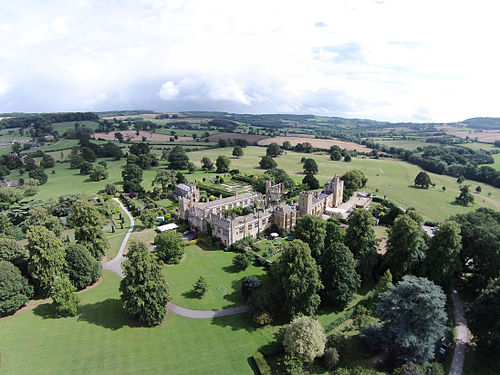
Built on islands within a broad lake, the castle presents a low, rectangular multi-storey main block with crenellated parapets and several round corner towers rising above continuous curtain walls. The masonry is pale Kent stone with numerous tall mullioned and transomed windows in regular rows. The roofline is dominated by battlements rather than pitched roofs; the structure sits directly at the waterline with stone base-walls meeting the lake and a flagged approach across the islands.
Its story
The story of Leeds Castle.
Led's Islands and Eleanor of Castile's Purchase, 1278
From 857 the site belonged to a Saxon chief called Led, or Leed, who put up a wooden structure on two islands in the middle of the River Len, seven miles south-east of Maidstone. In 1119 Robert de Crevecoeur rebuilt it in stone as a Norman stronghold, and Leeds descended through the de Crevecoeur family until the 1260s. What that Norman castle looked like is uncertain, since later centuries rebuilt and transformed it; Adrian Pettifer has suggested it may have been a motte and bailey.
In 1278 the castle was bought by Edward I's queen, Eleanor of Castile. The purchase was made by acquiring the debt bond from Jewish moneylenders who had been forced to sell at a considerable discount as a result of Edward's own excessive tax demands. It became a favoured residence of the king's and drew heavy investment. Edward strengthened the defences, built a barbican spanning three islands, and added a gloriette holding apartments for king and queen; the lake that rings the castle was probably his work too. That spending ran against the current, for as the royal household grew, outlay on royal residences in south-east England generally fell away, the Tower and Windsor excepted.
Lady Badlesmere's Archers, 31 October 1321
Bartholomew de Badlesmere, 1st Baron Badlesmere, held Leeds as constable and left his wife, Margaret de Clare, in charge during an absence. When Edward II's consort Isabella of France sought admittance, Lady Badlesmere refused her. Isabella then tried to force an entry, and Lady Badlesmere ordered her archers to shoot at the queen and her party; six of them were killed. The king besieged the castle in answer, and on 31 October 1321 Edward II's forces took it. Lady Badlesmere was held prisoner in the Tower of London until November 1322.
Isabella's connection with the place outlasted the quarrel: after Edward II died in 1327 his widow took Leeds as her principal residence. Anne of Bohemia, Richard II's first wife, spent the winter of 1381 there on her way to marry the king, and in 1395 Richard received the French chronicler Jean Froissart at the castle, an encounter Froissart set down in his Chronicles.
Henry VIII, Catherine of Aragon and the St Legers
Henry VIII transformed the castle in 1519 as a dwelling for his first wife, Catherine of Aragon; a painting commemorating the king's meeting with Francis I of France still hangs there. The glazier Galyon Hone reworked and restored the chapel windows in 1536, and came back in 1544 to repair the windows of the lodgings and of a banqueting house in the garden, in readiness for a visit by Catherine Parr.
In 1552 Leeds was granted to Sir Anthony St Leger of Ulcombe in Kent, who died in 1559. The family already knew the place: his grandfather Ralph St Leger, Sheriff of Kent in 1467/8, had served as Constable of Leeds Castle before his death in 1470.
Culpeper Loyalties and the Virginia Inheritance
The St Legers held the castle until Sir Warham St Leger sold it to Sir Richard Smythe in 1618; Smythe's daughters in turn sold it to Sir Thomas Colepeper of Hollingbourne. The English Civil War then split the house. Leeds escaped destruction because its owner, Sir Cheney Culpeper, sided with Parliament, and the castle served through the war as an arsenal and a prison. Other Culpepers took the king's part: John Colepeper, 1st Baron Colepeper, was rewarded for helping Charles, Prince of Wales, escape with a grant of more than five million acres of land in Virginia.
Thomas Fairfax, 6th Lord Fairfax of Cameron, was born at the castle in 1693 and settled in North America to oversee the Culpeper estates; a sundial at Leeds still tells the time in Belvoir, Virginia. He was the great-grandson of the Thomas Fairfax who led the parliamentarian attack at the Battle of Maidstone in 1648. Robert Fairfax held Leeds for forty-six years until 1793, when it passed to the Wykeham Martins, and the sale of the family's Virginia estates released the money for extensive repair and a remodelling in Tudor style, finished in 1823, which gave the castle the appearance it carries today.
Lady Baillie's Weekend Castle and the Trust
Death duties forced the Wykeham Martins to sell castle and estate in 1924. The buyer, in 1926 and for £180,000, was the Hon. Olive, Lady Baillie, daughter of Almeric Paget, 1st Baron Queenborough, and his first wife Pauline Payne Whitney, an American heiress. She found the house unlived-in and in poor condition, with parts of the grounds overgrown. She worked first with the French architect and designer Armand-Albert Rateau, who oversaw alterations outside and introduced features such as a sixteenth-century-style carved-oak staircase, and then with the Paris decorator Stéphane Boudin, spending two million dollars on the work over the years.
Lady Baillie became renowned as a hostess, living in London during the week and filling the castle at weekends. The 1930s brought the Prince of Wales with Mrs Simpson, Queen Maria of Romania and Alfonso XIII of Spain, politicians including Anthony Eden and the German ambassador Joachim von Ribbentrop, and, because she loved the cinema, film stars from Charlie Chaplin to Errol Flynn and James Stewart. In the early part of the Second World War the castle was used as a hospital, where Lady Baillie and her daughters hosted burned Commonwealth airmen through their recovery; survivors remembered the experience with fondness.
The castle was named a Grade I listed building in 1952, its listing summary reading: "Castle. Early-to-mid C12, with C13, C14, C15 and C16 alterations. Partly rebuilt 1822". On Lady Baillie's death in 1974 it passed to the Leeds Castle Foundation, a private charitable trust charged with preserving castle and grounds for the public. Corporate conferences alone could not carry the running costs, so the gardens opened to visitors in 1975 and the castle itself in 1976. On 17 July 1978 the Egyptian foreign minister Muhammad Ibrahim Kamel, his Israeli counterpart Moshe Dayan and the US Secretary of State Cyrus Vance met at Leeds to prepare for the Camp David Accords, and in September 2004 the castle hosted the Northern Ireland peace talks led by Tony Blair.
Step inside
9 places to explore in 1823.
The record describes 9 distinct spots at Leeds Castle, including 4 interiors: gloriette (royal apartments), royal lodgings (lodgings with restored windows), chapel interior and more. Create your own photoreal reconstruction and explore every one, more scenes means more rooms, more angles, and more of the place to stand in.
Build Your Own Castle
Recreate Leeds Castle with AI to explore it.
The artist rebuilds it as it stood in 1823, a photoreal reconstruction that belongs to you alone. Pay with coins, no subscription needed.
Recreate this castle →Defend this castle →Whose castle
Clans who held Leeds Castle.
The families that held Leeds Castle for a decade or more across its history, follow a name to its clan.
Crevecoeur
Rebuilt in stone by Robert de Crevecoeur in 1119 and held by the family until the 1260s.
Culpeper
Held by the Culpeper (Colepeper) family in the 17th century.
Nearby