
England · Partial ruin
Ludlow Castle
Ludlow Castle is a medieval stone castle on a promontory above the River Teme in Ludlow, Shropshire. The site comprises an inner bailey with a Great Tower, domestic ranges (Great Hall, Solar and Great Chamber), a rare circular chapel, and a larger outer bailey linked to the town by curtain walls and gatehouses.
First raised
1066
Its prime
1634
Today
Partial ruin
As it stood in 1634
What Ludlow Castle looked like in its prime.
A compact castle massed on a grassy promontory above the River Teme: a tall square Great Tower rises from the inner bailey surrounded by continuous curtain walls punctuated by both rectangular and rounded mural towers. Stone is weathered grey-brown sandstone; rooflines in the inner bailey include pitched roofs over domestic ranges while battlemented parapets cap the defensive walls. The outer bailey opens to the town to the east, and a rock-cut ditch separates inner and outer enclosures; the circular chapel sits within the inner ward.
Its story
The story of Ludlow Castle.
Walter de Lacy's Ringwork Above the Teme
Walter de Lacy came to England in 1066 with William fitzOsbern, the new Earl of Hereford, whose task was settling the Welsh border. Rewarded with 163 manors across seven counties, Walter began a castle around 1075 in his manor of Stanton Lacy (first called Dinham) on a promontory above a crossroads over the River Teme. He died in a construction accident at Hereford in 1085.
The stone defences went up possibly from the 1080s and were finished before 1115, making Ludlow one of the first masonry castles in England: a stone version of a ringwork with four towers and a gatehouse tower, looking out towards Wales.
Gilbert de Lacy's Private War, 1137–1153
Hugh de Lacy died childless around 1115 and Henry I gave Ludlow to Hugh's niece Sybil, marrying her to a household man, Pain fitzJohn, who was killed fighting the Welsh in 1137. King Stephen, insecure on a new throne, granted the contested castle to Robert fitzMiles for promises of support, passing over Gilbert de Lacy, who claimed it by descent.
Gilbert seized Ludlow when war broke out between Stephen and the Empress Matilda. Stephen marched into the Marches, married his knight Joce de Dinan to Sybil, promised them the castle, and took it after several attempts in 1139, a siege remembered for his rescue of Prince Henry of Scotland, caught on a hook thrown over the walls by the garrison. Gilbert fought a private war against Joce and won it back a few years before the fighting ended in 1153. The Norman entrance tower was converted into the Great Tower in these decades.
Confiscated, Bought Back, Retaken: 1194–1265
Gilbert's grandson Walter spent decades losing Ludlow and buying it back. Richard I confiscated it in 1194 after Walter joined the attacks on Prince John's rebellion and released it in 1198 for 3,100 marks; John seized it repeatedly before restoring it in 1215. Henry III met the Welsh prince Llywelyn ab Iorwerth here in 1223 for peace talks that failed.
Walter's granddaughter Maud carried Ludlow to Geoffrey de Geneville, a friend of the future Edward I. Simon de Montfort seized the castle after the Royalist defeat of 1264, but it was retaken shortly afterwards, probably by Geneville, and when Prince Edward escaped captivity in 1265 he joined his supporters here before the campaign that ended de Montfort at Evesham. Geoffrey built the Great Hall and Solar block, and held Ludlow until his death in 1314.
The Mortimers, Ludford Bridge and the Yorkist Claim
Roger Mortimer took the castle in 1301 by marrying Geoffrey's eldest granddaughter Joan, and added the Great Chamber block around 1320. He lost the Despenser War, escaped the Tower of London into exile in 1323, allied with Edward II's estranged queen Isabella, returned to seize power in 1327 and was made Earl of March, building a chapel to Saint Peter in the outer bailey for the saint's day of his escape. He fell soon after and was executed; his widow kept Ludlow.
Edmund Mortimer rode out from Ludlow against the Owain Glyndŵr revolt in 1402 and was taken at Bryn Glas; Henry IV refused to ransom him, and he married one of Glyndŵr's daughters and died at the siege of Harlech in 1409.
Richard, Duke of York, took possession in 1432, made Ludlow the base for his estates and raised his sons there in the 1450s, the future Edward IV among them. The Wars of the Roses mostly passed it by, the exception being the Battle of Ludford Bridge outside the town in 1459, a largely bloodless Lancastrian victory. Richard was killed in battle in 1460; his son seized the throne the next year and Ludlow passed to the Crown.
Capital of Wales, and the Surrender of 1646
In 1473 Edward IV sent his heir, the future Edward V, to Ludlow and made it the seat of the new Council in the Marches of Wales. Prince Arthur came for his honeymoon with Catherine of Aragon in 1501 and was dead the following year; Catherine's daughter by Henry VIII, Mary Tudor, spent 19 months here overseeing the Council between 1525 and 1528. As that body grew into both a government and a court of law, Ludlow became effectively the capital of Wales. Milton's masque Comus had its first performance in the Great Hall in 1634.
Ludlow held for the King when civil war came, garrisoned under Sir Michael Woodhouse with artillery from Bringewood Forge, though the garrison was drawn down for the field army as the war turned. In April 1646 Sir William Brereton and Colonel John Birch marched a Parliamentary army from Hereford; after a short siege Woodhouse surrendered town and castle on good terms on 26 May. The furnishings were sold off in 1650, the garrison disbanded in 1655, the Council abolished in 1689. Defoe found the place in 1722 "in the very Perfection of Decay".
Step inside
12 places to explore in 1634.
The record describes 12 distinct spots at Ludlow Castle, including 5 interiors: great hall (interior), solar block chamber, great chamber block (interior/exterior) and more. Create your own photoreal reconstruction and explore every one, more scenes means more rooms, more angles, and more of the place to stand in.
Build Your Own Castle
Recreate Ludlow Castle with AI to explore it.
The artist rebuilds it as it stood in 1634, a photoreal reconstruction that belongs to you alone. Pay with coins, no subscription needed.
Recreate this castle →Defend this castle →Whose castle
Clans who held Ludlow Castle.
The families that held Ludlow Castle for a decade or more across its history, follow a name to its clan.
de Lacy
Founded by Walter de Lacy after the Norman Conquest and long contested by the de Lacy family.
Mortimer
Acquired by Roger Mortimer in 1301, who extended the castle's buildings.
York
Inherited by Richard, Duke of York, in 1425; a seat of Yorkist power until the Crown took it in 1461.
From the archive
Ludlow Castle on paper: the measured plan and period views.
The survey plan and photographs below are the ground truth this page's reconstructions are checked against, drawn and photographed while the castle was still a working garrison. Every image is public-domain or openly licensed, with its source named.
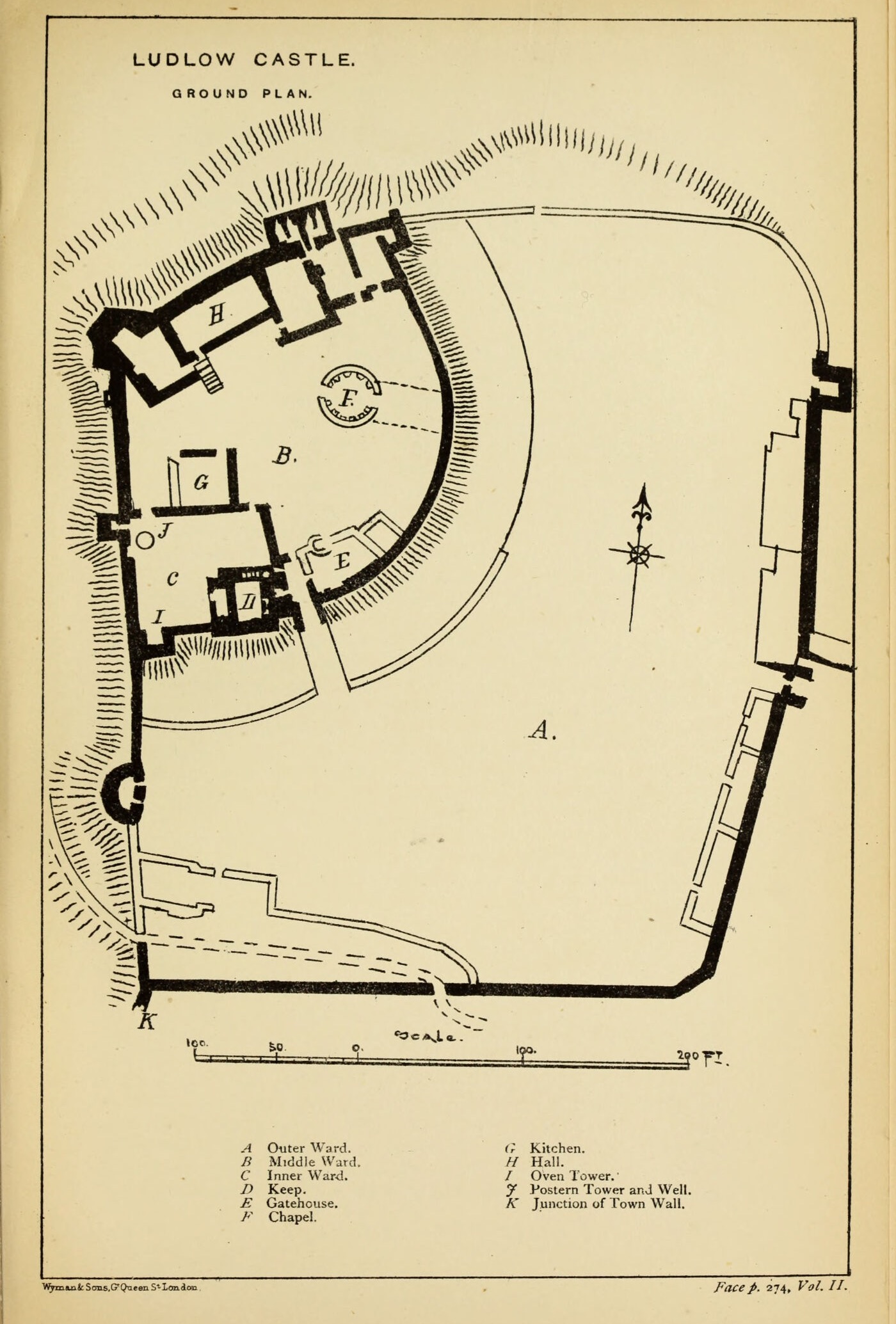
LUDLOW CASTLE. GROUND PLAN.
1884 · G. T. Clark, Mediaeval Military Architecture, vol. 2 (1884)
Public domain
Nearby


