England · Partial ruin
Lydford Castle
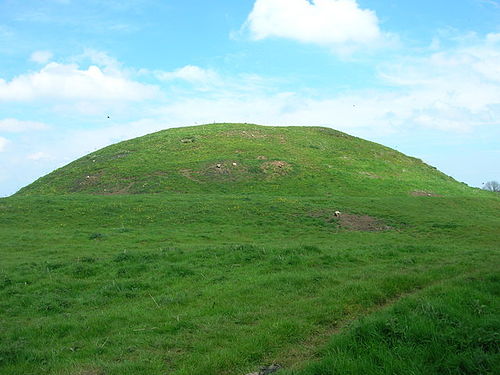
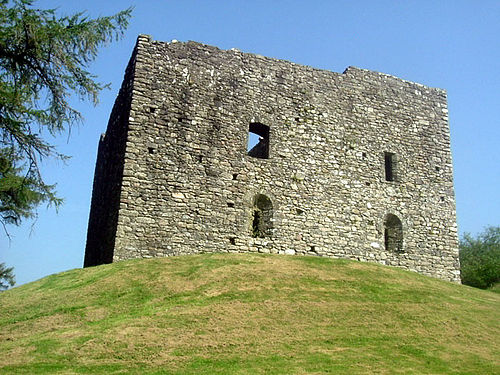
Lydford Castle is a medieval stone tower and bailey in the town of Lydford, Devon, long used as a prison and court administering stannary and forest law. The principal tower was rebuilt and deliberately set into an earthen mound in the mid-13th century and the site functioned as a legal centre for centuries. The separate early Norman ringwork earthworks survive nearby and are owned by the National Trust; the castle later passed to the Duchy of Cornwall and is now in state care.
Its prime
1265
Today
Partial ruin
As it stood in 1265
What Lydford Castle looked like in its prime.
Square stone tower roughly 15 by 14 metres, built of local slate and granite with very thick walls and narrow arrow slits, set part-buried into a man-made earth mound about 5 metres high around its base; the tower rises above a rectangular bailey protected by earthen ramparts and deep surrounding ditches. The tower exterior shows coursed granite repairs and a simpler higher upper storey; internally a spine wall divides each floor into two rooms and the ground level contains a deep cellar or pit.
Its story
The story of Lydford Castle.
The Norman Fort in the Burh, 1068-1150
In 1068 William the Conqueror intervened in South-West England to put down widespread Anglo-Saxon revolts, raising urban castles at Exeter, Totnes and Lydford. Lydford's first castle, the Norman fort, went up soon after in the isolated south-west corner of the Anglo-Saxon burh: a ringwork only 55 by 60 metres, protected in part by the burh's own defences and largely given over to grain stores. It was used only briefly and seems to have been abandoned by the mid-12th century. The grain stores were destroyed by fire, for unclear reasons.
A Strong House for Royal Prisoners, 1195-1199
In 1195, amid widespread problems with law and order across England, Richard I's government decided to build a fortification at Lydford for holding royal prisoners, beside the town church. It cost £74 from Crown revenues in Devon and Cornwall. The tower was square and free-standing, 52 feet across and at least two storeys tall, on flat ground with no mound, inside a rectangular bailey of ramparts and ditches. It lacked the usual military features of the time, such as external gatehouses, and seems meant to evoke authority rather than resist attack. When King John succeeded in 1199 he had it garrisoned and expensively equipped against unrest.
Tin, Forest Law and the Earls of Cornwall, 1198-1299
The Crown regulated Devon's tin trade through stannary law. In 1198 William of Wrotham, who controlled Lydford, was appointed Warden of the Stannaries, and from that year the castle was the prison supporting the Devon stannary court. In 1204 John curtailed the Forest of Dartmoor, whose officials met at Lydford to impose fines and punishments. Castle and forest were given in 1239 to Richard, Earl of Cornwall.
Around the 1260s the main tower was demolished and rebuilt, probably by Richard and possibly after a serious fire: the old walls were levelled off some 14 feet up and two better-built storeys raised on them, the prison on the first floor, a hall and chamber above for courtroom and keeper. An earth motte 17 feet high was piled around the base, turning the original ground floor into a cellar, probably the pit for low-status prisoners. The mound was almost certainly not a serious defence but probably an imitation of the older motte-and-bailey form, antiquated by then, heavily symbolic of power. Richard's son Edmund preferred Restormel and Lostwithiel, and by his death in 1299 Lydford had been left to decay.
Lydford Law, 1307-1650
The castle reverted to the Crown and passed in 1307 to Piers Gaveston, Edward II's favourite, as Earl of Cornwall; it was repaired early in the century and in use once again as a prison. In 1342 it came to Edward the Black Prince, Duke of Cornwall, who had it extensively repaired.
By the end of the 14th century the prison had a reputation for grim conditions, and the first known rhymes about "Lydford Law" date from 1399. In 1510 Richard Strode, an MP campaigning to reform stannary law, was arrested by stannary officials and shut in the keep; he later described an underground room, bread and water, and legcuffs worn until he paid the keeper to strike them off. A report of 1618 suggested it was unable to function as a prison; repairs followed in the 1620s and 1630s under Charles I.
In the civil war that broke out in 1642 the Royalist commander Sir Richard Grenville used Lydford as his main military prison in the region; Parliamentarians complained that it served to execute military prisoners summarily and extort money from civilians. Parliament appears to have sold the estate at the war's end; its surveyors assessed the castle as "almost totally ruined" in 1650, the site worth around £80.
From Stannary Courtroom to English Heritage
With the Restoration in 1660 castle and forest returned to the Duchy of Cornwall and the Lydford courts went on regulating the forest, though the building was not repaired; a report of 1704 noted the stannary laws could not be enforced without a working prison. Work completed in 1733 brought it back into good order. Early in the 19th century Sir Thomas Tyrwhitt, Lord Warden of the Stannaries, began building Dartmoor Prison at Princetown and the courts moved there; by 1833 the judicial fittings had been stripped out, and by the 1870s the roofs and floors had collapsed or been removed.
In 1932 the Duchy gave the castle to the Office of Works. English Heritage now runs it as a tourist attraction and the National Trust owns the earthworks of the Norman fort, also open to the public; both sites are protected as ancient monuments. The historian Andrew Saunders has described the castle as architecturally significant, "the earliest example of a purpose-built gaol" in England.
Step inside
9 places to explore in 1265.
The record describes 9 distinct spots at Lydford Castle, including 4 interiors: first-floor prison chambers / entrance level, ground-floor cellar / puteus (prison pit), second-floor hall and courtroom and more. Create your own photoreal reconstruction and explore every one, more scenes means more rooms, more angles, and more of the place to stand in.
Build Your Own Castle
Recreate Lydford Castle with AI to explore it.
The artist rebuilds it as it stood in 1265, a photoreal reconstruction that belongs to you alone. Pay with coins, no subscription needed.
Recreate this castle →Defend this castle →Nearby