
England · Partial ruin
Mitford Castle
Mitford Castle is a Norman motte-and-bailey castle on a small prominence above the River Wansbeck in Mitford, Northumberland. Its remains include squared ashlar inner and outer curtain walls, a distinctive pentagonal keep, and the ruins of a 12th-century chapel. The site is a Scheduled Ancient Monument and several elements are separately Grade I listed.
Its prime
1220
Today
Partial ruin
As it stood in 1220
What Mitford Castle looked like in its prime.
Sited on an elliptical grassy motte above the River Wansbeck, the castle is built of pale squared ashlar stone with fragments of inner and outer curtain walls visible along the ridge. A pentagonal keep sits on the highest northern point, rising to first-floor level. The west inner ward shows a large rounded arch set on a stepped plinth; the east curtain includes a round-arched gateway to a barmkin and a semicircular breastwork. The chapel survives as battered stone walls with a chancel arch.
Its story
The story of Mitford Castle.
Sybilla Mitford's Marriage and the Bertram Oppidum
There were few if any stone castles in England before 1066, and the land at Mitford was held after the Conquest by Sir John de Mitford. His only daughter and heiress, Sybilla, was given in marriage by William the Conqueror to the Norman knight Richard Bertram, and the manor went with her. By the late 11th century Mitford was an earthwork fortification of the Bertram family, set on a small, somewhat elliptical prominence above the River Wansbeck where the natural hill could be scarped and ditched into a motte. It enters the record in 1138 as William Bertram's oppidum.
King John's Troops, 1215, and the Seizure from Roger Bertram, 1264
In 1215 the castle was seized by the troops of King John. Stone came to Mitford in stages: an inner ward early in the 12th century, a triangular outer ward to the south and east late in the same century, and in the early 13th an unusual pentagonal keep raised on the highest ground at the north end, each of its five sides cut to a different dimension. In 1264 the stone castle was held by the third Roger Bertram, and in that same year it was seized from him and committed to the custody of William de Valence, 1st Earl of Pembroke and half-brother of King Henry. In 1275 it was in the hands of Alexander de Balliol, son of John de Balliol and elder brother of John Balliol, King of Scotland, the 'Toom Tabard' or empty coat.
Gilbert de Middleton's Gaol, 1315
During the rebellion in Northumberland in the 1310s, Mitford was seized from the Valence family by Sir Gilbert de Middleton and Sir John de Lilburn. In 1315 Sir Gilbert used it for kidnappings and as a gaol for high-profile prisoners: Lewis de Beaumont, Bishop of Durham, his brother Harry de Beaumont, and two Italian cardinals who had been travelling with the bishop from Darlington to Durham. Ralph de Greystoke seized de Middleton for treason, and he was taken to the Tower of London and executed.
"Entirely Destroyed and Burnt", 1323
Accounts of the castle's end conflict. One holds that it burned during Middleton's own rebellion; another that the Scots destroyed it in May 1318, while Middleton was imprisoned in the Tower. What is certain is the verdict of 1323, when an inquest held after the death of its then owner Aymer de Valence, Earl of Pembroke, recorded Mitford Castle as "entirely destroyed and burnt". Even a ruin still changed hands by force: by the death of David II Strathbogie, Earl of Atholl, in 1335, the castle had been seized from him.
Nothing was rebuilt on the mound. Mitford had been the first of three seats of the main line of the Mitford family on the manor lands; after its destruction they used Mitford Old Manor House, to the north-west, from the 16th century until Mitford Hall was built in 1828. The castle's mid-12th-century chapel was largely quarried away in the early 19th century, and in 1939 a cemetery came to light north of it, its headstones dating to the 12th century, at least one was moved to Mitford churchyard, others removed or vandalised. The Mitfords sold the estate, castle included, to the Bruce Shepherd family in 1993.
Step inside
9 places to explore in 1220.
The record describes 9 distinct spots at Mitford Castle, including 3 interiors: pentagonal keep interior (interior), chapel and chancel arch (interior/exterior), divided basement with barrel-vaulted chambers (interior). Create your own photoreal reconstruction and explore every one, more scenes means more rooms, more angles, and more of the place to stand in.
Build Your Own Castle
Recreate Mitford Castle with AI to explore it.
The artist rebuilds it as it stood in 1220, a photoreal reconstruction that belongs to you alone. Pay with coins, no subscription needed.
Recreate this castle →Defend this castle →Whose castle
Clans who held Mitford Castle.
The families that held Mitford Castle for a decade or more across its history, follow a name to its clan.
Mitford
The first seat of the main line of the Mitford family, who still owned the estate when it was sold to the Bruce Shepherd family in 1993.
Bertram
Fortress of the Bertram family from the late 11th century, William Bertram's oppidum in 1138, until seized from the third Roger Bertram in 1264.
Valence
Committed to William de Valence, 1st Earl of Pembroke, in 1264; seized from the Valence family in the 1310s, and Aymer de Valence was its owner at his death in 1323.
From the archive
Mitford Castle on paper: the measured plan and period views.
The survey plan and photographs below are the ground truth this page's reconstructions are checked against, drawn and photographed while the castle was still a working garrison. Every image is public-domain or openly licensed, with its source named.
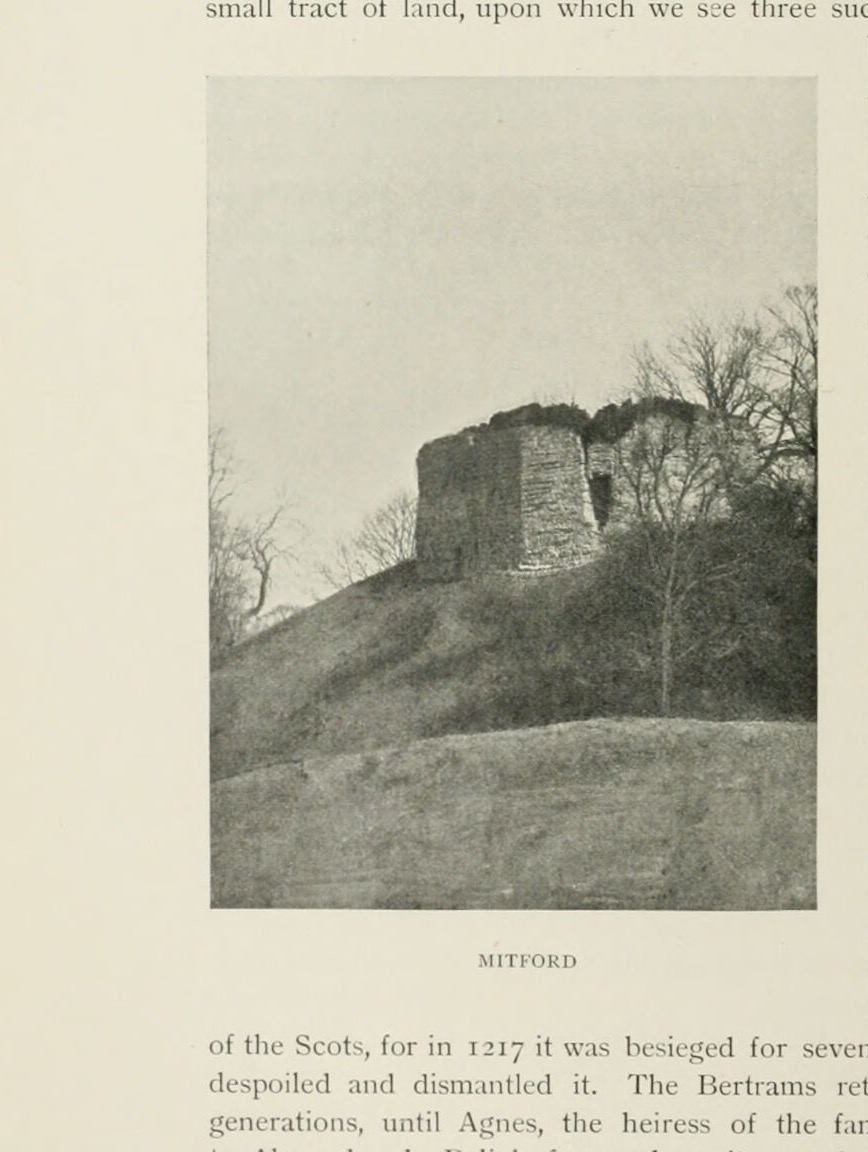
MITFORD
1897 · J. D. Mackenzie, The Castles of England, vol. 2 (1897)
Public domain
Nearby


