England · Restored
Naworth Castle
Naworth Castle is a medieval fortified residence in Cumbria, England, long associated with the Dacre family and later the Howards, Earls of Carlisle. The building preserves a medieval quadrangular plan with later additions and 19th‑century restorations and interiors influenced by Pre‑Raphaelite artists.
Its prime
1875
Today
Restored
As it stood in 1875
What Naworth Castle looked like in its prime.
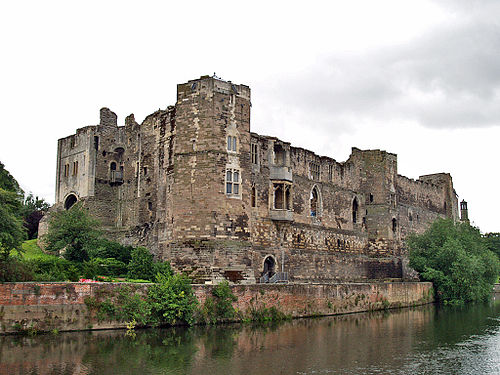
A long two‑storey rectangular stone range forming three sides of a quadrangle, terminated by two square crenellated towers; a central arched gateway pierces the south range. The façade is composed of weathered red‑brown sandstone with regular mullioned windows and a crenellated parapet hiding most roofs and chimneys. The castle sits amid rolling farmland and trees near the River Irthing, approached by a curving drive leading to the gateway and enclosed courtyard.
Its story
The story of Naworth Castle.
Ralph Dacre's Licence to Crenellate, 1335
Naworth is thought to have mid 13th-century origins, possibly as a peel tower with a square keep and bailey. The castle first appears in the record in 1323, and in 1335 Ralph Dacre was granted a licence to crenellate in the reign of Edward III. Set in border country within sight of Lanercost Priory across the River Irthing, it became a stronghold of the Lord Wardens of the Marches and the Dacres' impregnable fortress (the place they retreated to in times of trouble) extended by generation after generation of the family.
The Dacres were long established in Cumberland, famous for their exploits in checking the depredations of the Scots. Marriage tied them to the Nevilles, the Percys, the Greystokes, the Greys, the Parrs and the de Vaux, and those same links dragged them into the feuds within the Neville family, and between Percy and Neville, that ended in the Wars of the Roses.
The Builder Dacre and the Flodden Reserve
Thomas Dacre (1467–1525), who commanded the reserve of the English army at the Battle of Flodden, was known as "the Builder Dacre". He built the castle's gateway and set over it his coat of arms with the family motto beneath: Fort en Loialte: "Strong in Loyalty". The castle's Great Hall was the largest in the north, its 15-foot fireplace arched like a stone bridge.
Around 1520 Thomas commissioned the "Dacre Beasts", four six-foot heraldic figures believed carved from a single Cumbrian oak from the Naworth estate, which stood in the Great Hall beneath a ceiling painted with the kings and queens of England. They encode the family's history, elopements included: the dolphin (or salmon) stood for Elizabeth de Greystoke, whom Thomas carried off from Brougham Castle in 1488 while she was a ward of the King, and the white ram for Margaret de Moulton, whom Ralph Dacre had carried off from Warwick Castle. Rescued from the fire of 1844, the beasts remained in the hall until 2000, when the Victoria and Albert Museum purchased them.
Heiresses, the Duke of Norfolk and a Fugitive Uncle, 1566–1573
Thomas Dacre, 4th Baron Dacre, died in 1566, leaving his estates to his young son George. His widow Elizabeth married Thomas Howard, 4th Duke of Norfolk, and died in childbirth within a year; the Duke applied for wardship of her four children. Two years later George Dacre died in an accident, a minor without issue, and his sisters became co-heiresses. Norfolk married two of them, Anne and Elizabeth, to his sons Philip and William Howard, and so the Howard name, and in time the earldom of Carlisle, came into the Dacre inheritance.
The girls' uncle Leonard Dacre believed the estates should have come to him under his brother's will. After joining the Northern Rebellion against Queen Elizabeth he fled to Scotland and then to Flanders, where he died in poverty in 1573. Naworth passed to Lord William Howard through his wife Elizabeth Dacre, nicknamed "Bess of the Broad Apron" for the vastness of her northern estates. In June 1568, while Mary, Queen of Scots was held at Carlisle, it was noted that "Naward Castle is moated about, and much stronger for her detention", strong and fit for Mary, though the castle had no store of wine or beer.
The Fire of 18 May 1844
On Saturday 18 May 1844 the castle caught fire, possibly from soot igniting in the flue of the Porter's Lodge. With few internal walls to check it, the blaze spread to nearly every room on three sides of the quadrangle; by the time two fire engines arrived by train from Carlisle most of the roof had collapsed, and water had to be passed in buckets from a rivulet below the north side. "Belted Will's Tower" was saved, and the fire was brought under control around one o'clock on Sunday morning. Anthony Salvin directed the restoration, in which the former chapel became the library.
Under George Howard, 9th Earl of Carlisle (patron and friend of Burne-Jones, William Morris and Philip Webb) the rebuilt interiors took on Pre-Raphaelite designs, including a library bas-relief of Lord Thomas Dacre's charge at Flodden. Morris, visiting in 1874, called Naworth "the most poetical in England". Rossall School occupied the castle in 1939–40 after evacuating its Lancashire buildings, and Naworth remains the principal seat of the Howard Earls of Carlisle.
Step inside
10 places to explore in 1875.
The record describes 10 distinct spots at Naworth Castle, including 3 interiors: great hall, library (former chapel), dungeons and long staircase. Create your own photoreal reconstruction and explore every one, more scenes means more rooms, more angles, and more of the place to stand in.
Build Your Own Castle
Recreate Naworth Castle with AI to explore it.
The artist rebuilds it as it stood in 1875, a photoreal reconstruction that belongs to you alone. Pay with coins, no subscription needed.
Recreate this castle →Defend this castle →Whose castle
Clans who held Naworth Castle.
The families that held Naworth Castle for a decade or more across its history, follow a name to its clan.
Dacre
Seat of the Barons Dacre from Ralph Dacre's 1335 licence to crenellate; Thomas "the Builder" Dacre (1467–1525) added the gateway.
Under the control of the Duke of Norfolk from the late 16th century; now the seat of the Howard Earls of Carlisle, cognatic descendants of the Dacres.
From the archive
Naworth Castle on paper: the measured plan and period views.
The survey plan and photographs below are the ground truth this page's reconstructions are checked against, drawn and photographed while the castle was still a working garrison. Every image is public-domain or openly licensed, with its source named.
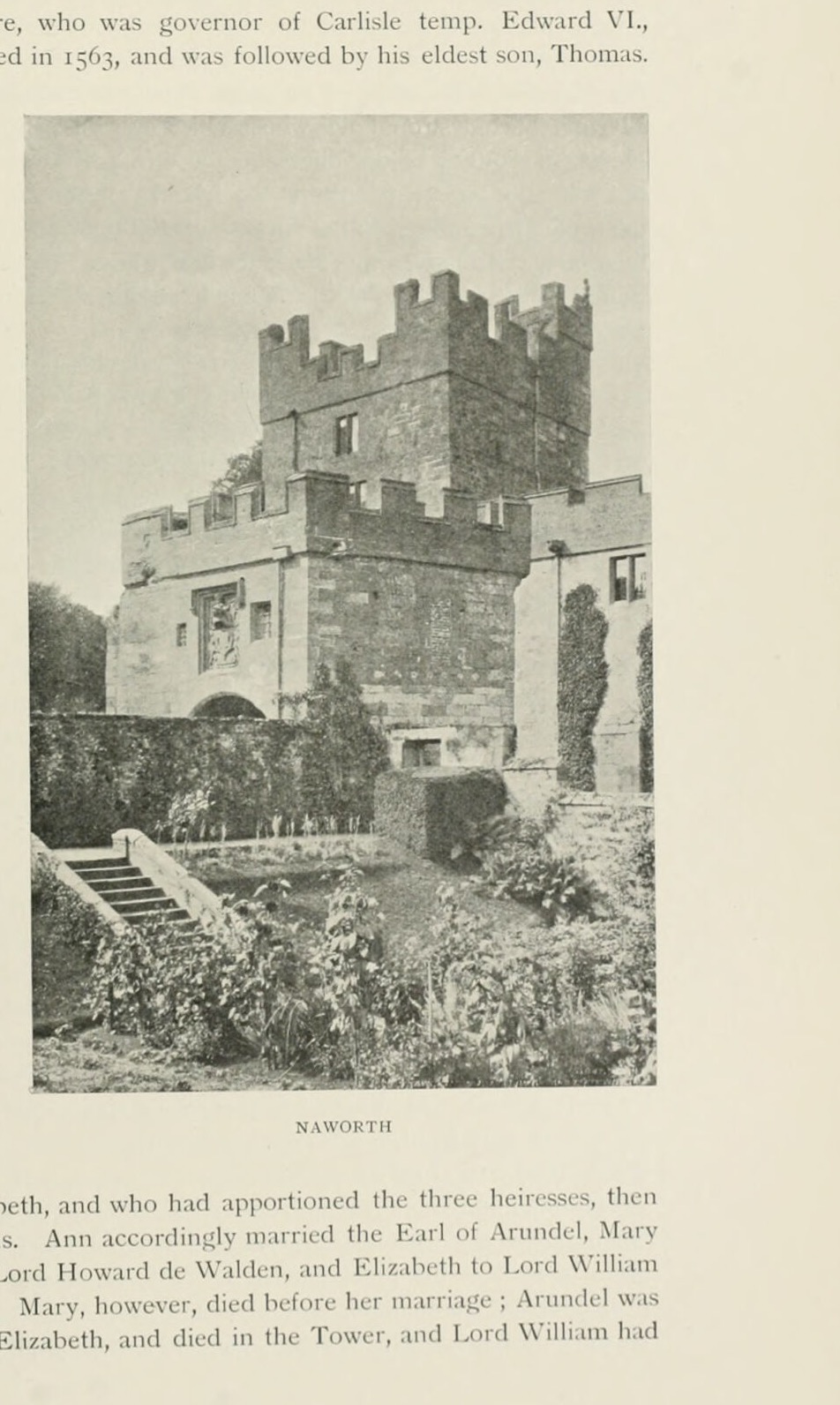
NAWORTH
1897 · J. D. Mackenzie, The Castles of England, vol. 2 (1897)
Public domain
Nearby