
England · Restored
Norwich Castle
Norwich Castle is a Norman royal castle founded by William the Conqueror and built as a stone keep on a high motte within the city of Norwich. The medieval keep later served as a county gaol for centuries and was converted into a museum in the late 19th century; the keep has since been conserved and reconstructed to present its early 12th-century appearance.
First raised
1066
Its prime
1121
Today
Restored
As it stood in 1121
What Norwich Castle looked like in its prime.
A massive square Norman stone keep set atop a high grassy motte in the urban centre; the pale ashlar-faced walls are vertically articulated with groups of paired arched windows, bands of blind arcading and narrow slit openings, rising to a crenellated parapet with squared merlons and a flat roofline behind the battlements. The keep’s eastern forebuilding (Bigod Tower) is reached by an external stone stair; in its prime the stonework and defensive silhouette are complete and intact.
Its story
The story of Norwich Castle.
Raised Over Norwich's Saxon Dead, 1066-1086
William the Conqueror ordered the castle built in the aftermath of the Norman Conquest, and it was founded between 1066 and 1075 as a motte and bailey, probably early in 1067 as William campaigned to subjugate East Anglia. The town paid for it: estimates of houses destroyed to clear the ground run from 17 to 113, and excavation in the late 1970s found the bailey laid straight over a Saxon cemetery. Named among 48 castles in the Domesday survey of 1086, it was the only major royal castle in East Anglia until Henry II raised Orford in the mid-12th century.
Emma and the Revolt of the Earls, 1075
The earliest recorded incident here is a siege. In 1075 Ralph de Gael, Earl of Norfolk, co-led the rising remembered as the Revolt of the Earls, then went abroad to raise Danish support and left his wife Emma in charge of the garrison. The Danes never came. Troops loyal to William held the castle under siege for three months, and it ended not in storm but in terms. Emma secured promises that she and her garrison would be unharmed and given safe passage out of the country.
The Stone Keep and Bigod's Flemings, 1094-1174
By about 1100 the motte had been heightened and its ditch deepened, and between 1094 and 1121 a stone keep went up on the south-west of the mound, faced in Caen stone over a flint core, some 95 ft by 90 ft and 70 ft high, entered at first-floor level through a forebuilding later known as the Bigod Tower. It was a hall-keep with a kitchen, a chapel, a two-storey hall and sixteen latrines; the 19th-century antiquary G. T. Clark called it “the most highly ornamented keep in England”.
When Henry II's sons rebelled in 1173-74 the castle was put in a state of readiness and taken anyway. Hugh Bigod, 1st Earl of Norfolk, landed 318 Flemish soldiers in May 1174 and advanced on Norwich with 500 men of his own, holding fourteen prisoners for ransom; peace later that year returned the castle to the king. In Lent 1190, when the violence against East Anglia's Jews reached Norwich on Shrove Tuesday, the castle sheltered those who got inside it. Those who could not were massacred.
The County Gaol, 1220-1887
Prisoners were held here early, state prisoners in 1264 and 1274, and an Act of Parliament in 1340 gave sheriffs control of the prisons inside royal castles, making Norwich the public gaol of Norfolk while the king kept ownership and named its constable. By the 18th century the stone had blackened, the battlements decayed, and the ditch served the city as a rubbish tip. The reformer John Howard came six times between 1773 and 1782, recording at most 53 inmates split between felons and debtors, and criticised the limited separate accommodation for women.
John Soane gutted the keep's interior for cells between 1789 and 1793 at a cost of £15,000, burying the Bigod Tower behind a new block for debtors and women. An Act of 12 July 1806 vested the castle in the magistrates of Norfolk, ending more than 700 years of royal ownership. The architect William Wilkins then rebuilt it again by 1828 for £50,000, spreading cell wings across the mound from an octagonal governor's house: 240 cells in the wings, 36 in the keep, and a foot tunnel along which prisoners were walked to the crown court.
Felons were hanged publicly on a gallows on the bridge behind the entrance lodges, or privately inside the gaol. On 7 December 1549, at Edward VI's behest, Robert Kett was drawn from the Guildhall and hanged in chains from a gibbet on the keep's west face for leading the rebellion that carries his name. James Blomfield Rush was hanged before thousands of spectators on 21 April 1849 for murdering the Norwich Recorder Isaac Jermy and his son at Stanfield Hall. The gaol closed on 2 August 1887, when every prisoner was moved to the new HMP Norwich at Mousehold Heath.
Museum in 1894, Royal Palace Reborn in 2025
The city bought the castle for a museum. Edward Boardman swept Soane's cells out of the keep, put in floors, balconies and Norman-style arches to carry a glazed roof, and turned the cell blocks into galleries; the Duke and Duchess of York opened it on 23 October 1894. The outer shell had already been refaced in Bath stone under Anthony Salvin between 1835 and 1839, a job the etcher Edward Thomas Daniell denounced in the Norwich Mercury as a “scandalous re-facing of the ancient keep”.
A £27m reconstruction begun in 2020 and titled Royal Palace Reborn reinstated the keep's lost floors and rooms, among them the Great Chamber and a banquet hall, furnished as they might have greeted Henry I on his stay at Norwich in 1121. Delayed by the pandemic and by what the builders uncovered, it reopened in August 2025.
Step inside
6 places to explore in 1121.
The record describes 6 distinct spots at Norwich Castle, including 2 interiors: upper-floor hall of the keep, lower chamber of the keep. Create your own photoreal reconstruction and explore every one, more scenes means more rooms, more angles, and more of the place to stand in.
Build Your Own Castle
Recreate Norwich Castle with AI to explore it.
The artist rebuilds it as it stood in 1121, a photoreal reconstruction that belongs to you alone. Pay with coins, no subscription needed.
Recreate this castle →Defend this castle →From the archive
Norwich Castle on paper: the measured plan and period views.
The survey plan and photographs below are the ground truth this page's reconstructions are checked against, drawn and photographed while the castle was still a working garrison. Every image is public-domain or openly licensed, with its source named.
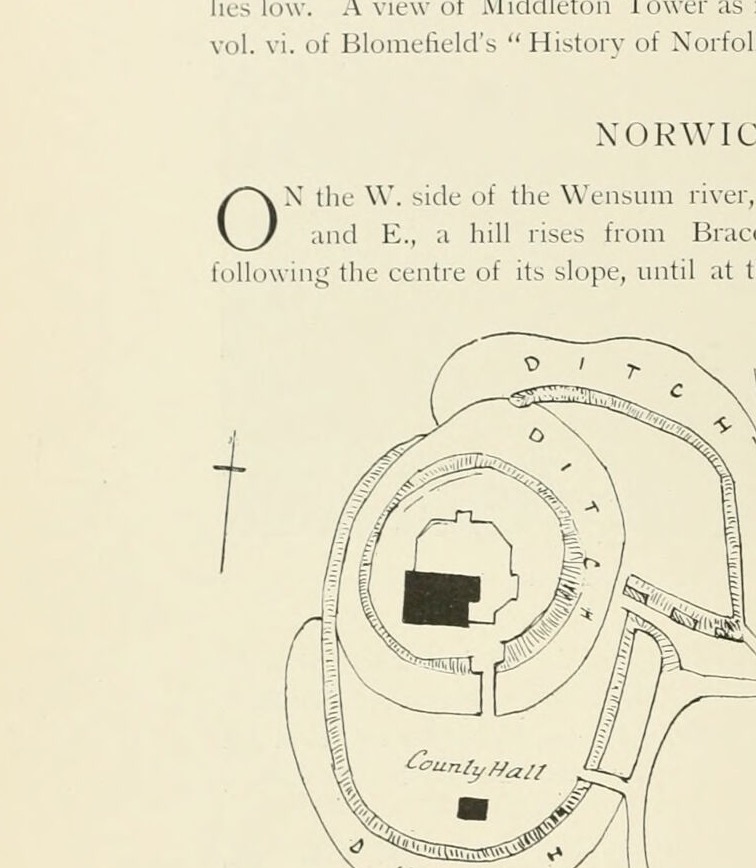
NORWICH
1897 · J. D. Mackenzie, The Castles of England, vol. 1 (1897)
Public domain
Nearby
Landmarks within reach of Norwich Castle.


Questions about Norwich Castle
What is the history of Norwich Castle?
What is inside Norwich Castle?
Who owns Norwich Castle now?
Why was Norwich Castle built, and what was it used for?
Where is Norwich Castle?
When was Norwich Castle built?
Was Norwich Castle ever attacked or besieged?
What did Norwich Castle look like in its prime?
Is Norwich Castle still standing, or is it a ruin?
Can you visit Norwich Castle?
More castles of England


Explore the city


