England · Ruin
Nunney Castle
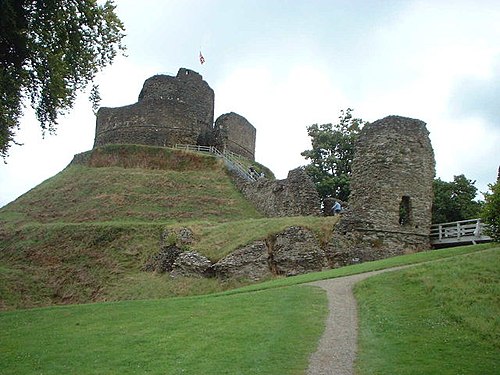
Nunney Castle is a late 14th-century moated tower-keep in Nunney, Somerset, built by Sir John Delamare and remodelled in the late 16th century. The castle retains its four large round corner towers and central stone tower-keep but was damaged in the English Civil War and is now a ruin managed by English Heritage.
Its prime
1590
Today
Ruin
As it stood in 1590
What Nunney Castle looked like in its prime.
A compact rectangular stone tower-keep set within a full water-filled moat, built of pale Lias Oolite ashlar. Each of the four corners is occupied by a massive cylindrical tower with conical roofs and a continuous machicolated parapet; the keep rises three storeys with narrow slit windows at lower levels and larger upper windows added in the 16th-century remodelling. A modest entrance is reached by a timber drawbridge across the moat, and a low bailey wall encloses the outer edge of the site.
Its story
The story of Nunney Castle.
Sir John Delamare's Licence to Crenellate, 1373
Sir John Delamare had soldiered in the Hundred Years War with France and made his fortune there. In 1373 he obtained a licence to crenellate from Edward III for a castle on the site of the unfortified manor house he already held near the Somerset village of Nunney.
The result was a stone tower-keep, 60 feet by 24 feet internally and 54 feet tall, with four round corner-towers under conical roofs and prominent machicolations. Its walls were eight feet thick, in Lias Oolite ashlar, over three floors: kitchen and service rooms at ground level, the family's living accommodation on the third, and the two floors between still argued over - hall above service rooms, hall below, or, on a minority view, an armoury.
A drawbridge crossed a moat that at first ran right up to the base of the keep, ten feet deep and difficult for a besieger to drain, while the bailey wall enclosing it stood only twelve feet high and was of minimal defensive value. On the east side Nunney Brook served instead of a wall.
The Argument Over a French Design
Nunney's plan has provoked considerable academic debate. Adrian Pettifer and Stuart Rigold read it as a design shaped by the French castles Delamare would have seen on campaign - it closely resembles the Bastille in Paris, and its machicolations are typical of French work - and as a conservative, even slightly backward design probably built against French invasion. Robert Liddiard and Matthew Johnson are less certain: there is no direct evidence of deliberate imitation, and English castles such as Mulgrave and Dudley share a similar structure. Nunney may be better understood as one of a wider range of tower-keeps built in England in the period, in Nigel Pounds's phrase, "to allow very rich men to live in luxury and splendour".
Delameres, Poulets and Praters
The castle passed to John's son Philip Delamere and then to his grandson Elias, and by marriage into the Poulet family after Elias probably died during Henry V's campaigns in France. Three generations of Poulets, all named John, held Nunney through most of the 15th century, though the family's primary residence was Basing Castle in Hampshire.
William Paulet, Marquess of Winchester, was the last of the family to own it; after his death in 1572 the castle changed hands quickly. Swithun Thorpe sold it to John Parker in 1577, and Parker kept it a single year before selling to Richard Prater for £2,000. The Praters were probably behind the remodelling of the later 16th century: windows enlarged to let in more light, a grand staircase built into one of the towers, a Catholic altar installed, and a revetted terrace raised around the inside of the moat, leaving it twenty-five feet wide.
Colonel Prater's Siege, 1645-1660
The Roman Catholic Praters still held Nunney when civil war broke out in 1642, and Colonel Richard Prater, like many Catholics, took the king's side. As the Royalist position deteriorated the south-west became one of its few remaining strongholds; Nunney was garrisoned against Parliamentary attack and took in refugees, many of them Catholic.
In September 1645 a Parliamentary army under Lord Fairfax and Oliver Cromwell advanced into Somerset, taking Sherborne, Cary and Shepton Mallet before turning to Nunney. Two regiments with cannon surrounded the castle on 18 September; when Prater refused to surrender they opened fire on the north side and breached the wall. He resisted still, hoisting a flag with a Catholic crucifix to taunt the besiegers, but the garrison surrendered two days later.
The cannon damage spared Nunney the deliberate slighting inflicted on many castles at the end of the war. Prater was nonetheless forbidden to return despite promising to support Parliament, and his son George recovered it from its interim owners only after Charles II was restored in 1660.
From William Whitchurch to English Heritage
The Praters sold it to William Whitchurch around 1700. It remained in reasonable condition through the 18th century; an order came in 1789 to ready it for French prisoners, who are unlikely ever to have arrived.
By the 20th century it was increasingly ruined and covered in thick ivy, and on 25 December 1910 a portion of the damaged north wall collapsed entirely - most of the fallen stone is believed to have been stolen by local residents. The castle was scheduled as a monument in 1915, and in 1926, with its fabric under threat, the owner Robert Baily-Neale transferred it to the Commissioner of Works, who began a programme of restoration. English Heritage runs the site as a tourist attraction; Nikolaus Pevsner called it "aesthetically the most impressive castle in Somerset".
Step inside
10 places to explore in 1590.
The record describes 10 distinct spots at Nunney Castle, including 5 interiors: ground-floor kitchen and service rooms, spiral grand staircase in a corner tower, the great hall (principal floor) and more. Create your own photoreal reconstruction and explore every one, more scenes means more rooms, more angles, and more of the place to stand in.
Build Your Own Castle
Recreate Nunney Castle with AI to explore it.
The artist rebuilds it as it stood in 1590, a photoreal reconstruction that belongs to you alone. Pay with coins, no subscription needed.
Recreate this castle →Defend this castle →Whose castle
Clans who held Nunney Castle.
The families that held Nunney Castle for a decade or more across its history, follow a name to its clan.
Delamare
Built in the late 14th century by Sir John Delamare; held by his son and grandson.
Poulet
Held by the Poulets from the early 15th century until the death of William Paulet, Marquess of Winchester, in 1572.
Prater
Bought by Richard Prater in the late 1570s for £2,000; the Catholic Praters held it until c.1700.
Nearby