England · Ruin
Odiham Castle
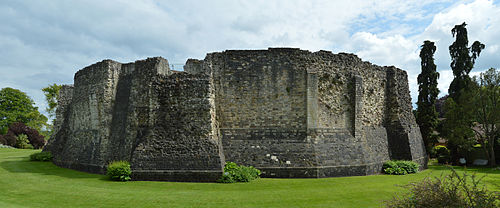
Odiham Castle (also called King John's Castle) is a medieval royal castle near Odiham in Hampshire, England, begun under King John from 1207. At its height it comprised a three-storey octagonal stone keep, inner and outer moats and two moated baileys with associated domestic buildings. Today the site is a ruin: only part of the octagonal keep and earthworks are visible and the site is open to the public.
First raised
1207
Its prime
1239
Today
Ruin
As it stood in 1239
What Odiham Castle looked like in its prime.
A compact castle dominated by a three-storey octagonal stone keep of pale flint-rubble, set within a concentric defence of an inner round moat and an outer square moat with two moated baileys. Raised earth banks and wooden palisades ring the baileys; the keep has regularly spaced arched openings and small square embrasures in its face. Domestic ranges and service buildings bridge and overhang the inner moat; the whole sits beside a bend in the River Whitewater.
Its story
The story of Odiham Castle.
King John's Fortress on the Whitewater, 1207–1214
Odiham is one of only three fortresses King John built during his reign. Work began in 1207 on twenty acres acquired from the local lord, Robert the Parker, by modifying a bend in the River Whitewater. The site lay halfway between Windsor and Winchester, and John had visited the area in 1204; both have been offered as reasons for his choice.
Seven years' building produced a three-storey stone keep, an inner round moat and an outer square moat, two moated baileys, and raised banking with palisades. Notably, the stronghold also held a domus regis, a king's house. Surviving records of expenditure put the total spent between the start of work in 1207 and its end in 1214 at £1,000.
Runnymede, the French Siege and the Repaired Keep, 1215–1225
In 1215 it was from either Odiham or Windsor that King John rode out to Runnymede, where he met the barons and attached his seal to Magna Carta. A year later, during the First Barons' War, the castle was taken by the French after a two-week siege: a garrison of just thirteen surrendered on 9 July 1216.
At some point over the following nine years the keep was renovated, possibly to remedy the damage done by the French. It has been suggested that the mound the keep sat on was raised by five metres in the same campaign of work, and that the inner moat was added then, though that moat was more likely already in place before the siege.
Eleanor, Simon de Montfort and the Return to the Crown, 1236–1265
Henry III granted Odiham to his sister Eleanor, King John's daughter, in 1236; two years later she married Simon de Montfort. In 1239 a kitchen was built on a bridge over the inner moat and a new hall added on the outside of the keep, and in the same period a further building went up over the moat on the south-eastern side to provide extra living space. De Montfort rebelled against Henry in 1263 and died at the Battle of Evesham in 1265. Eleanor was exiled, and Odiham was again retained by the Crown.
Parliament and King David's Captivity, 1303–1357
The royal manor of Odiham, which predates the castle, hosted Parliament at least once, in 1303. David II of Scotland, captured at the Battle of Neville's Cross in 1346, was imprisoned at Odiham for eleven years, held under light guard and allowed to keep a household. Using the castle as a prison seems to have been common practice in the 13th and 14th centuries; the nearby manor of Greywell was required to provide guards one night in three.
Hunting Lodge, Canal and Shell Keep, 1400s–2007
By the 15th century Odiham was used only as a hunting lodge, and in 1605 it was described as a ruin. In 1792 the Basingstoke Canal was cut through the southern corner of the bailey; the most southerly corner of the moat survives as a small overgrown pond on the far side of the canal from the rest of the site. Archaeological excavations were carried out in 1953 and again between 1981 and 1985, the later series by Hampshire County Council Museum Services.
The remains have been a Grade I listed building since November 1961 and are a scheduled monument. In September 2007 Hampshire County Council restored the shell keep under guidance from English Heritage. The ruin is open to the public.
Step inside
8 places to explore in 1239.
The record describes 8 distinct spots at Odiham Castle, including 2 interiors: new hall on the outside of the keep, domus regis (king's house) domestic block. Create your own photoreal reconstruction and explore every one, more scenes means more rooms, more angles, and more of the place to stand in.
Build Your Own Castle
Recreate Odiham Castle with AI to explore it.
The artist rebuilds it as it stood in 1239, a photoreal reconstruction that belongs to you alone. Pay with coins, no subscription needed.
Recreate this castle →Defend this castle →From the archive
Odiham Castle on paper: the measured plan and period views.
The survey plan and photographs below are the ground truth this page's reconstructions are checked against, drawn and photographed while the castle was still a working garrison. Every image is public-domain or openly licensed, with its source named.
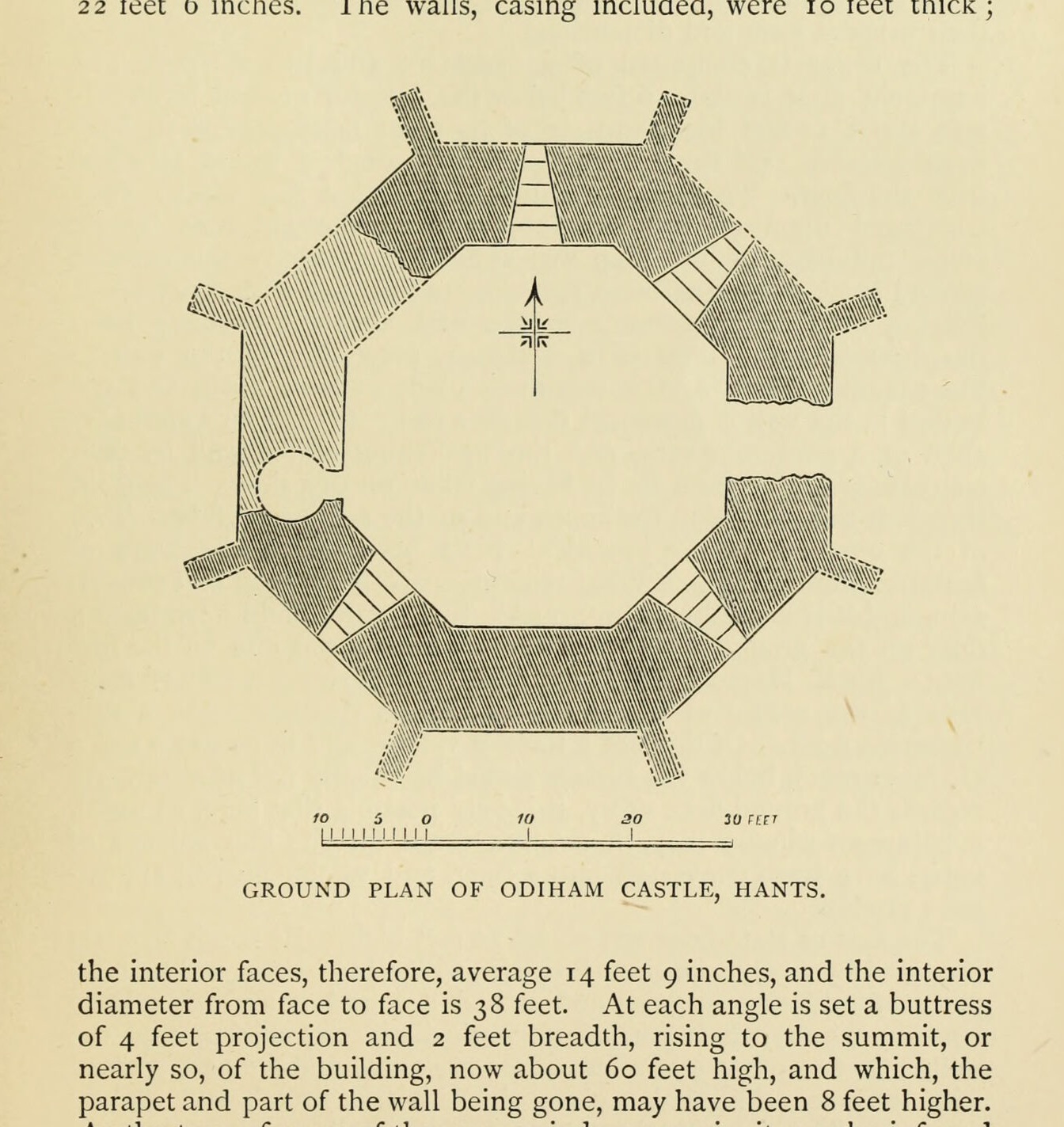
GROUND PLAN OF ODIHAM CASTLE, HANTS.
1884 · G. T. Clark, Mediaeval Military Architecture, vol. 2 (1884)
Public domain
Nearby