
England · Ruin
Old Sarum
Old Sarum is the earthwork and ruin of the earliest settlement of Salisbury, sited on a prominent hill in Wiltshire with visible Norman castle earthworks, stone curtain, and the footprint of a cathedral and palace. The site preserves concentric banks and ditches and low stone ruins arranged around an oval inner bailey and outer enclosures, and is an English Heritage visitor site.
Its prime
1150
Today
Ruin
As it stood in 1150
What Old Sarum looked like in its prime.
Sited on a broad oval hilltop, Old Sarum is defined by a continuous circular bank and wide ditch enclosing an inner bailey; within this the low, pale limestone remains of a Norman stone curtain form an irregular rectangular cluster of walls and foundations. To the north-west lie the long rectangular foundations of the cathedral precinct, while a large palace complex occupied the south-east quadrant; approach is by an eastern causeway and gate through the earthwork.
Its story
The story of Old Sarum.
Sorviodunum, and the Hill Cynric Took in 552
Signs of prehistoric settlement on the hill go back as far as 3000 BC, and around 400 BC, in the Iron Age, the people living there threw up a fort called Sorviodunum (an oval of enormous banks and ditches, 400 metres in length by 360 in width, with a double bank, a ditch between them and an entrance on the eastern side) set to control the crossing of two trade paths and the River Avon. Occupation carried on through the Roman period, when the old trade paths were made into roads.
Cynric, king of Wessex, captured the hill in 552, and it stayed Wessex ground thereafter, but the Saxons preferred bottomland sites such as nearby Wilton and largely left it alone until the Viking invasions moved King Alfred to restore its fortifications. Egbert of Wessex was often in residence there early in the 9th century, and in 960 King Edgar assembled a national council on the hill to plan the defence against the Danes in the north. In 1003 its people abandoned it, along with Wilton, to be sacked and burned by the Dano-Norwegian king Sweyn Forkbeard; it later became the site of Wilton's mint.
The Oath of Salisbury and the First Cathedral
A motte-and-bailey castle stood here by 1069, three years after the Norman Conquest. It was held directly by the Norman kings, and its castellan was generally also the sheriff of Wiltshire, an arrangement that would matter a great deal later. In 1075 the Council of London made Herman the first bishop of Salisbury, uniting his former sees of Sherborne and Ramsbury into a diocese covering Dorset, Wiltshire and Berkshire; he and Saint Osmund began the first Salisbury cathedral on the hill, and neither lived to see it finished in 1092.
The Domesday Book was probably presented to William at Old Sarum in 1086, the year he summoned the prelates, nobles, sheriffs and knights of his dominions to the hill to pay him homage in the Oath of Salisbury. Two further national councils followed, one held by William Rufus in 1096 and one by Henry I in 1116 that has sometimes been called the first English Parliament. The cathedral was consecrated on 5 April 1092 and then badly damaged in a storm, said by tradition to have struck only five days afterwards.
Bishop Roger's Palace and Henry II's Prisoner
Bishop Roger was a close ally of Henry I, served as his viceroy while the king was in Normandy, and ran the royal administration and exchequer with his extended family. In the 1110s he refurbished and enlarged the cathedral, work that doubled its length and required the ecclesiastical quarter in the north-west of the town to be levelled on a large scale, and during the 1130s he began a royal palace: long assumed to be the small structure whose ruins lie in the central bailey, but perhaps instead the large one lately identified in the south-east quadrant of the outer bailey, 170 metres by 65 around a great central courtyard, with walls up to three metres thick. Stephen arrested him before the work was done; the castle Roger had been administering on the king's behalf was thereafter left to fall into disrepair, though the sheriff and castellan went on governing the area under the king's authority.
The town was not merely a fortress: it had industrial works including kilns and furnaces, and its residential quarters lay chiefly in the two southern quadrants, built up against the ditch that protected the inner bailey. Henry II held his wife, Eleanor of Aquitaine, prisoner at Old Sarum, and in the 1190s the plain between Old Sarum and Wilton was one of five grounds Richard I set aside for the holding of English tournaments.
Cardinal Gualo's Verdict and the Move of 1219
William of Malmesbury, writing early in the 12th century, called Sarum a town "more like a castle than city, being environed with a high wall", and observed that "such was the want for water that it sold at a great rate". Holinshed contradicted him, calling the hill "very plentifully served with springs and wells of very sweet water"; excavation has turned up numerous wells, one of them inside the Norman keep, but suggests they were so deep that using them was more trouble than carting water up from the rivers. Water was the argument put to Richard and John as the chief reason for moving the cathedral, though it was plainly not the whole of it. The late 12th-century canon Peter of Blois called his prebend "barren, dry, and solitary, exposed to the rage of the wind" and the cathedral itself "as a captive on the hill where it was built, like the ark of God shut up in the profane house of Baal", and Holinshed records the clerics brawling openly with the garrison troops.
Bishop Herbert obtained permission to move from Richard I, who was well disposed towards a diocese he had discovered was holding £90,000 in coin in trust for his father; John's succession forced the change to be put off. Herbert's brother Richard Poore was translated from Chichester to succeed him in 1217 by papal order, and the following year Sarum's dean and chapter laid their arguments before Rome. The papal legate Cardinal Gualo investigated and confirmed them: the water was expensive and at times restricted by the castellans; there was not enough housing inside the walls for the clerics, who had to rent from the laity; the wind could blow so hard that the divine offices could not be heard and the roof was damaged again and again; and the soldiers of the royal fortress shut ordinary people out of the cathedral precinct when the Eucharist was to be given.
Pope Honorius III issued the indulgence to relocate on 29 March, in 1217 or 1218 by different reckonings, and the chapter voted unanimously, undertaking to pay for the move by withholding portions of their prebends over seven years. On Easter Monday 1219 a wooden chapel dedicated to the Virgin Mary was begun near the banks of the Hampshire Avon, and on St Vitalis's Day, 28 April 1220, the foundation of the stone cathedral was laid. The settlement that grew around it was New Salisbury, then formally New Sarum, then simply Salisbury.
Quarried Away, and the Most Notorious Rotten Borough
The old cathedral was formally dissolved in 1226, and the people of the new city gradually pulled the old one down, building Salisbury Cathedral and much else out of the materials taken from the hill. Quarrying evidence running into the 14th century shows some continued habitation, but the settlement was largely deserted, Edward II ordered the castle demolished in 1322, and Henry VIII sold the castle grounds in 1514.
From Edward II's reign the borough of Old Sarum returned two Members of Parliament to the Commons, and from at least the 17th century it did so with no resident voters at all, a pocket borough of the Pitt family, one of whose members in the 18th century was William Pitt the Elder. In 1831 it had eleven voters, every one of them a landowner living somewhere else, which made it the most notorious of the rotten boroughs; the Reform Act 1832 absorbed it into an enlarged borough of Wilton. The site of castle and cathedral was among the 26 English locations scheduled under the Ancient Monuments Protection Act of 1882, the first British legislation of its kind, and in 2014 a geophysical survey by the University of Southampton brought the royal palace and the street plan of the medieval city back out of the empty ground.
Step inside
9 places to explore in 1150.
The record describes 9 distinct spots at Old Sarum, including 4 interiors: interior of the cathedral nave and east-west axis, royal palace courtyard and the 60-metre great hall, norman keep interior and deep well and more. Create your own photoreal reconstruction and explore every one, more scenes means more rooms, more angles, and more of the place to stand in.
Build Your Own Castle
Recreate Old Sarum with AI to explore it.
The artist rebuilds it as it stood in 1150, a photoreal reconstruction that belongs to you alone. Pay with coins, no subscription needed.
Recreate this castle →Defend this castle →From the archive
Old Sarum on paper: the measured plan and period views.
The survey plan and photographs below are the ground truth this page's reconstructions are checked against, drawn and photographed while the castle was still a working garrison. Every image is public-domain or openly licensed, with its source named.
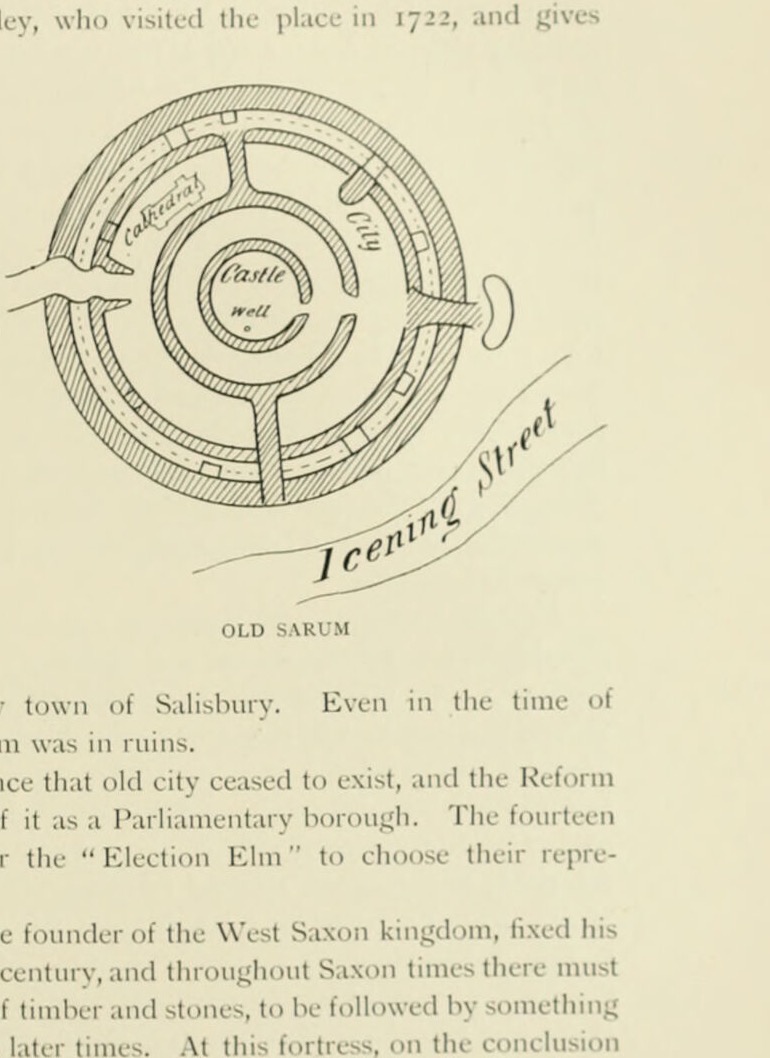
OLD SARUM
1897 · J. D. Mackenzie, The Castles of England, vol. 1 (1897)
Public domain
Nearby


