
England · Ruin
Old Sarum Castle
Old Sarum Castle is an 11th-century motte-and-bailey castle built within an older Iron Age hillfort at Old Sarum, Wiltshire. The castle was rebuilt in stone and later expanded with a royal palace, hall, and service buildings; today only earthworks and low stone foundations survive and the site is managed by English Heritage.
Its prime
1215
Today
Ruin
As it stood in 1215
What Old Sarum Castle looked like in its prime.
A circular motte-and-bailey plan on a raised earthen mound with a broad ditch surrounding the outer bailey; low, pale stone curtain and foundation walls outline buildings around the inner enclosure. The motte (central mound) bears the truncated stone base of a keep and adjacent rectangular foundation blocks of a great hall and service ranges in the southeast quadrant. An eastern approach with a gatehouse and causeway crosses the ditch; interiors are grassy and open atop the earthworks.
Its story
The story of Old Sarum Castle.
William the Conqueror Fortifies Seresberi, 1069
In 1069, having recognised the defensive qualities of Seresberi, the place now known as Old Sarum, William the Conqueror raised a motte-and-bailey castle inside an older Iron Age hillfort called Sorviodunum, itself constructed around 400 BC. The castle went up first in timber and was eventually rebuilt in stone.
Bishop Roger's Palace and His Arrest by Stephen
The courtyard was added around 1100 by Bishop Roger, who directed the royal administration and the exchequer from Old Sarum along with his extended family, and who began work on a royal palace during the 1130s, before his arrest by Henry's successor, Stephen. At the time of that arrest Roger was administering the castle on the king's behalf; afterwards it was allowed to fall into disrepair, though the sheriff and castellan continued to administer the area under the king's authority.
Which building was Roger's palace is unsettled. It was long thought to be the small structure whose ruins lie in the central bailey, but it may instead have been the large palace found more recently in the south-east quadrant of the outer bailey: 170 by 65 metres around a large central courtyard, with walls up to three metres thick, a room 60 metres long that was probably a great hall, and what appears to have been a large tower.
Henry II's Works and Eleanor of Aquitaine, 1171–1215
In 1171 Henry II ordered improvements at Old Sarum (a new gatehouse, a drawbridge, inner bailey walls, and a treasury built within the keep), and the work continued until 1189. A refurbishment of the quarters of Eleanor of Aquitaine, who was held under house arrest at Old Sarum until that same year, was also undertaken. A new hall, kitchen and bakehouse for the sheriff of Wiltshire followed, begun about 1201 and completed by 1215.
Abandonment, Demolition and Sale, 1220–1514
By 1220 most of the population of Old Sarum had relocated to Salisbury; the castle went unused and was in decay by 1240. It was later repaired, only to be demolished by King Edward III in 1322. Around 1350 Edward III ordered £700 to be spent on repairs and maintenance of the castle at Old Sarum, but a further £600 required to repair the keep was never spent, and its fabric began to deteriorate over time. Henry VIII sold the castle grounds in 1514.
Scheduled in 1882, Grade I Listed in 1972
The castle and the ruins of Old Sarum Cathedral are held to be a highly important ancient monument: Old Sarum was among the 26 English locations scheduled under the Ancient Monuments Protection Act of 1882, the first British legislation of its kind. That protection has continued since, widening to take in some suburban areas west and south-east of the outer bailey, and in 1972 Old Sarum was also listed Grade I. Only the mound and the castle's foundations survive. English Heritage administers the castle along with the cathedral ruins, and the site is open to the public with the rest of Old Sarum.
Step inside
9 places to explore in 1215.
The record describes 9 distinct spots at Old Sarum Castle, including 3 interiors: the great hall (60-metre long room), sheriff's hall, kitchen and bakehouse range, quarters of eleanor of aquitaine (royal apartments). Create your own photoreal reconstruction and explore every one, more scenes means more rooms, more angles, and more of the place to stand in.
Build Your Own Castle
Recreate Old Sarum Castle with AI to explore it.
The artist rebuilds it as it stood in 1215, a photoreal reconstruction that belongs to you alone. Pay with coins, no subscription needed.
Recreate this castle →Defend this castle →From the archive
Old Sarum Castle on paper: the measured plan and period views.
The survey plan and photographs below are the ground truth this page's reconstructions are checked against, drawn and photographed while the castle was still a working garrison. Every image is public-domain or openly licensed, with its source named.
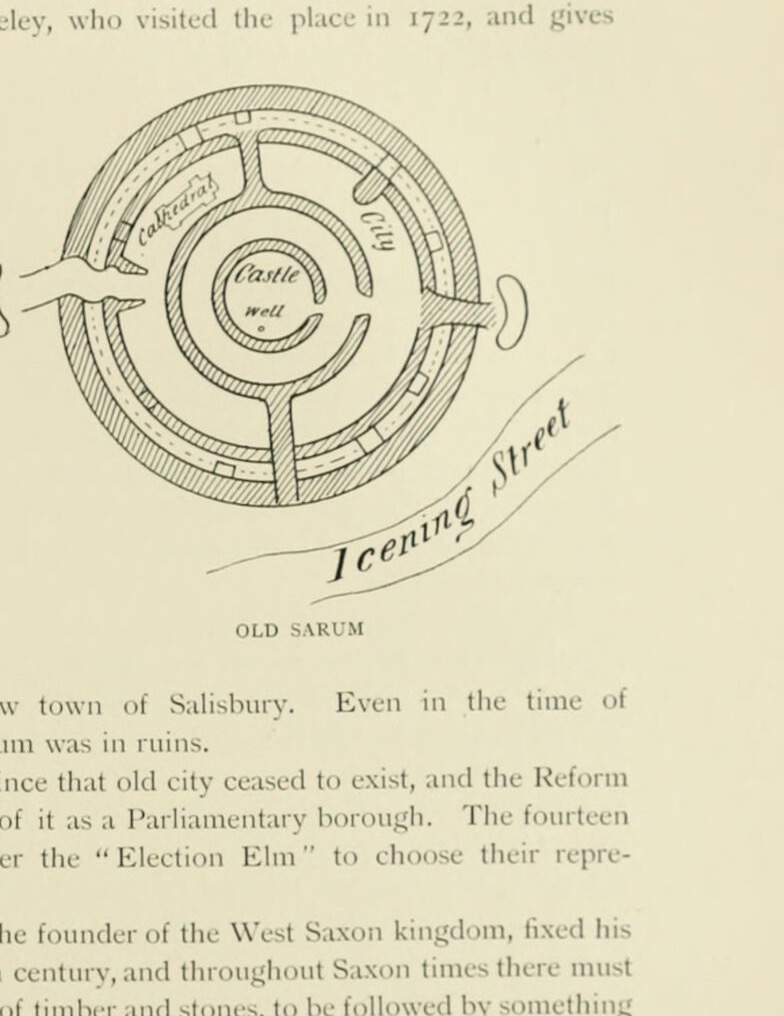
OLD SARUM
1897 · J. D. Mackenzie, The Castles of England, vol. 1 (1897)
Public domain
Nearby


