England · Partial ruin
Pevensey Castle
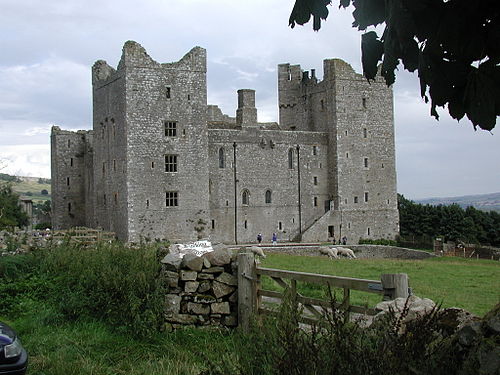
Pevensey Castle is a medieval castle built within the remains of a large late Roman Saxon Shore fort at Pevensey, East Sussex. The site incorporates massive Roman curtain walls and medieval inner bailey defences with a unique rectangular keep; it served as a Norman stronghold and remained occupied through the later medieval period. The site is a scheduled monument in the care of English Heritage and is open to visitors today.
First raised
1066
Its prime
1320
Today
Partial ruin
As it stood in 1320
What Pevensey Castle looked like in its prime.
A broad oval fortress of thick masonry curtain walls faced with ironstone and sandstone (now partly robbed), pierced by D-shaped projecting towers and medieval crenellations at the top; the curtain stands on a raised earthen core with horizontal bonding courses of tile visible in places. The landward approach is a causeway leading to a rectangular gatehouse and arch; inside a grassy inner bailey is dominated by the stump of a large rectangular keep with several projecting towers, all set on low marshland.
Its story
The story of Pevensey Castle.
Anderitum, Fort of the Saxon Shore
Pevensey began as the Roman fort of Anderitum, largest of the nine Saxon Shore forts. Oak piles beneath the walls have dated its construction to around 290, and coins of the usurper emperors Carausius and Allectus have been found buried in the foundations, evidence for a newer theory that the fort was built not against Saxon pirates but by a breakaway regime trying to stop Rome reimposing control over Britain. The Notitia Dignitatum records a fleet presumably based there, the Classis Anderidaensis. After the Roman withdrawal civilians appear to have moved inside the walls, and the Anglo-Saxon Chronicle records that in 491 the Saxons Aelle and Cissa "besieged Andredadsceaster and slew all the inhabitants; there was not even one Briton left there".
William's First Night in England, 1066
When William the Conqueror landed at Pevensey Bay on 28 September 1066, his army sheltered for the night in a temporary fortification inside the ruined Roman fort before marching for Hastings the next day. After his victory William gave the castle and the surrounding Rape of Pevensey to his half-brother Robert, Count of Mortain, under whom it was probably expanded into a permanent castle in the 1070s (two baileys divided by a ditch and timber palisade within the repaired Roman walls), and founded a borough outside that counted 110 burgesses and a mint by Domesday in 1086.
Starved but Never Stormed
Pevensey stood four sieges and was never taken by assault. In the Rebellion of 1088 rebel barons backed by Robert of Mortain and Bishop Odo of Bayeux held it against an army led by William Rufus; assaults by land and sea failed, but after six weeks the food ran out. Robert's son William lost the castle after rebelling against Henry I, and under King Stephen its holder Gilbert de Clare rebelled in turn; Stephen blockaded the castle by land and sea and once again starved the garrison out.
The first major stone buildings, perhaps including the keep, appear to date from Richard I's reign in the 1190s, though mentions of a "Tower of Pevensey" from 1130 hint at something earlier. About 1216, during the First Barons' War, King John ordered the castle slighted rather than let it fall to the invading Prince Louis of France. Rebuilt in stone, perhaps under Peter of Savoy after 1246, it endured a lengthy siege in the Second Barons' War: Simon de Montfort's forces invested it for over a year after the Battle of Lewes, but supplies still reached the garrison and the siege was lifted in July 1265.
Pelham's Letter, 1399
The castle passed through the hands of queens consort, Eleanor of Provence acquired it in 1268, before John of Gaunt took possession in 1372. Gaunt refused to garrison it in 1377, asserting he was wealthy enough to rebuild it if a French attack destroyed it; in the Peasants' Revolt of 1381 a mob attacked the castle and burnt its court rolls. The fourth and last siege came in 1399, when Richard II's forces trapped the constable Sir John Pelham inside for supporting Henry Bolingbroke. "I am here bylaid in manner of a siege ... so that I may not out, nor no vitals get me without much difficulty," Pelham wrote to Bolingbroke. The siege failed; Bolingbroke was crowned Henry IV and granted Pevensey to Pelham. Under the Lancastrians it became a prison for high-ranking captives: King James I of Scotland, captured en route to France in 1405; Edward, Duke of York; and Joan of Navarre, held from December 1419 to March 1420 on charges of plotting to kill her stepson Henry V by witchcraft.
Armada Gun to Machine-Gun Posts
Abandoned under the Tudors, the castle was recorded as ruins by 1573, and Elizabeth I's order that it be "utterlye raysed" went unenforced. Instead it was reoccupied in 1587 as a gun position; two iron demi-culverins stood ready at the Armada in 1588, and one survives in the inner bailey. The ruin was robbed for stone (by 1591 the best stones had been "imbeselled and carried away", one family alone removing 677 cartloads of ashlar from the keep), and under the Commonwealth it was sold for £40 to a builder who meant to quarry it, though little work took place before the Crown reacquired it in 1660.
In 1925 the 9th Duke of Devonshire gave the castle to the state. From May 1940 it was garrisoned again by British and Canadian troops, with the United States Army Air Corps running a radio direction centre there from early 1944; machine-gun posts were built into the Roman and medieval walls, disguised as original masonry. When the castle returned to civilian control in 1945 the gun posts were left in place, and the site is now managed by English Heritage.
Step inside
9 places to explore in 1320.
The record describes 9 distinct spots at Pevensey Castle, including 3 interiors: inner bailey courtyard looking east to the keep, keep first-floor entrance and stair, inner bailey north tower basement. Create your own photoreal reconstruction and explore every one, more scenes means more rooms, more angles, and more of the place to stand in.
Build Your Own Castle
Recreate Pevensey Castle with AI to explore it.
The artist rebuilds it as it stood in 1320, a photoreal reconstruction that belongs to you alone. Pay with coins, no subscription needed.
Recreate this castle →Defend this castle →Whose castle
Clans who held Pevensey Castle.
The families that held Pevensey Castle for a decade or more across its history, follow a name to its clan.
Mortain
Gifted with the Rape of Pevensey to Robert, Count of Mortain, after 1066; his son William was stripped of it under Henry I.
de l'Aigle
Re-granted by Henry I to Gilbert I de l'Aigle; confiscated under King Stephen.
From the archive
Pevensey Castle on paper: the measured plan and period views.
The survey plan and photographs below are the ground truth this page's reconstructions are checked against, drawn and photographed while the castle was still a working garrison. Every image is public-domain or openly licensed, with its source named.

Castle, Pevensey, England-LCCN2002708044
ca. 1890-1900 · Photochrom Prints Collection (via Wikimedia Commons)
Public domain
PEVENSEY CASTLE.
1897 · J. D. Mackenzie, The Castles of England, vol. 1 (1897)
Public domain
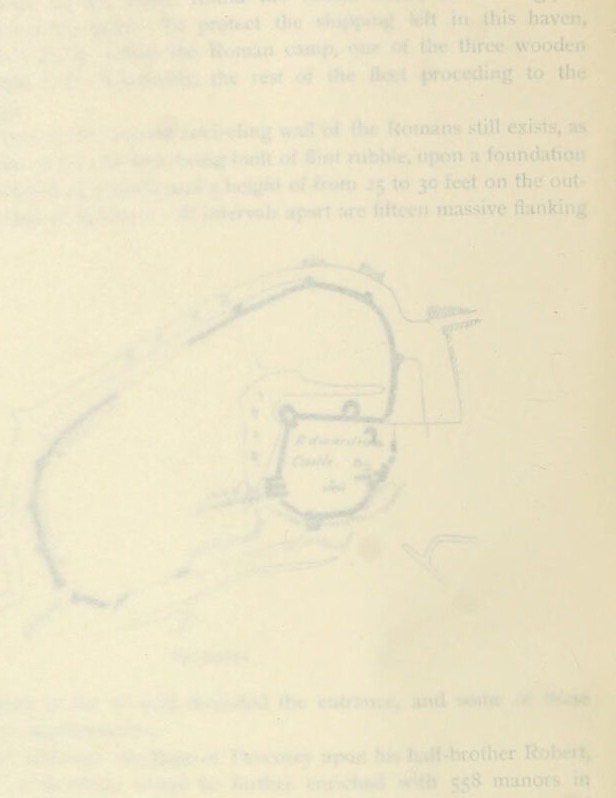
Plan of Pevensey Castle
1897 · J. D. Mackenzie, The Castles of England, vol. 1 (1897)
Public domain
Nearby