
England · Demolished
Queenborough Castle
Queenborough Castle was founded in 1361 in the town of Queenborough on the Isle of Sheppey, United Kingdom. It was a medieval royal fortress; there are no substantial visible remains on the modern site and the location is now marked by an information board and open ground.
First raised
1361
Its prime
1361
Today
Demolished
As it stood in 1361
What Queenborough Castle looked like in its prime.
Reconstructed at its prime as a compact 14th‑century stone fortress sited on low coastal marshland, with a continuous stone curtain wall punctuated by multiple round towers rising above a surrounding water‑filled moat. A prominent fortified gatehouse faces the main approach, with timber hoardings and crenellated parapets along the wallwalk; within the walls are low timber‑and-tile roofs of service ranges and a small central keep or strongpoint.
Its story
The story of Queenborough Castle.
Bynne to Queenborough, 1361-1367
In 1361 Edward III bought land on the Isle of Sheppey from the manor of Rushenden, at a little fishing hamlet called Bynne, where two houses were pulled down and their occupants rehoused. The stated purpose was "for the defence of the realm and for the refuge of the inhabitants of the island". The 1360s were an uneasy peaceful interlude in the Hundred Years' War, opened by the Treaty of Brétigny in May 1360; French raiders had struck Rye and Winchelsea that March. It has been suggested that the new work was more a palace-fortress, a refuge for the royal family from the Black Death that had reached England the previous decade; but the position commanding the confluence of the Swale and the Medway, then an important route into the Thames Estuary, together with the refurbishment of Hadleigh Castle across the Thames at the same date, points to a strategic consideration.
Oversight has been credited variously to the master masons John Box and Henry Yevele, and to William of Wykeham. Some 1,600 craftsmen and labourers were employed, and the work was finished by about 1367 at a cost of around £20,000. The design was radical, the first concentric castle built in England, possibly influenced by Bellver Castle in Mallorca. Queenborough was among the first English castles built to withstand siege artillery and to mount guns of its own.
A Rotunda of Six Towers
A large circular building, described as a rotunda or shell keep, enclosed a paved courtyard, buttressed by six circular towers set at regular intervals apart from the two that guarded the main eastern entrance. The Parliamentary Commissioners who surveyed it in 1650 counted twelve rooms downstairs and about forty from the first storey upwards, and put the whole at upwards of three acres.
Some 30 yards out ran a plain circular curtain wall, ringed by a large moat. The curtain carried only two towers, forming a gatehouse on the western side, so an attacker who forced that gate still had to work round the bailey to reach the rotunda door. Roof water first ran through lead piping into cisterns; in 1393 a contractor spent sixty weeks digging a deep well in the middle of the courtyard.
Guns Before Dover: The Constables, 1365-1461
The first constable was appointed in 1365, before the castle was finished, with instructions to arm it and make it defensible. That year "two great guns and nine small ones" went to Queenborough from the cannon foundry at the Tower of London, taking priority before even Dover. On completion Edward III visited and issued a royal charter for the town being laid out beside it, naming it Queenborough for his queen consort, Philippa of Hainault, and he came often in the later part of his reign. The constableship was evidently a prestigious office: John of Gaunt, Duke of Lancaster, from 1377, Robert de Vere, Duke of Ireland, from 1385, Thomas Arundel, Archbishop of Canterbury, from 1409, and George Plantagenet, Duke of Clarence, from 1461.
French Raiders, Cade's Rebels and the Tudor Castle, 1450-1629
On 21 April 1450 a French force attacked Queenborough in a coastal raid. That July the castle easily repelled an attack by Jack Cade and his rebels, and Cade himself was wounded in the attempt. Henry VIII had the place repaired in 1536, and an account written in 1629 describes the arms of Elizabeth I on the wall of the great hall, with a laudatory Latin verse exhorting her to "live a virgin and a lion reign".
Not Fit to be Kept: Demolition and After, 1650-2005
During the English Civil War Queenborough was held for the King. After the execution of Charles I the castle passed to the Commonwealth. In 1650 Parliament sent commissioners to survey the crown properties it had acquired; their report found the castle "much out of repair, and no ways defensive by the commonwealth" and judged it "not fit to be kept, but demolished". It was sold to one John Wilkinson for £1,792, twelve shillings and one halfpenny, who took it down to the foundations and sold the materials.
The courtyard well outlasted the walls. In 1723 the Royal Navy surveyed it, found it 200 feet deep and lined with Portland stone, and after deepening drew "good, soft, sweet and fine" water for the dockyard at Sheerness. The Sheerness branch line opened in 1860 through the eastern part of the site, and a pump house was built over the well to water the locomotives, and a school over the western side. The site has been a scheduled monument since 30 January 1962 and is now a public park, the only visible remains low earthworks. Excavation in September 2005, recorded by Wessex Archaeology for the Time Team series, traced the outer curtain in a robber trench and rubble pushed into the moat.
Step inside
2 places to explore in 1361.
The record describes 2 distinct spots at Queenborough Castle, including the full exterior approach. Create your own photoreal reconstruction and explore every one, more scenes means more rooms, more angles, and more of the place to stand in.
Build Your Own Castle
Recreate Queenborough Castle with AI to explore it.
The artist rebuilds it as it stood in 1361, a photoreal reconstruction that belongs to you alone. Pay with coins, no subscription needed.
Recreate this castle →Defend this castle →From the archive
Queenborough Castle on paper: the measured plan and period views.
The survey plan and photographs below are the ground truth this page's reconstructions are checked against, drawn and photographed while the castle was still a working garrison. Every image is public-domain or openly licensed, with its source named.
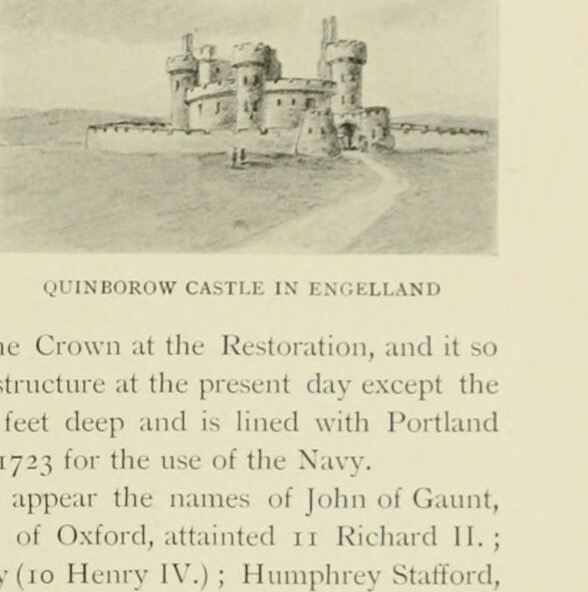
QUINBOROW CASTLE IN ENGELLAND
1897 · J. D. Mackenzie, The Castles of England, vol. 1 (1897)
Public domain
Nearby


