England · Restored
Richmond Castle
Richmond Castle is an early Norman castle in Richmond, North Yorkshire, England, notable for its large late-12th-century keep and surviving curtain walls. The site consists of a triangular main enclosure with a northern keep, an outer eastern enclosure, and a small ward around the keep; it is now cared for by English Heritage.
First raised
1071
Its prime
1180
Today
Restored
As it stood in 1180
What Richmond Castle looked like in its prime.
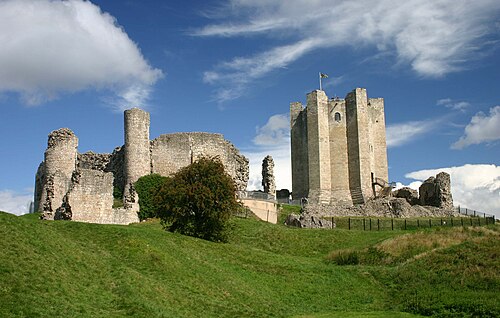
A tall, square late-12th-century keep of honey-coloured sandstone rises above a broad grassy inner bailey, its top finished with a crenellated parapet. Low, irregular curtain walls form a triangular main enclosure with an outer eastern bailey; masonry is coarse ashlar and rubble in warm yellow-brown tones. Narrow slit and round-headed window openings puncture the keep and wall faces. The castle stands on a raised position above the River Swale, with the town visible beyond the outer walls; the whole complex is complete and defensible.
Its story
The story of Richmond Castle.
Alan Rufus and the Harrying of the North, 1071
In 1069 William the Conqueror put down a rebellion at York, then followed it with the "harrying of the North", an act of ethnic cleansing that depopulated large areas for a generation or more. As a further punishment he divided the lands of North Yorkshire among his most loyal followers, and Alan Rufus of Brittany received the borough of Richmond. From 1071 Alan built a castle on the strong hill above the River Swale (the site was originally called Riche Mount) to defend against further rebellions and to anchor a personal power base. His holdings, the Honour of Richmond, covered parts of eight counties and amounted to one of the most extensive Norman estates in England. By the Domesday Book of 1086 there was already "a castlery" at Richmond.
The Keep and King John's Order of 1216
In the 12th century Alan's great-nephew Conan expanded the castle, and Duke Conan IV of Brittany raised a keep of honey-coloured sandstone 100 feet high with walls 11 feet thick. Henry II of England seized the Earldom of Richmond in 1158, and it was probably Henry who completed the keep, strengthening the castle considerably at the same time with towers and a barbican, a sealed entry space in front of the main gate where visitors and wagons could be checked before they entered. The original 11th-century gate arch survives in the keep's basement, built over when the keep went up in front of it and unblocked again in the 19th century.
On 5 June 1216, during the First Barons' War, King John gave orders to slight Richmond Castle if it could not be held against the rebels. Henry III and Edward I later spent money on the site, Edward improving the keep's interior. On the river side lay a second enclosure called the Cockpit, which may have served as a garden overlooked by a balcony; a drawing of 1674 suggests a longer balcony ran along the river front of Scolland's Hall, the great hall.
Out of Use by 1400, Partly in Ruins by 1538
Richmond had fallen out of use as a fortress by the end of the 14th century and received no major improvements after that date. A survey of 1538 found it partly in ruins. Centuries later, paintings by Turner and others, together with the rise of tourism and an interest in antiquities, prompted repairs to the keep in the early 19th century. Local legend holds that King Arthur and his knights sleep in a cave beneath the castle, once discovered by a potter named Thompson who fled as they began to wake; another tells of a drummer boy lost in a tunnel, whose drumming is sometimes still heard.
Militia Barracks and the Richmond Sixteen
In 1855 the castle became the headquarters of the North Yorkshire Militia, and a barracks block was built in the great courtyard. From 1908 to 1910 it was the home of Robert Baden-Powell, later founder of the Boy Scouts, while he commanded the Northern Territorial Army; the barracks were demolished in 1931.
During the First World War the castle was the base of the Non-Combatant Corps, made up of conscientious objectors, conscripts who refused to fight. It was also used to imprison objectors who refused to accept army discipline or take any part in the war. Among them were the "Richmond Sixteen", who were taken from the castle to France, charged under Field Regulations and sentenced to death; the sentences were commuted to ten years' hard labour. The cell block holds 2,300 examples of graffiti left by prisoners from the mid-19th century to the 1970s, the marks of the Richmond Sixteen among the most significant.
The castle, the best-preserved early Norman castle in England, is a scheduled monument and a Grade I listed building, in the care of English Heritage.
Step inside
9 places to explore in 1180.
The record describes 9 distinct spots at Richmond Castle, including 2 interiors: scolland's hall interior with riverside balcony, basement with original 11th-century gate arch. Create your own photoreal reconstruction and explore every one, more scenes means more rooms, more angles, and more of the place to stand in.
Build Your Own Castle
Recreate Richmond Castle with AI to explore it.
The artist rebuilds it as it stood in 1180, a photoreal reconstruction that belongs to you alone. Pay with coins, no subscription needed.
Recreate this castle →Defend this castle →Nearby