England · Partial ruin
Rougemont Castle
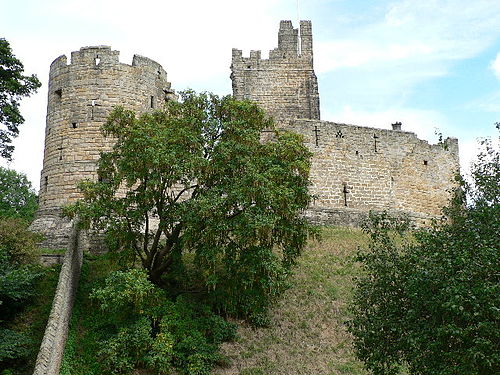
Rougemont Castle (Exeter Castle) is the historic Norman castle built into the northern corner of Exeter's Roman city walls from about 1068. Its principal surviving medieval feature is a large red-sandstone early Norman gatehouse and associated stretches of curtain wall and corner turret. The site originally formed a roughly square enclosure with inner and outer baileys and contained a chapel and service buildings within the walls.
Its prime
1200
Today
Partial ruin
As it stood in 1200
What Rougemont Castle looked like in its prime.
At its prime the castle presented a massive red-brown volcanic sandstone gatehouse built into the northern angle of the Roman city wall, with lighter ashlar dressings on arches and quoins. A roughly square curtain walled enclosure extended from the gate, bonded into the older city wall and punctuated by corner turrets (including the western Athelstan's Tower). The gatehouse upper storey shows paired triangular-headed window openings above a large semicircular external arch; ditches and an outer bailey lay beyond the walls.
Its story
The story of Rougemont Castle.
Eighteen Days Against William, 1068
Exeter may have become a centre of resistance to William the Conqueror after 1066 because Gytha, mother of the defeated King Harold, was living in the city, and because William was insisting its traditional annual tribute of £18 must be increased. When the citizens refused to swear him an oath of fealty, he marched on Exeter in 1068 and besieged it for eighteen days before it capitulated. They held out that long behind the city wall, first built by the Romans and extensively repaired around 928 by King Athelstan.
Even though the city surrendered, William ordered a castle raised inside the wall in the northern angle of the defences to safeguard his position, and left the work to Baldwin FitzGilbert, whom he made castellan. A deep ditch and internal rampart cut from the north-western to the north-eastern city wall, enclosing a roughly square area about 600 feet across; Domesday recorded that 48 houses in Exeter had been destroyed since the king came to England, taken by historians to mean the houses cleared for the castle. The great gatehouse on the south side carries plainly Anglo-Saxon detail, suggesting English masons raised it very early to Norman orders. The castle appears to have been attacked before it was finished; Orderic Vitalis reports an assault on Exeter in 1069, and the western corner turret, Athelstan's Tower, shows early repairs.
Baldwin de Redvers Holds Out, 1136
In 1136 Baldwin de Redvers seized the castle as part of his rebellion against King Stephen. Stephen's army moved quickly to besiege it, and Redvers resisted for three months, until his water supply failed. The eastern turret that would have matched Athelstan's Tower is missing and may have been brought down by undermining; a short length of crude tunnel running towards that point of the wall, found around 1930, has been read as the miners' work. The barbican covering the city side of the drawbridge was probably taken and destroyed at the same time.
A small circular earthwork on the hill just north was long taken for an outwork guarding Rougemont; since its excavation in 1992 it is thought instead to have been thrown up by Stephen for the siege. Heavier siege engines apparently prompted an outer bailey in the late 12th century, a walled circuit with its own ditch running between the eastern and western city walls.
The Red Hill, Richard III and Perkin Warbeck
Officially the place was always Exeter Castle; the name Rougemont, for the red rock of the hill and the walls built out of it, first appears in a local record of about 1250. King Richard III visited Exeter in 1483, and Shakespeare has him shown the castle and recalling a premonition of his death, confusing Rougemont with Richmond. The castle was said to have been badly damaged in the second Cornish uprising of 1497, when Perkin Warbeck and 6,000 Cornishmen entered the city; by 1600 it was described as showing "gaping chinks and an aged countenance".
Civil War Batteries and the Devon Witches
A courthouse went up within the castle walls in 1607, and in 1617 the cartographer John Norden drew the castle and its precincts, showing the new court houses, St Mary's chapel, the well and what may be the ruined walls of a rectangular keep. The castle played no major part in the Civil War: Parliament authorised the city to spend £300 of public funds in late 1642 on fortifying Exeter and repairing the castle, but despite at least four artillery batteries mounted there the city fell to the Royalists in 1643 and to the Parliamentarians in 1646. For part of the war the gatehouse served as a prison. In 1682 and again in 1685 the three Devon witches were tried here before being executed at Heavitree, the last people in England put to death for witchcraft.
Swept Away for the Palladian Courthouse, 1773
In 1773 every building inside the walls was demolished and replaced by a limestone courthouse in the Palladian style, designed by Philip Stowey and amended by James Wyatt; the early 16th-century entrance arch gave way to a new one of reclaimed stone with a false portcullis, and the northern sally port, with its tower and drawbridge, was destroyed in 1774. The court buildings were extended west in 1895 for the new county council's offices and again in 1905.
The county council left for Devon County Hall in 1964, and the Crown and County Courts moved out when new law courts were completed in Exeter's legal quarter in 2004. The site was sold in early 2007 to GL50 Properties, whose managing director said the castle would be transformed into "the Covent Garden of the South West of England". In 2011 the former Court 1 reopened as a ballroom and Court 2 as a gallery, and twelve apartments were made within the walls.
Step inside
9 places to explore in 1200.
The record describes 9 distinct spots at Rougemont Castle, including 2 interiors: gatehouse passage (through the main gate), chapel of st mary (interior). Create your own photoreal reconstruction and explore every one, more scenes means more rooms, more angles, and more of the place to stand in.
Build Your Own Castle
Recreate Rougemont Castle with AI to explore it.
The artist rebuilds it as it stood in 1200, a photoreal reconstruction that belongs to you alone. Pay with coins, no subscription needed.
Recreate this castle →Defend this castle →Nearby