England · Restored
Saltwood Castle
Saltwood Castle is a medieval castle in Saltwood village, one mile north of Hythe in Kent. Of Norman origin and enlarged in the 13th–14th centuries, it remained an archiepiscopal possession until the Reformation and is today a private house and Grade I listed building.
First raised
1100
Its prime
1390
Today
Restored
As it stood in 1390
What Saltwood Castle looked like in its prime.
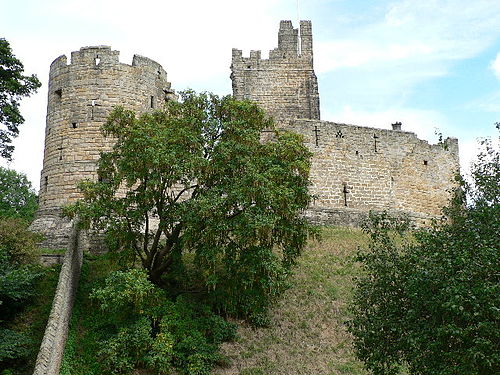
A compact fortress of rough grey rubble stone with a prominent round drum tower at one corner capped by a crenellated parapet, attached to high rectangular curtain walls topped by regular crenellations. Narrow vertical lancet and arrow-slit windows puncture the walls in slender pairs and singles. The masonry is coarse Kentish stone with visible repair lines and a simple stringcourse; the castle sits close to the village behind low boundary walls and trees, its roofline mostly concealed by battlements.
Its story
The story of Saltwood Castle.
Christ Church, Lanfranc and the Coastal Fiefs
Bronze Age implements and copper ingots turned up in Hayne's Wood in 1874, and the castle itself was probably raised on a Roman site. Tradition credits a castle here to Aesc, son of Hengist and king of Kent, in 488, but the place first appears on firm ground in a charter of King Egbert in 833. The manor of Saltwood was granted to the priory of Christ Church, Canterbury, by a deed dated 1026.
After the Norman Conquest Archbishop Lanfranc appropriated the castle, and under William of Normandy Saltwood (held by the archbishop and let under knights' service to Hugo de Montfort) formed part of the string of large fiefs running along the south coast from Hythe to the New Forest. A twelfth-century Norman structure replaced the earlier work, with building continuing over the next two centuries. For a time it was the residence of Henry of Essex, constable of England.
The Knights Who Rode to Canterbury, 1170
Thomas Becket had asked Henry II, on the Church's behalf, for Saltwood to be restored as an ecclesiastical palace. Henry gave it instead to one of his loyal barons, Ranulf de Broc, an arrangement that has left de Broc under suspicion of some complicity in what followed.
On 28 December 1170 four knights are presumed to have plotted Becket's death at Saltwood; the killing was done the next day in Canterbury Cathedral, about fifteen miles away. The four were Reginald Fitzurse, William de Tracey, Richard le Breton and Hugh de Moreville.
Slighted After the Revolt of 1173–1174
In the aftermath of the revolt of 1173–1174 Saltwood was demolished, slighted. Richard I returned the castle to the archbishop of Canterbury during his reign, and the archbishops built again: the gun-ports in the gatehouse, dated to 1385–94, are attributed to Henry Yevele, whom B. H. St John O'Neil called the English father of the science of artillery fortification.
The Wycliffite William Thorpe's account of his questioning at Saltwood in 1407 became a familiar document because sixteenth-century Reformers put it into print.
Cranmer's Surrender and the Earthquake of 1580
Saltwood stayed church property until the reign of Henry VIII, when Hythe and Saltwood were seized by the Crown; in 1540 Thomas Cranmer was compelled to cede the castle to the king. The earthquake of 6 April 1580 left it uninhabitable.
It was largely ruinous by the nineteenth century. Restoration in that century made it once more a residence of the Archbishop of Canterbury, and the gatehouse has been lived in ever since; further work in the 1880s and again in the 1930s made portions of the castle habitable.
The Deedes Family and the Clarks
An ancestor of the journalist and politician Bill Deedes bought the castle in the late nineteenth century, and Deedes grew up there. It passed to Sir Martin Conway, who commissioned Philip Tilden to carry out a restoration.
The art historian Kenneth Clark (1903–1983) bought Saltwood in the 1950s, and in 1971–72 employed John King to build a bungalow, The Garden House, at the edge of the moat as a home for himself and his wife. The castle became the home of his son, the politician and diarist Alan Clark (1928–1999), who was buried in its grounds; it stayed in the Clark family as the private home of his widow, Jane Clark.
Step inside
5 places to explore in 1390.
The record describes 5 distinct spots at Saltwood Castle, including 1 interior: gatehouse passage and gun-ports (interior). Create your own photoreal reconstruction and explore every one, more scenes means more rooms, more angles, and more of the place to stand in.
Build Your Own Castle
Recreate Saltwood Castle with AI to explore it.
The artist rebuilds it as it stood in 1390, a photoreal reconstruction that belongs to you alone. Pay with coins, no subscription needed.
Recreate this castle →Defend this castle →Whose castle
Clans who held Saltwood Castle.
The families that held Saltwood Castle for a decade or more across its history, follow a name to its clan.
Deedes
Bought in the late 19th century by an ancestor of the journalist Bill Deedes, who grew up at the castle.
Conway
Sold in the 20th century to Sir Martin Conway, who commissioned Philip Tilden's restoration.
Bought by the art historian Kenneth Clark in 1953; home of Alan Clark and still of his widow Jane Clark.
From the archive
Saltwood Castle on paper: the measured plan and period views.
The survey plan and photographs below are the ground truth this page's reconstructions are checked against, drawn and photographed while the castle was still a working garrison. Every image is public-domain or openly licensed, with its source named.
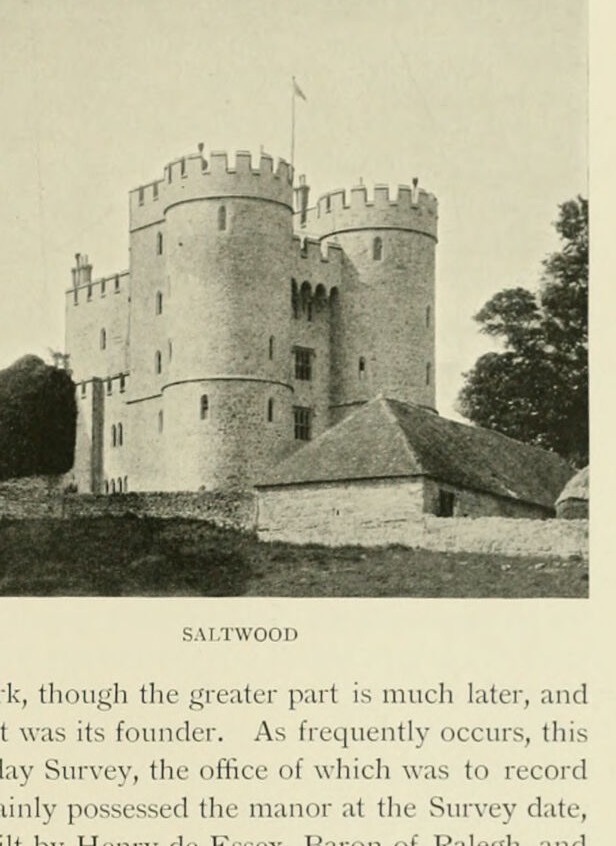
SALTWOOD
1897 · J. D. Mackenzie, The Castles of England, vol. 1 (1897)
Public domain
Nearby