England · Ruin
Scarborough Castle
Scarborough Castle is a medieval royal fortress sited on a rocky headland overlooking the North Sea and the town of Scarborough in North Yorkshire. The stone keep and curtain walls were erected from the mid-12th century and extensively rebuilt and expanded under later medieval kings. The site has been a ruin since the Civil War sieges but remains an archaeological monument on the promontory above the harbour.
First raised
1130
Its prime
1212
Today
Ruin
As it stood in 1212
What Scarborough Castle looked like in its prime.
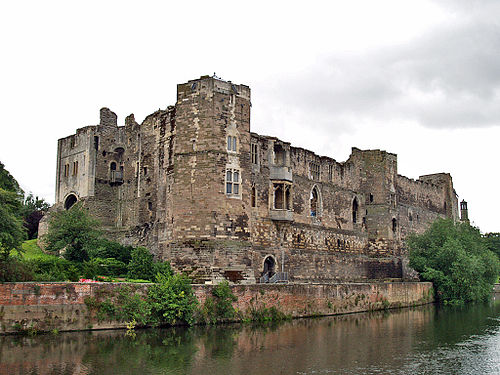
Perched on a windswept rocky promontory above the North Sea, the castle is dominated by a three-storey rectangular stone keep surrounded by a compact curtain wall enclosing an inner bailey. Masonry is primarily yellow‑brown rubble and ashlar; the keep shows multiple tall, narrow arched window and slit openings and projecting tower-bays. The west and south curtain walls form a defended approach across grassy slopes and terraced stone retaining walls down the seaward face.
Its story
The story of Scarborough Castle.
William le Gros's Fort and Henry II's Keep
Excavations in the 1920s produced evidence suggesting a hill fort once stood on the headland, with finds dated to 900–500 BC, and in the 4th century the Romans built a signal station on the cliff top. Around the year 1000 the Anglo-Saxons raised a chapel on the station site.
William le Gros, Count of Aumale, a grand-nephew of William the Conqueror, built a wooden fortification here after King Stephen granted him the Earldom of York in 1138, his reward for victory at the Battle of the Standard. Henry II ordered all royal castles returned to the Crown; Aumale resisted handing over Scarborough until the king's forces arrived at York. The chronicler William of Newburgh claimed the timber castle had decayed; later interpretations hold that Henry demolished it himself. From about 1157 the king rebuilt in stone, raising the three-storey keep between 1159 and 1169, and granted the town beneath the fortress the title of Royal Borough.
King John's Favourite Fortress
King John, whose rule the northern barons strongly opposed, made Scarborough both a comfortable residence and a strategic stronghold. He visited four times, built the curtain wall on the west and south sides in 1202–1212, and spent £2,291 in all, the largest investment among the 95 castles he funded during his reign. Henry III added a barbican of flanking towers around 1240–1250. In 1265 the castle was committed to Prince Edward, later Edward I, who held court there in 1275 and 1280; in 1295 hostages from his Welsh campaigns were held within its walls.
The castle could also menace the town it guarded: Geoffrey de Neville, governor for twenty years in the 13th century, used the garrison to seize port goods, and in the 1270s William de Percy blocked the main road into Scarborough and imposed illegal tolls.
The Fall of Piers Gaveston, 1312
When the barons imposed the Ordinances of 1311 to curb Edward II's power, his Gascon favourite Piers Gaveston became their target. In April 1312 Edward made Gaveston governor of the castle; in May the Earls of Pembroke and Surrey, joined by Henry de Percy, laid siege, and the castle fell quickly for want of provisions. Gaveston surrendered on a promise of safe escort, but on the journey south he was seized by the Earl of Warwick and killed. Edward punished Scarborough for failing to support his favourite, revoking the town's royal privileges.
Richard III, the Pilgrimage of Grace and Stafford's Three Days
Richard III was the last monarch to enter the castle grounds, residing there in 1484 while forming a fleet against Henry Tudor, a struggle he lost the following year. In 1536 Robert Aske tried and failed to take the castle during the Pilgrimage of Grace. In 1557 forces loyal to Thomas Wyatt the younger seized it by entering disguised as peasants; their leader, Thomas Stafford, held the castle for three days and was executed for high treason on Tower Hill.
Seven Changes of Hands, 1642–1648, and the Long Aftermath
Sir Hugh Cholmley occupied the castle for Parliament in September 1642, then changed sides in March 1643, holding the town, its port and a garrison of 700 for Charles I. On 18 February 1645 Sir John Meldrum took the town; Cholmley withdrew into the castle and refused to yield, opening a five-month siege, among the bloodiest of the Civil War. The Parliamentarians mounted the Cannon Royal, then the largest cannon in the country, in St Mary's Church below and partially destroyed the keep, though the outer walls were never breached; Meldrum was killed in hand-to-hand fighting at the barbican gateway. When the garrison, worn down by scurvy, thirst and hunger, surrendered on 25 July 1645, only 25 men were fit to fight and about half the 500 defenders emerged alive.
The new governor, Matthew Boynton, declared for the King in July 1648 when his soldiers went unpaid, forcing a second siege that ended on 19 December with the garrison defeated as much by winter as by the besiegers. The castle changed hands seven times between 1642 and 1648, and the keep has stood as a ruined shell ever since. George Fox, founder of the Quakers, was imprisoned there from April 1665 to September 1666.
The Jacobite rising of 1745 brought new gun batteries and barracks for 120 men, with the keep pressed into service as a powder magazine; French prisoners were held there in 1796. On 16 December 1914 the German warships Derfflinger and Von der Tann shelled Scarborough, killing 19 people; some 500 shells damaged the keep, barracks and curtain walls, and the barracks were demolished. The castle served as a secret listening post in the Second World War, and the headland, a scheduled monument, has been managed by English Heritage since 1984.
Step inside
8 places to explore in 1212.
The record describes 8 distinct spots at Scarborough Castle, including 3 interiors: great hall inside the keep, king's chambers (mosdale hall), anglo‑saxon chapel site. Create your own photoreal reconstruction and explore every one, more scenes means more rooms, more angles, and more of the place to stand in.
Build Your Own Castle
Recreate Scarborough Castle with AI to explore it.
The artist rebuilds it as it stood in 1212, a photoreal reconstruction that belongs to you alone. Pay with coins, no subscription needed.
Recreate this castle →Defend this castle →From the sea
Ships that came to Scarborough Castle.
- SMS Derfflinger: Bombarded Scarborough in the December 1914 raid on the English coast
From the archive
Scarborough Castle on paper: the measured plan and period views.
The survey plan and photographs below are the ground truth this page's reconstructions are checked against, drawn and photographed while the castle was still a working garrison. Every image is public-domain or openly licensed, with its source named.
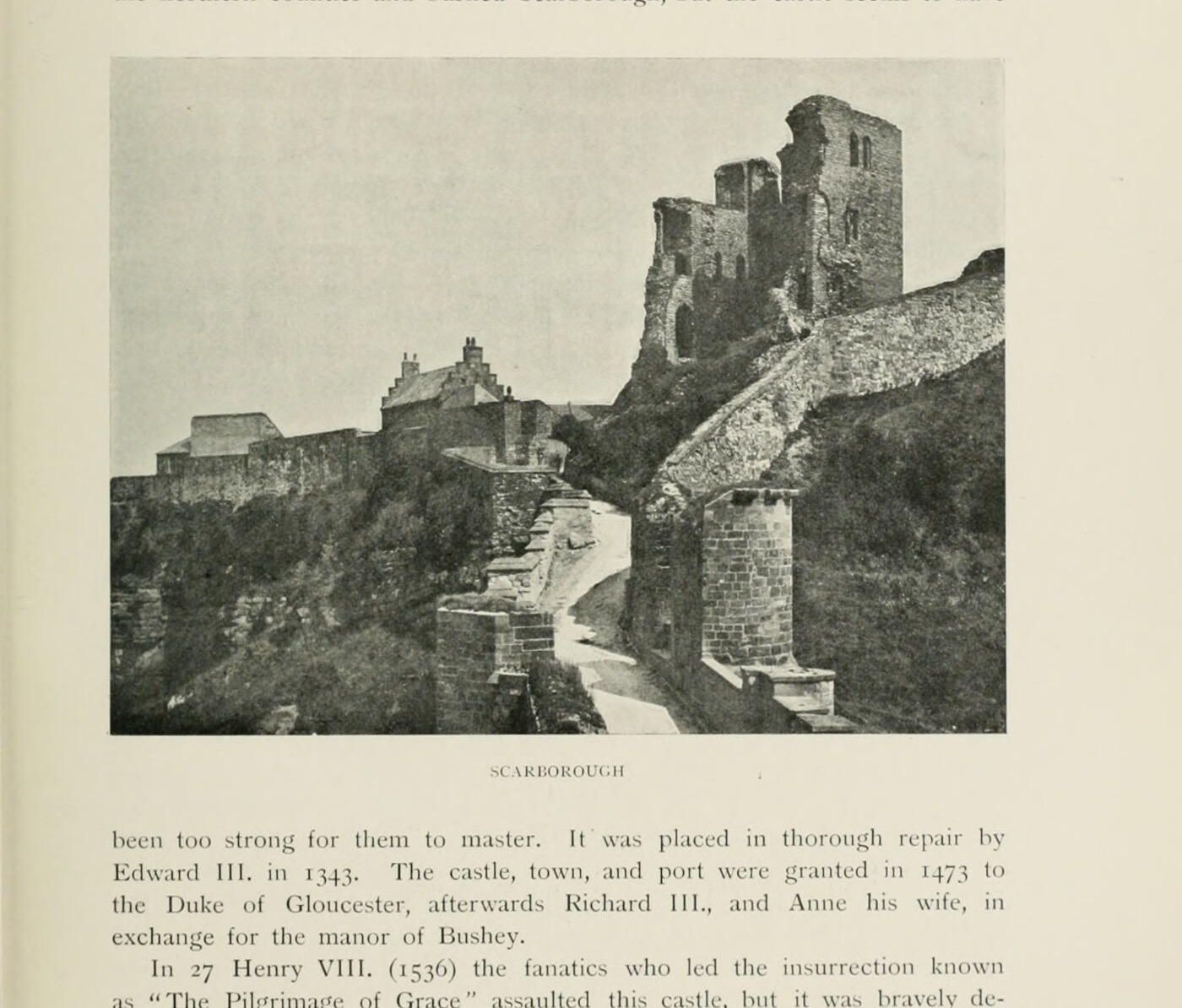
SCARBOROUGH
1897 · J. D. Mackenzie, The Castles of England, vol. 2 (1897)
Public domain
Nearby