England · Still standing
Skipton Castle
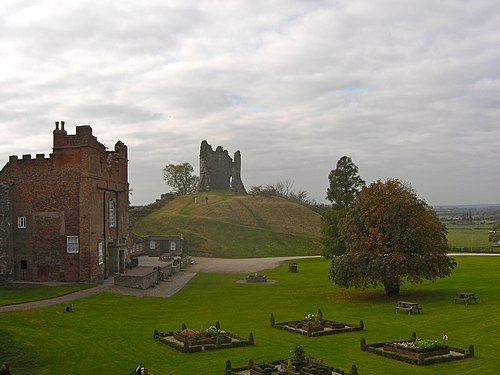
Skipton Castle is a medieval stone castle in Skipton, North Yorkshire, built from 1090 and long-held by the Clifford family. It retains its ring of drum towers, curtain wall and domestic ranges and is now a privately owned historic house and tourist attraction.
First raised
1090
Its prime
1322
Today
Still standing
As it stood in 1322
What Skipton Castle looked like in its prime.
A horizontal stone silhouette of six fortified drum towers linked by a domestic range and curtain wall, built of variegated brown–grey sandstone with crenellated battlements and mullioned windows. The northern front presents projecting rectangular bay windows and an arched twin-towered Norman gatehouse; the roofline is continuous and intact. The castle sits above a steep drop to the Eller Beck with a broad clipped lawn to the north and a central Tudor courtyard within the inner wards.
Its story
The story of Skipton Castle.
Robert de Romille's Stronghold Against the Scots
Skipton Castle began as a motte-and-bailey built in 1090 by Robert de Romille, a Norman baron and lord of the multiple estates of Bolton Abbey. Shortly after 1102 Henry I extended Romille's lands to take in all of upper Wharfedale and upper Airedale, and the earth-and-timber castle was rebuilt in stone to withstand attacks by the Scots. The site did much of the work itself: the cliffs dropping down to Eller Beck behind the castle made it a formidable defensive position.
The Cliffords Come to Skipton, 1310
After the Romille line died out, Edward II granted the castle in 1310 to Robert Clifford, appointed Lord Clifford of Skipton and Guardian of Craven. Clifford ordered many improvements to the fortifications, but died at the Battle of Bannockburn in 1314 with the work barely complete. The improvements were soon tested: the Scots raided Skipton during the Great Raid of 1322, and the castle withstood the attack.
Skipton became the Clifford seat for centuries; Henry Clifford, 2nd Earl of Cumberland, and George Clifford, 3rd Earl of Cumberland, lie buried in the family vault.
The Three-Year Siege, 1643–1645
In the English Civil War, Skipton was the last Royalist stronghold in the north of England to surrender. After a three-year siege, terms were negotiated on 21 December 1645 between Oliver Cromwell and the Royalists. Legend has it that during the siege sheep fleeces were hung over the walls to deaden the impact of cannon fire (fleeces feature in the town's coat of arms to this day), and an ancient well may explain how the garrison held out from 1643 to 1645.
Cromwell then slighted the castle, ordering the removal of its roofs.
Lady Anne Clifford's Restoration
Lady Anne Clifford (1590–1676) was the last Clifford to own the castle. After the siege she ordered repairs, and planted a yew tree, reputedly in 1659, in the central Conduit Court to commemorate the castle's restoration after the war. Skipton remained the Cliffords' principal seat until 1676.
Lady Anne's daughter, Lady Margaret Sackville, married John Tufton, 2nd Earl of Thanet, and the castle passed down through the Tufton family, becoming the seat of Lord Hothfield in 1871. The Fattorini family purchased it in 1956, and it remains both a private residence and a tourist attraction, Grade I listed.
Step inside
11 places to explore in 1322.
The record describes 11 distinct spots at Skipton Castle, including 5 interiors: conduit court (central tudor courtyard) with yew, great hall (first floor), original kitchen (first floor) and more. Create your own photoreal reconstruction and explore every one, more scenes means more rooms, more angles, and more of the place to stand in.
Build Your Own Castle
Recreate Skipton Castle with AI to explore it.
The artist rebuilds it as it stood in 1322, a photoreal reconstruction that belongs to you alone. Pay with coins, no subscription needed.
Recreate this castle →Defend this castle →Whose castle
Clans who held Skipton Castle.
The families that held Skipton Castle for a decade or more across its history, follow a name to its clan.
Romille
Built by Robert de Romille in 1090; held until the Romille line died out.
Clifford
Granted to Robert Clifford in 1310; the Cliffords' principal seat until 1676.
Tufton
Passed via Lady Margaret Sackville's marriage to John Tufton, 2nd Earl of Thanet; seat of Lord Hothfield from 1871.
Fattorini
Purchased by the Fattorini family in 1956.
Nearby