England · Restored
Taunton Castle
Taunton Castle is a medieval castle in Taunton, Somerset whose inner ward and Great Hall survive and now house museums. Built around a Norman keep with an inner stone enceinte, the site was altered across the medieval and Tudor periods and later restored and repurposed.
First raised
1129
Its prime
1496
Today
Restored
As it stood in 1496
What Taunton Castle looked like in its prime.
Long rectangular inner-ward range of pale, mortar-rubbed local stone with a crenellated parapet and a low tiled roof behind it; a stout round tower at the left end with narrow tall window openings; three tall pointed-arched, traceried windows along the main wall; a squat arched gateway at the right with a two-light Tudor window and heraldic tablet above; stone is warm beige-brown with ashlar dressings and a cobbled approach leading into the inner ward. At prime the walls are complete and roofed.
Its story
The story of Taunton Castle.
Ine's Fortification and the Bishops' Minster, c.710–1086
The earliest fortification at Taunton was raised for King Ine of Wessex and Æthelburg in or about 710; the Anglo-Saxon Chronicle records it destroyed twelve years later, though it is unlikely to have stood on the site of the present castle. A minster is traditionally said to have been founded at Taunton only a few years afterwards by Queen Frithugyth, wife of King Æthelheard of Wessex, and the Bishops of Wessex appear to have built a manor house adjoining it. At the time of the Domesday survey in 1086 Taunton belonged to the Bishop of Winchester, who held a minster or Augustinian priory on the site.
From Bishop's Hall to Foxe's Schoolhouse, 1107–1520s
Between 1107 and 1129 William Giffard, Chancellor of King Henry I, converted the bishop's hall into a castle. In 1216 Bishop Peter des Roches, a supporter of King John, defended it during a barons' revolt. The Norman keep of the first half of the twelfth century was 50 feet long by 40 wide in three storeys, with walls some 13 feet thick, let into the walls of an inner ward with a stone enceinte, the outer bailey represented by the modern Castle Green; by the late twelfth century the keep measured 65 feet by 98, with a first-floor great hall over a stone-vaulted undercroft. During the Second Barons' War it served as a prison for the son of Simon de Montfort, held here until 1282.
In 1451 the Earl of Devon besieged the castle, then held by Lord Bonville; by that date it was arranged around two baileys. The gate-house of the inner ward was probably of Edward I's date, but Bishop Langton altered it in 1496, inserting a large two-lighted Tudor window and setting above it a tablet bearing his own arms supported by angels, with the royal arms of Henry VII below. Langton put Tudor windows into the Great Hall as well, 120 feet by 31, whose walls are apparently in part Norman; all but two on the north front were later replaced by seventeenth- or eighteenth-century substitutes. The last building raised within the walls was a schoolhouse paid for by Bishop Richard Foxe in the 1520s.
Blake's Year Under Siege, 1644–1645
The castle had fallen into ruin by 1600 and was repaired during the Civil War. The Earl of Essex's Parliamentarian army captured Taunton in June 1644, making it the only Parliamentary enclave in the South West; after Essex's army was forced to surrender at Lostwithiel in September, the Royalists maintained a siege. From July 1644 to July 1645 the Parliamentary garrison under Colonel Robert Blake was besieged by Royalist forces under Lord Goring, the town briefly relieved by Sir William Waller in late November. Colonel Ralph Weldon's relief column reached Taunton on 11 May, but the combined forces were still besieged, and the two generals held out until help arrived on 14 June, once troops could be spared from the Battle of Naseby.
The Bloody Assizes and Hammet's Repairs, 1685–1816
It was in the Great Hall, in 1685, that Judge Jeffreys held the Bloody Assizes following the Monmouth Rebellion. More than 500 supporters of James Monmouth were brought before the court on 18 and 19 September; 144 were hanged and their remains displayed around the county to ensure people understood the fate of those who rebelled against the king. Until the late seventeenth century the castle was still used as a prison.
By 1780 many parts of the fabric had fallen into bad condition and were repaired in Georgian style by Sir Benjamin Hammet, a banker of Lombard Street in London and Member of Parliament for Taunton; in 1786 he purchased the grant as bailiff and keeper of Taunton Castle in the names of his sons and his nephew. He put on a new roof, inserted many windows and recast many other details all round the castle. The great gate keeps the arches of an Early Decorated gate-house of about Edward I's time, though its superstructure is a restoration of 1816.
The Society's Museum, 1873–2013
The Somerset Archaeological and Natural History Society bought the castle in 1873, and between 1899 and 1900 the Great Hall was repaired and refitted as the society's chief museum space; the Adam Library was created in 1908–9 to house its growing collection of books. The building is designated a Grade I listed building. The great hall and inner ward make up the Museum of Somerset, which opened in September 2011 after a £7 million refurbishment part-funded by the Heritage Lottery Fund, and the inner ward also houses the Somerset Military Museum. The seventeenth-century Castle House, designated an Ancient Monument, was placed on the Heritage at Risk Register and underwent repairs, but remained unoccupied as of 2013.
Step inside
7 places to explore in 1496.
The record describes 7 distinct spots at Taunton Castle, including 2 interiors: great hall interior (the hall itself), stone-vaulted undercroft beneath the great hall. Create your own photoreal reconstruction and explore every one, more scenes means more rooms, more angles, and more of the place to stand in.
Build Your Own Castle
Recreate Taunton Castle with AI to explore it.
The artist rebuilds it as it stood in 1496, a photoreal reconstruction that belongs to you alone. Pay with coins, no subscription needed.
Recreate this castle →Defend this castle →From the archive
Taunton Castle on paper: the measured plan and period views.
The survey plan and photographs below are the ground truth this page's reconstructions are checked against, drawn and photographed while the castle was still a working garrison. Every image is public-domain or openly licensed, with its source named.

The castle, Taunton, England-LCCN2002708148
ca. 1890-1900 · Photochrom Prints Collection (via Wikimedia Commons)
Public domain
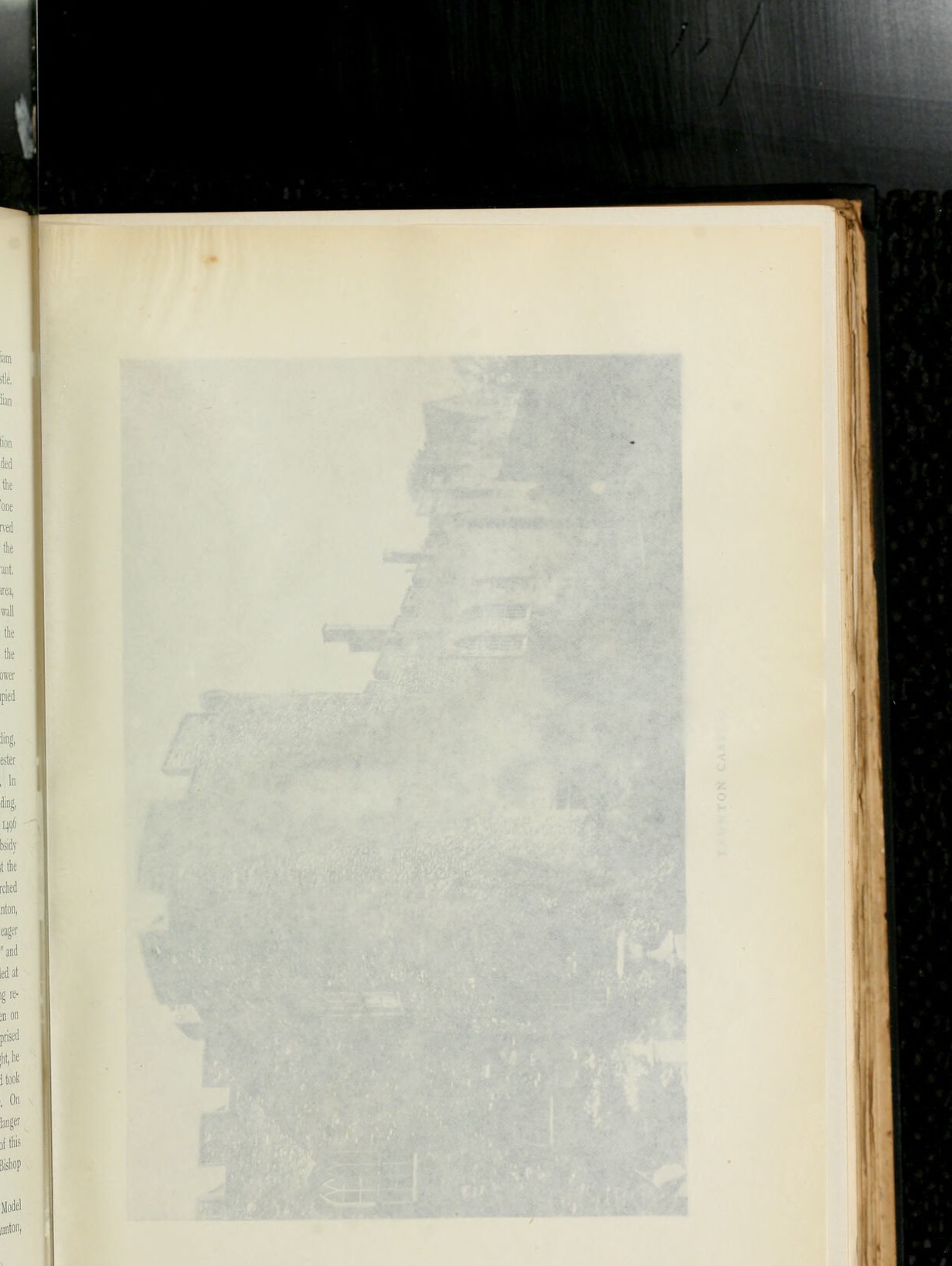
TAUNTON CASTLE
1897 · J. D. Mackenzie, The Castles of England, vol. 2 (1897)
Public domain
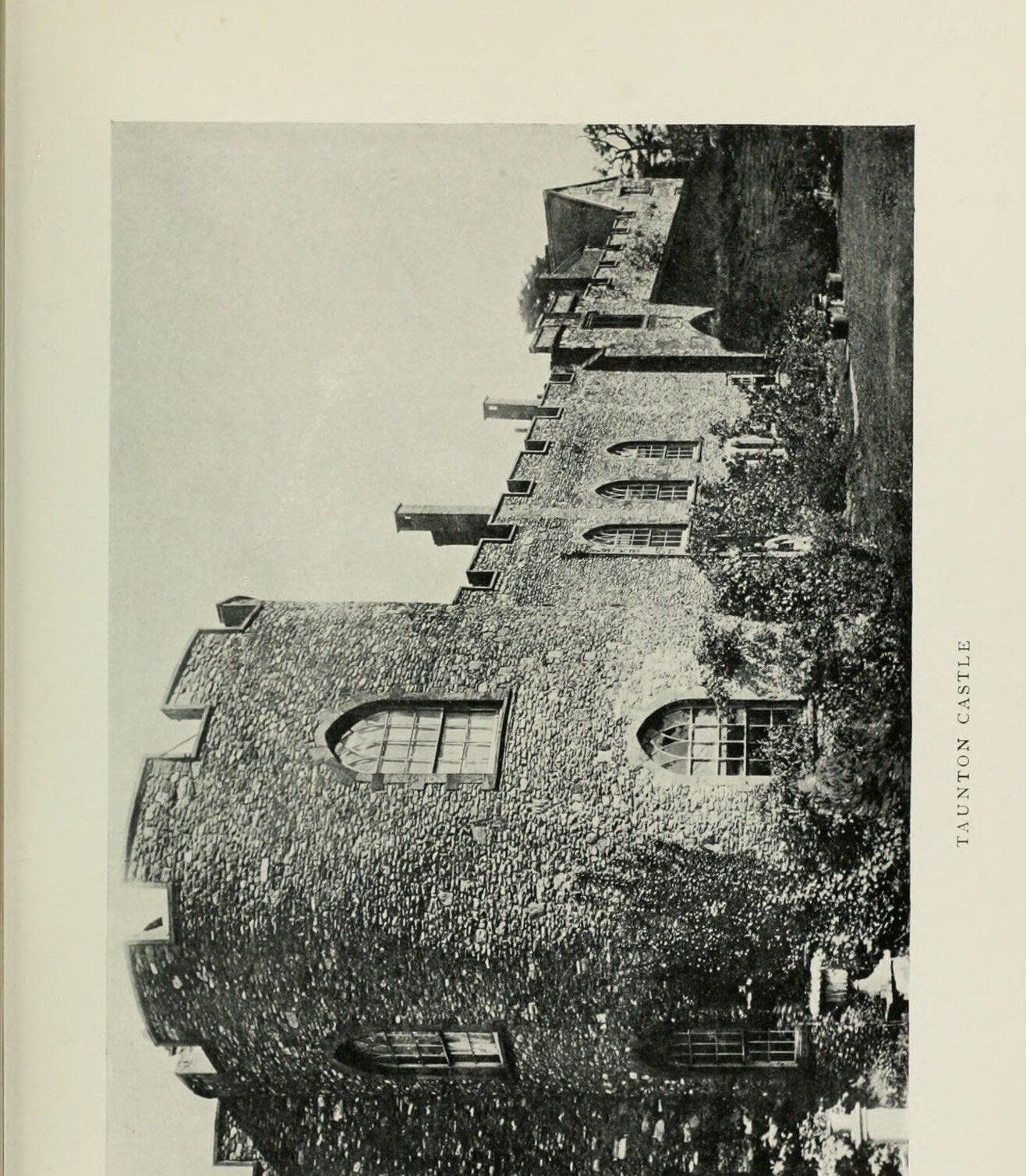
TAUNTON CASTLE
1897 · J. D. Mackenzie, The Castles of England, vol. 2 (1897)
Public domain
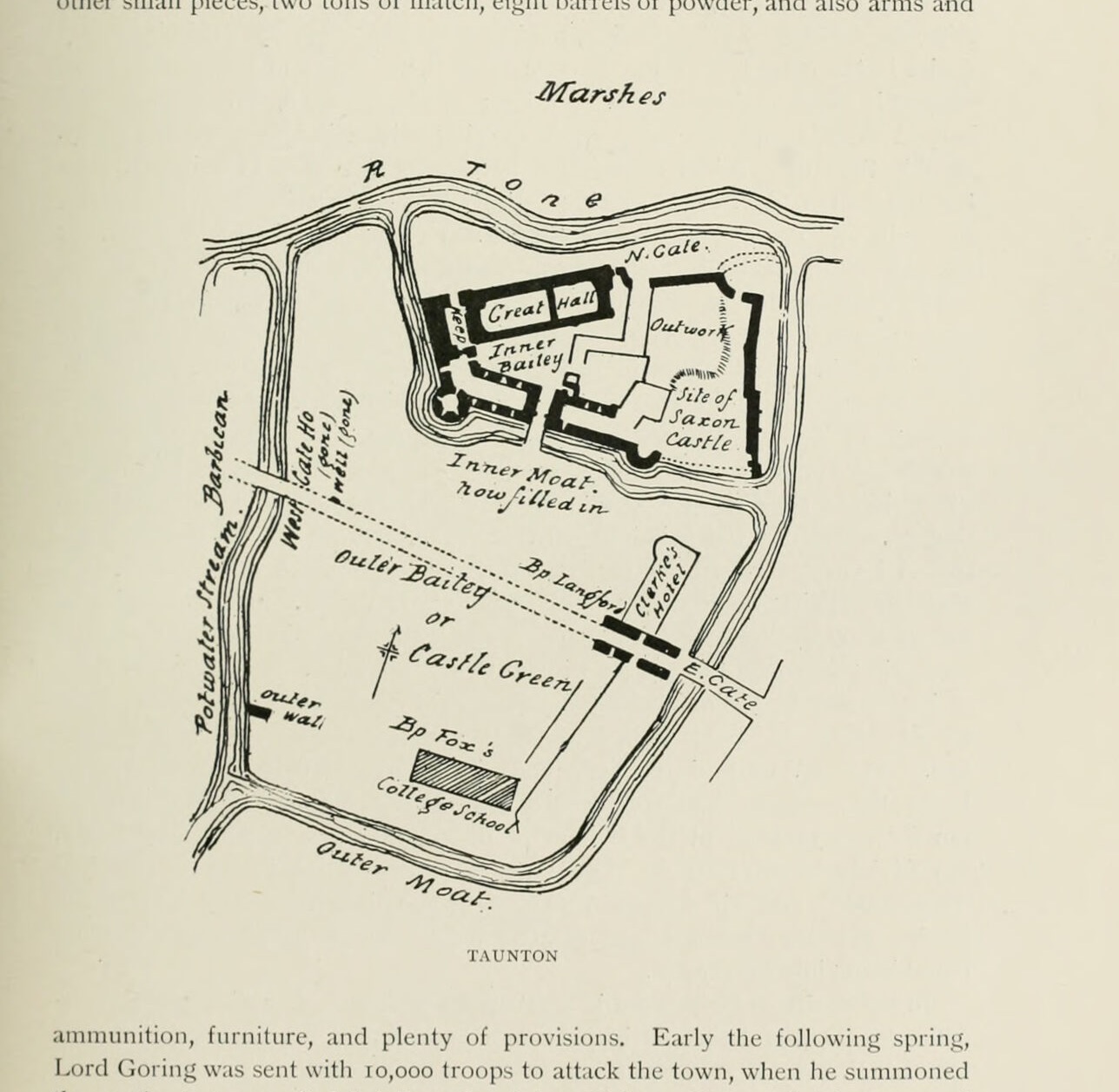
TAUNTON
1897 · J. D. Mackenzie, The Castles of England, vol. 2 (1897)
Public domain
Nearby