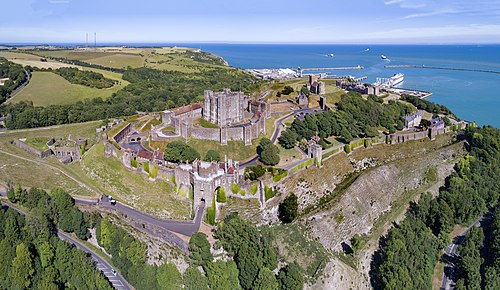
England · Ruin
Tintagel Castle
Tintagel Castle is a medieval fortification on a small peninsula (Tintagel Island) adjacent to the village of Tintagel in North Cornwall, England. The visible ruins are mainly the remains of a 13th-century castle constructed by Richard, 1st Earl of Cornwall; the site also contains evidence of much earlier high-status settlement from the early medieval period and has long associations with Arthurian legend.
Its prime
1250
Today
Ruin
As it stood in 1250
What Tintagel Castle looked like in its prime.
Perched on a narrow, steep-sided peninsula, the site presents a low grey-stone curtain of masonry running along the plateau and terminating in a rounded ruined tower on the seaward promontory. The headland drops in near-vertical cliffs to the sea; grassy slopes and rocky outcrops surround the stonework. Access to the plateau is only by a narrow approach along the isthmus; within the walls are the footprints of halls, a courtyard and a small chapel.
Its story
The story of Tintagel Castle.
The Dumnonian Seat, 5th and 6th Centuries
Rome assigned the territory of modern Cornwall to the civitas Dumnoniorum, named for the tribal group the Romans called the Dumnonii, and took little interest in this remote corner until its tin-streaming drew attention in the 3rd century. No structure of Roman date has yet been proven on Tintagel Island, as Charles Thomas noted in 1993, though Romano-British pottery has come out of the site along with a leather purse holding ten low-denomination coins struck between the reigns of Tetricus I and Constantius II.
After Roman control collapsed the district became the Kingdom of Dumnonia, and occupation continued. Ralegh Radford, who dug here from 1933, read the early medieval buildings as a Celtic Christian monastery on the strength of similarities with 7th-century Whitby; that thesis was abandoned from about 1980. The headland is now taken for an elite settlement held by a powerful local warlord or by Dumnonian royalty, its approach cut in this period by a large ditch leaving only a narrow trackway onto the peninsula. Thomas doubted anyone lived here year-round, picturing instead a king moving a household of perhaps one to three hundred. What sets the site apart is what arrived by sea: African and Phocaean red slip wares, traded the length of the Mediterranean, in a quantity Thomas judged "dramatically greater than that from any other single site dated to about 450–600 in either Britain or Ireland".
Earl Richard's Bargain, 1225–1233
In 1225 Richard, 1st Earl of Cornwall traded Gervase de Tintagel the land of Merthen, originally part of the manor of Winnianton, in exchange for Tintagel, and in 1233 built his castle on the headland. He wanted the association: Geoffrey of Monmouth had tied the place to the Arthurian legends a century earlier, and it was regarded as the traditional seat of Cornish kings. The work was deliberately done in a style already old-fashioned for the 1230s, so the castle would look more ancient than it was. Radford read the earliest fabric as the work of Earl Reginald de Dunstanville with later additions by Richard; later work dates the whole of it to Richard's own building campaign.
The Roof Comes Off the Great Hall, 1330s
The earls who followed Richard took no interest, and the castle was left to the High Sheriff of Cornwall; part of the accommodation became a prison and the land was let as pasture. The roof was taken off the Great Hall in the 1330s, after which the buildings grew steadily more ruinous, a decay compounded by the erosion of the isthmus joining the site to the mainland. By the early 1540s, when John Leland came to look, the island was reached over a makeshift bridge of tree trunks. Some military value survived (the defences at the Iron Gate were strengthened when England faced the threat of Spanish invasion in the 1580s), and the manor was among the Duchy of Cornwall properties seized by the Commonwealth government in the 1650s and returned at the Restoration of 1660.
Geoffrey of Monmouth and the Conception of Arthur
The Arthurian claim on Tintagel begins with a single book. Writing around 1135–38, Geoffrey of Monmouth made the headland the setting of Arthur's conception in his Historia Regum Britanniae. Uther Pendragon goes to war with Gorlois, Duke of Cornwall, to take his wife Igraine; Gorlois defends himself at Dimilioc and sends Igraine to Tintagel as his most secure refuge, a place his friend Ulfin tells Uther cannot be stormed, since "there, three armed warriors could forbid all entry, even if you took up your stand with the whole of Britain behind you." Merlin then changes Uther's appearance to that of Gorlois, and so disguised he passes the guard. Geoffrey nowhere claims Arthur was born here, ever returned as a man, or held the stronghold as king; the birth was added by later medieval retellings.
The scholars who dug here found nothing to bear the story out. Radford declared in 1935 that "no concrete evidence whatsoever has yet been found to support the legendary connection of the Castle with King Arthur", and Thomas concluded in 1993 that "there simply is no independently attested connection in early Cornish folklore locating Arthur, at any age or in any capacity, at Tintagel." The Artognou stone, inscribed PATERN[--] COLI AVI FICIT ARTOGNOU, has been offered by some as evidence of a historical Arthur, a reading most historians reject. The literary tradition ran on regardless: Tennyson set part of Idylls of the King here and gave Merlin's Cave its name.
Radford's Trenches and the Advancing Sea
Radford's excavation, begun in 1933, was worked by former cliff-quarry men under a trained foreman, told to follow any walling they met and keep every find. It stopped in 1938, and many of the original site reports burned when the Luftwaffe bombed Radford's house in Exeter. A fire on the island in the mid-1980s stripped enough topsoil to expose far more foundations than he had recorded, and in 1998 the Artognou stone showed that literacy in Latin survived here after the collapse of Roman Britain. The seasons of 2016 and 2017 brought out the outlines of a palace of the 5th or early 6th century and a 7th-century slate window ledge inscribed with Latin, Greek and Celtic words.
The headland remains Duchy of Cornwall land, managed by English Heritage and drawing around 200,000 visitors a year. The sea is the standing threat. Parts of the complex have gone over the cliff before, but by 2022 erosion had reached the front of the visitor centre and taken sections of coastal footpath and a viewing area, and that September English Heritage named Tintagel one of six sites at risk of destruction from coastal erosion.
Step inside
9 places to explore in 1250.
The record describes 9 distinct spots at Tintagel Castle, including 2 interiors: great hall (main accommodation), chapel. Create your own photoreal reconstruction and explore every one, more scenes means more rooms, more angles, and more of the place to stand in.
Build Your Own Castle
Recreate Tintagel Castle with AI to explore it.
The artist rebuilds it as it stood in 1250, a photoreal reconstruction that belongs to you alone. Pay with coins, no subscription needed.
Recreate this castle →Defend this castle →Whose castle
Clans who held Tintagel Castle.
The families that held Tintagel Castle for a decade or more across its history, follow a name to its clan.
Cornwall
Built c.1233 by Richard, 1st Earl of Cornwall; now part of the Duchy of Cornwall.
From the archive
Tintagel Castle on paper: the measured plan and period views.
The survey plan and photographs below are the ground truth this page's reconstructions are checked against, drawn and photographed while the castle was still a working garrison. Every image is public-domain or openly licensed, with its source named.

PHOTOCHROM COLOUR POSTCARD, CORNWALL, KING ARTHUR'S CASTLE, TINTAGEL, 1935 (50627540856)
ca. 1890-1900 · Photochrom Prints Collection (via Wikimedia Commons)
Public domain
Tintagel Castle
1897 · J. D. Mackenzie, The Castles of England, vol. 2 (1897)
Public domain
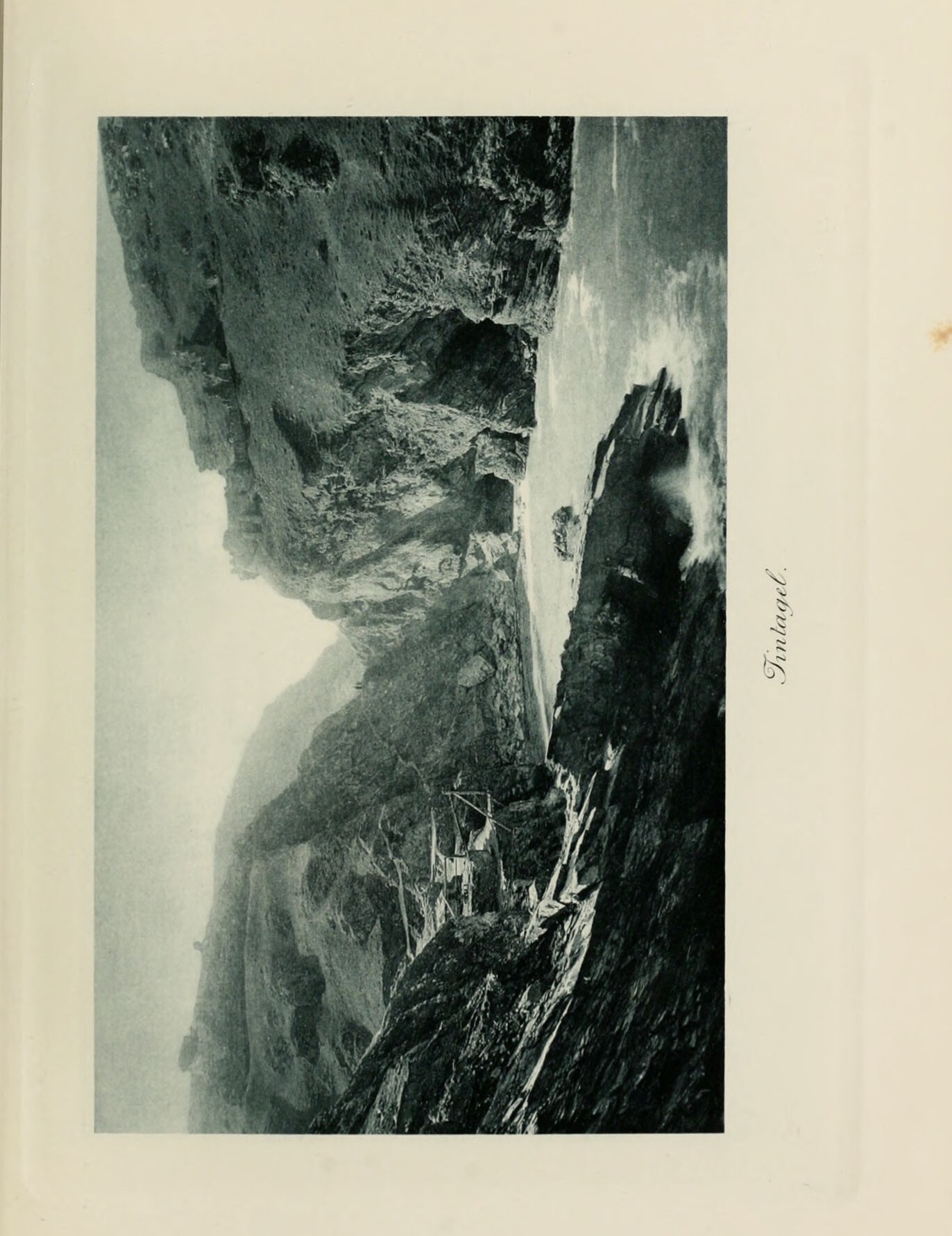
Tintagel.
1897 · J. D. Mackenzie, The Castles of England, vol. 2 (1897)
Public domain